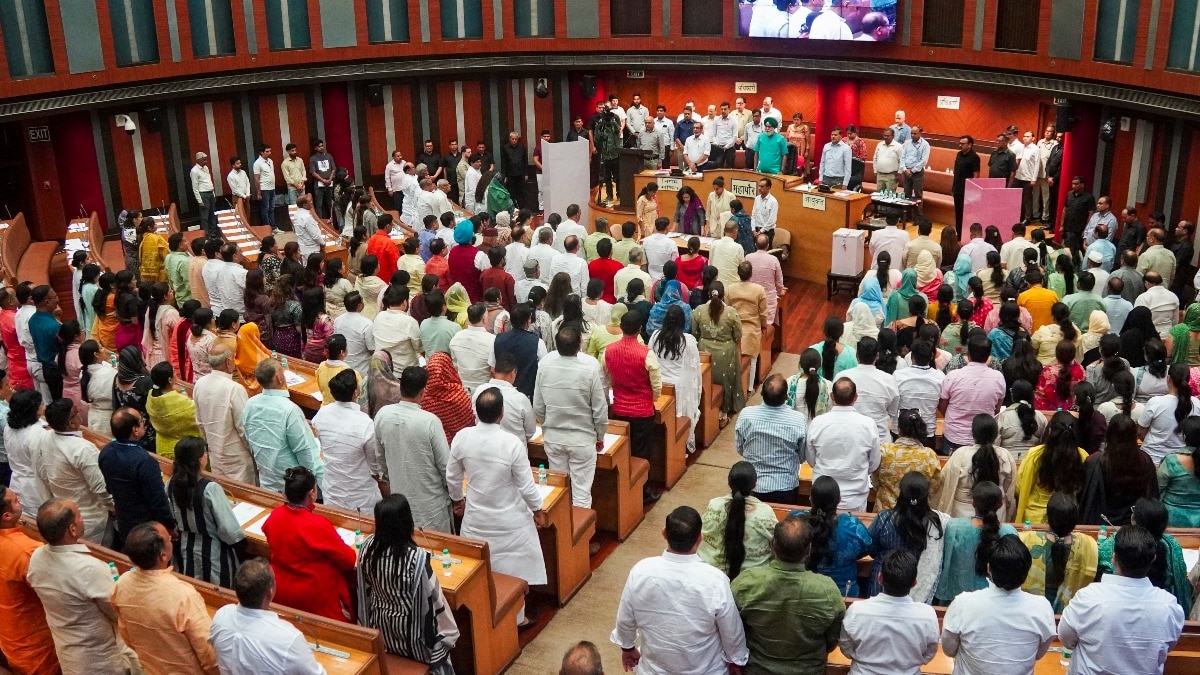
Congress leader Umang Singhar. File
| Photo Credit: SUSHIL KUMAR VERMA
The project has also faced criticism for allegedly damaging local ecology and wildlife, as a large part of it falls inside the Panna National Park and Tiger Reserve.
Leader of the Opposition in the State Assembly Umang Singhar, who visited the ongoing protest site in Chhatarpur on July 14, alleged corruption worth crores in the distribution of compensation and in awarding contracts to companies, which, he claimed, had made donations to the ruling Bharatiya Janata Party through electoral bonds. He also sought an independent investigation into the alleged irregularities.
“According to villagers, compensation amounting to around ₹11 crore was sanctioned for houses in Kharihani village. However, available documents indicate that around ₹8 crore was paid to individuals who had no connection to the village or had already left it between 1980 and 1990,” Mr. Singhar told a press conference in Bhopal, and claimed that several people genuinely affected were yet to receive compensation.
“The protestors have identified more than 500 cases of alleged fraudulent compensation payments on the basis of documentary evidence,” he claimed.
Residents of several villages, mostly tribals from Panna and Chhatarpur districts, have been protesting on the banks of the Barana River near Kupi village for nearly two weeks against the ₹44,000-crore project of the Union Government and various State irrigation projects, with several demonstrators tying nooses around their necks and lying on makeshift pyres in the river in a symbolic protest.
The protest, under the slogan “Nyaya do varna maar do” (Give us justice or kill us), which was first held in April, was relaunched earlier this month after the talks and government efforts failed to assuage the villagers’ concerns.
Mr. Singhar, a prominent tribal leader, also alleged that in various villages, affected families were not involved in the gram sabha proceedings.
“According to the affected villagers, the legal procedure for conducting gram sabhas was not followed over the last four years. Affected families were not informed about the Social Impact Assessment (SIA) nor were they included in the process,” he said, alleging that identical language was found in the proceedings registers of multiple gram panchayats, raising suspicions that meetings had been recorded on the same days and at the same time.
“The gram sabhas in tribal villages were reduced to a mere paper formality,” he said, while alleging that Kharihani village proceedings had the signature of a person who took charge as sarpanch (village head) six months after the meeting was purportedly conducted.
Under the Panchayats (Extension to Scheduled Areas) Act, 1996 (PESA), gram sabha approval is mandatory for development projects in tribal villages.
The Congress leader also accused the police of intimidating protestors and demanding money from them after detaining them.
“There were several lathi charges, in which elderly women were also injured. According to the affected people, criminal cases were registered against more than 250 tribal villagers,” he said.
Mr. Singhar also alleged that the construction for the Ken-Betwa link project (KBLP) had begun without the completion of rehabilitation process.
“Construction work started in early 2025, while many issues related to rehabilitation, compensation and entitlements were pending. There are allegations of forcible possession of six to seven villages within the Panna Tiger Reserve. Construction work was started and houses of many affected families were demolished,” he said.
Launched by Prime Minister Narendra Modi on December 25, 2024, the KBLP is the first of 30 such projects under a National Perspective Plan (NPP) for water resources development and interlinking of rivers with ‘surplus water’ to those with ‘deficit water’. The project plans to transfer excess water from the Ken river basin to the Betwa river basin in the poverty-ridden Bundelkhand region that covers parts of Madhya Pradesh and Uttar Pradesh.
The project has also faced criticism for allegedly damaging local ecology and wildlife, as a large part of it falls inside the Panna National Park and Tiger Reserve.
Published – July 18, 2026 04:00 am IST