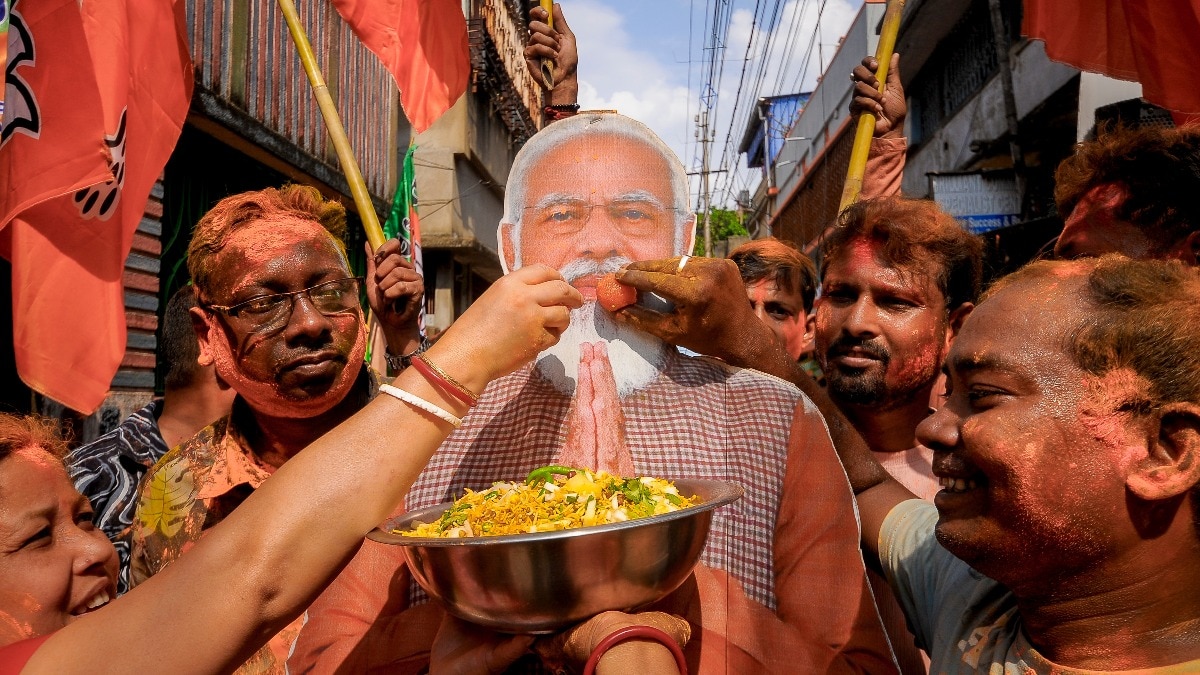
On May 4, the force was truly with the BJP, that it decimated the TMC in West Bengal and won Assam for the third time. These results pushed the BJP-led NDA’s tally to 21 states and Union Territories — exactly the number it had governed in March 2018 and matching the historic high set by the Congress under Indira Gandhi in the late 1970s. The BJP’s 2018 record was short-lived though. This time around, that is likely to continue longer.
This is no ordinary milestone. In 2014, when Narendra Modi first became the Prime Minister, the BJP ruled just seven states. By early 2018, organisational work, smart alliances in the northeast and strong anti-incumbency waves had taken the NDA to 21 states, home to over 70% of India’s population.
With the latest wins, the BJP and its alliance partners have built a modern equivalent of the Nehruvian-era dominance in terms of geographical spread and federal reach, something no other party has matched since the Congress system began eroding in the late 1960s.
From Gangotri to Ganga Sagar, the entire length of the Ganges, flowing through Uttarakhand, Uttar Pradesh, Bihar, and West Bengal, now falls under BJP or NDA governance.
This dominance that the BJP and the NDA alliance had once achieved previously, had proven fragile. In December 2018, the NDA suffered a sharp reversal when it lost Madhya Pradesh, Rajasthan and Chhattisgarh to the Congress.
Within months, the count fell to 16 states. By 2020, further setbacks in several smaller states and the impact of the Covid-19 period reduced the NDA’s direct control to just 13 states at one point.
The party appeared to have hit a plateau. Critics said the “Modi wave” had crested, and regional parties were regaining ground.
The real test came in the 2024 Lok Sabha elections. The BJP won only 240 seats — 63 fewer than in 2019 — and fell short of a majority on its own for the first time since 2014. The NDA still formed the government at the Centre with 293 seats, but the result was widely seen as a setback. Many observers predicted that state-level losses would follow.
Instead, the BJP did the opposite.
HOW BJP WON STATE AFTER STATE FOLLOWING 2024 LOK SABHA ELECTION
Former party president JP Nadda and Home Minister Amit Shah quietly shifted the machinery into high gear.
Booth-level workers were retrained. Local issues — from women’s safety in West Bengal to governance failures in several Congress-ruled states — were identified and hammered in targeted campaigns. The party struck fresh alliances where needed and focussed on door-to-door outreach rather than relying solely on national charisma.
Between 2024 and early 2026, the NDA steadily clawed back lost ground, winning or retaining key states such as Maharashtra, Haryana, Bihar and Odisha. By February 2026, the count had climbed back to 19 states and two Union Territories.
The twin victories in Assam and West Bengal on May 4 completed the circle.
Assam Chief Minister Himanta Biswa Sarma secured a second term, while West Bengal marked the BJP’s deepest-ever penetration into eastern India. With this, the NDA once again governs 21 states — a record high for the party in the post-2014 era and a return to the 2018 peak.
There are two lessons for the party here. First, the BJP has shown remarkable resilience. Unlike many parties that collapse after a national dip, it used the 2024 Lok Sabha result as a wake-up call to strengthen its state units. Second, Indian voters continue to separate national and state choices. Even when they checked the BJP in Parliament, they seemingly rewarded its state-level performance where governance delivery was visible.
The BJP-led NDA today has mountainous support of the masses, but such successes could be very difficult to manage, going by the 2018 example. But the BJP is a result-oriented party, and it will try to set examples with each of the 21 states. It has the responsibility of governing 72% of India’s population.
For now, the BJP can claim a rare feat. It has twice touched the high-water mark of 21 states in less than a decade — a level of federal dominance that even Indira Gandhi’s Congress managed only once at the height of its power.
– Ends
Published By:
Anand Singh
Published On:
May 4, 2026 22:17 IST