Boston Bruins
The Bruins need another high-end forward and some stability on the blue line if they want to take another step forward in 2026-27.
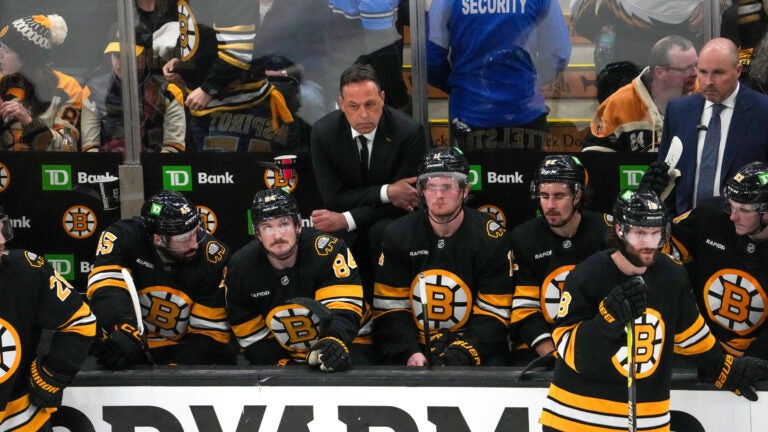
Marco Sturm and the Bruins have some work to do if they want to take another step forward in 2026-27. (Photo by: Barry Chin/Globe Staff).
May 5, 2026 | 7:16 AM
6 minutes to read
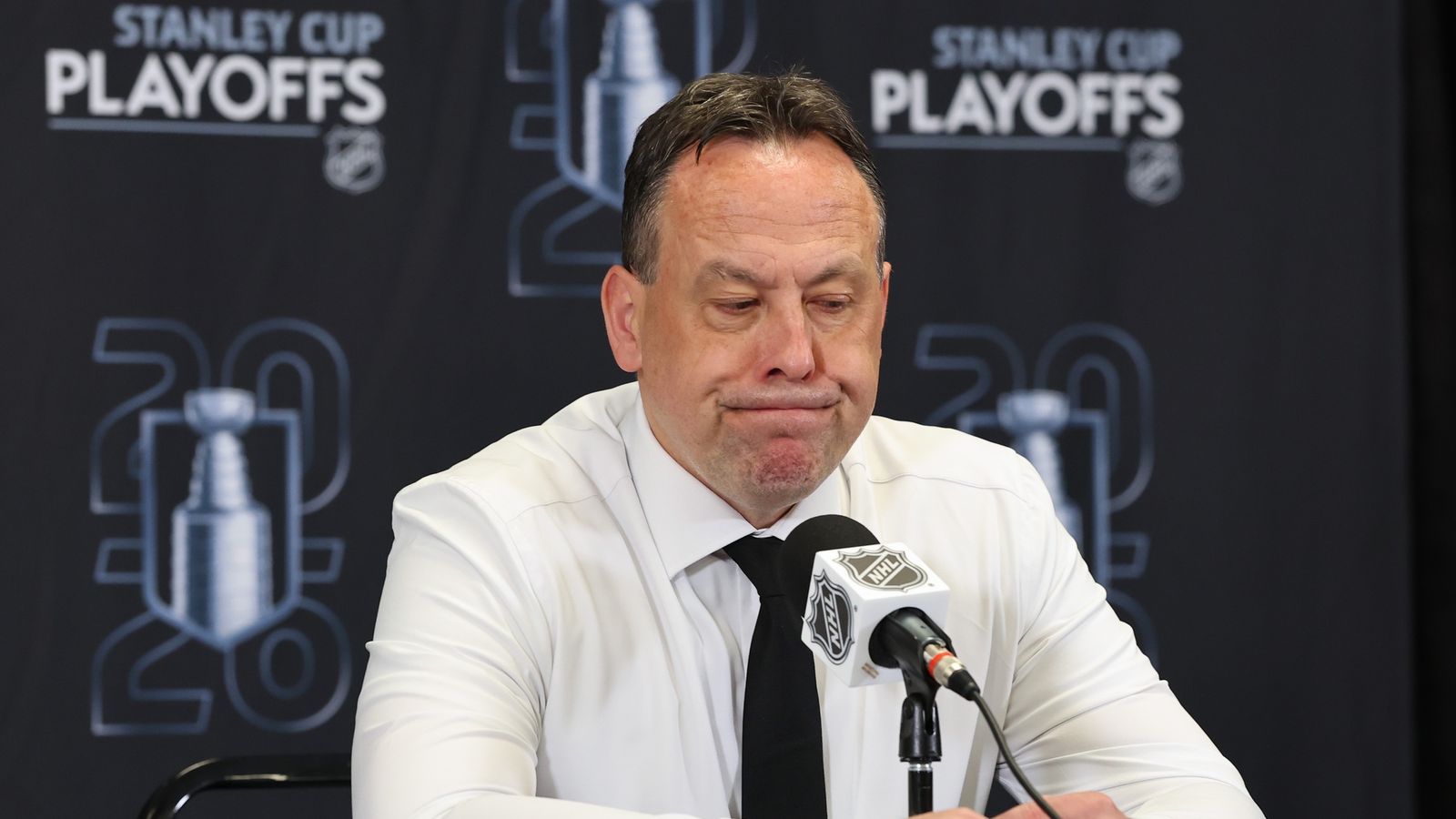
Marco Sturm acutely summed up the Bruins’ 2025-26 campaign on Friday evening — just a few minutes after his players skated off the TD Garden ice for the final time until the fall.
“Look at us, 100-point season and battled really hard until the end,” Sturm said as he reflected on his first year as an NHL head coach. “I just wanted them to know how proud I am, and also, now, we got a little taste. … [Don Sweeney] said it a few months ago. We still have work to do.”
The Bruins’ 2025-26 season was, all things considered, a step in the right direction.
But just two days after Boston’s season ended, Sturm was candid about the next steps his club must take to entrench itself as a true rising power in a shifting NHL landscape.
“You just can’t rest in this league,” Sturm added. “So that’s going to be the challenge. Expectations will be higher. We’re not going to be the surprise team anymore.”
Boston might have been a pleasant surprise during Sturm’s first year at the helm. But the Bruins’ first-round exit courtesy of a deeper, faster, and more skilled Sabres club served as a reminder that Don Sweeney and Co. have plenty of work to do this summer.
Here’s a look at some of Boston’s top tasks on its offseason to-do list:
Add at least one high-end forward
At first glance, boosting the Bruins’ scoring capabilities seems far from the most pressing need for Sturm’s club.
After ranking 27th in the NHL in goals per game (2.71) and 29th on the power play (15.2 percent) in 2024-26, the Bruins surged in both categories this year.
Only nine teams averaged more goals per game than the 2025-26 Bruins (3.27), while Boston ranked ninth on the man advantage — cashing in on 23.4 percent of those bids.
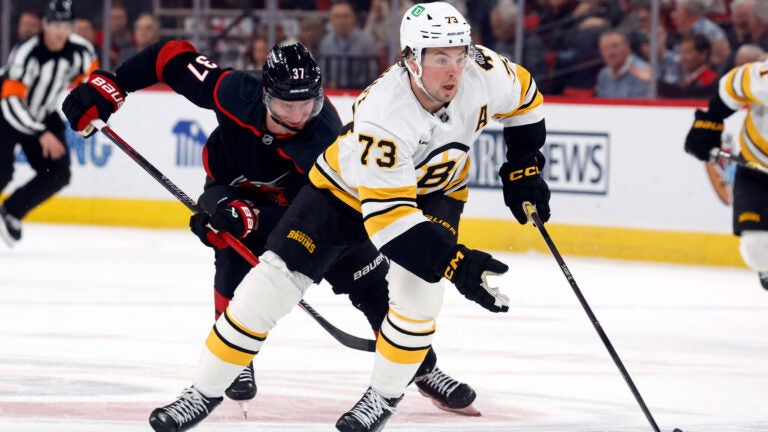
Having an offensive juggernaut in David Pastrnak certainly helps, while players like Morgan Geekie and Pavel Zacha had breakout seasons.
But simply banking on repeat performances from the likes of Geekie (21.5 shooting percentage), Zacha (22.9 percent), or Casey Mittelstadt (18.8 percent) invites the risk of being stung by some severe regression once hockey ramps up again in October.
It also remains to be seen if Viktor Arvidsson (25 goals, 54 points) is back ahead of what should be a lucrative payday amid a largely barren free agent market.
The Bruins — who, at 5-on-5 play, ranked 22nd in expected goals per 60 minutes and 24th in high-danger scoring chances per 60 — felt the sting of that scoring heater cooling down in the playoffs.
Boston only tallied one goal in regulation in each of its final four games against the Sabres, while its power play cashed in on just two of its 16 chances in the postseason.
The Bruins can’t just run back the same flawed forward corps and expect similar production, nor is it fair to put all of the onus on youngsters like James Hagens and Fraser Minten to counteract some of that expected shooting regression.
Even if this free-agent class is largely underwhelming, the Bruins do have the draft capital and prospects at their disposal to target immediate impact talent — especially up front.
If the Blues once again dangle center Robert Thomas in trade talks, or a cap-crunched Stars team balks at restricted free agent Jason Robertson’s hefty payday, Sweeney needs to make a call.
Acquiring a 26-year-old center like Thomas — signed through 2031 at an $8.125 million annual cap hit — would likely cost a few first-round picks, including a potential blue-chip prospect or two like Dean Letourneau.
But Boston can also parlay some of those assets without necessarily depleting the entire prospect pipeline, which also includes forwards like Minten, Hagens, Will Zellers, Cooper Simpson, and first-round picks from both Toronto and Florida.
And even with the steep price it’d take, adding a top-line forward just entering his prime like Thomas would be the upgrade that Boston’s forward corps desperately needs to establish itself as a viable contender in the coming years.
Add some rigidity on the blue line
The good news? Jeremy Swayman is the least of Boston’s worries as a legitimate franchise goaltender.
The bad news? The Bruins are asking for trouble if they keep relying on the 27-year-old netminder to bail out a leaky defensive structure once again in 2026-27.
Had it not been for Swayman’s knack for negating routine barrages of Grade-A scoring chances (28.8 goals saved above expected), Boston would have been a lottery team this past season.
At 5-on-5 play, the Bruins ranked 29th in the league in expected goals against 60 minutes (2.93) — ahead of only the Islanders, Canucks, and Blackhawks. Only four more teams coughed up more 5-on-5 high-danger scoring chances per 60 minutes than Boston (12.5).
“One of the biggest reasons we made it that far was because of our goalies,” Sturm said. “We can’t expect that every year. As a group, we need to find ways to limit some opportunities.”
Beyond making any tweaks to Boston’s hybrid man-to-man/zone system, the Bruins need some stronger personnel on the back end.
If fortune breaks Boston’s way and Toronto’s 2026 first-round pick falls to No. 6 or No. 7 overall during Tuesday’s draft lottery, that coveted draft asset transfers to Boston, who could use it to select one of several promising D-man prospects like Alberts Šmits, Chase Reid, Daxon Rudoplh, or Carson Carels.
Adding a legitimate defensive prospect who could arrive in a year or so would be a welcome sight for Boston, who could use a top-four option on the left side as a long-term replacement for Hampus Lindholm — or a right-shot skater who can anchor that second pairing for the long haul.
If the Bruins draft a legit blueliner in June, Boston could opt for a more short-term option to add some defensive fortitude to their lineup — such as trading for a meat-and-potatoes D-man like Zach Whitecloud.
If Toronto retains that pick as a top-five selection, things get a bit more complicated for the Bruins. Boston could target veteran right-shot D Rasmus Andersson in free agency, given Boston’s reported interest in the 29-year-old before he was dealt from Calgary to Vegas.
But Andersson would cost a pretty penny in free agency, with Boston likely needing to dole out a seven-year contract worth at least $8-9.5 million in AAV to reel him in.
Clear some contracts
With just two pending unrestricted free agents on their roster (Viktor Arvidsson, Andrew Peeke) and over $16 million in projected cap space, Boston has the means to potentially re-up Arvidsson without stressing its fiscal flexibility.
But if the Bruins want to really get aggressive this summer and reel in a bigger fish or two, Boston might be best served shedding a few more contracts for the right price.
During the Stanley Cup Playoffs, Boston had several either bloated or redundant contracts sitting up on the ninth floor — including Joonas Korpisalo ($3 million AAV), Mikey Eyssimont ($1.45 million), Henri Jokiharju ($3 million AAV), and Mason Lohrei ($3.2 million).
Boston’s most concerning contract is Elias Lindholm, who was hindered by an ailing back for the second year in a row and is counting $7.75 million against the cap for another five years. But that contract isn’t moving any time soon.
For now, the Bruins should try to exhaust several avenues to try and shed another $5-7 million off their books in order to free up roster logjams and increase their spending power.
Name a captain
Sturm had no qualms with the Bruins’ unorthodox leadership hierarchy in 2025-26 — with David Pastrnak and Charlie McAvoy leading the way as alternate captains alongside a veteran group that also included Hampus Lindholm, Nikita Zadorov, and others.
For McAvoy and Pastrnak, the focus this season was re-establishing culture and setting standards for a roster in a state of transition — rather than focusing on appointing a captain.
But as the Bruins continue to build their roster and grow with an influx of young talent and new faces, stitching the “C” on someone’s sweater and establishing a regular chain of command feels like a proactive move before the 2026-27 campaign.
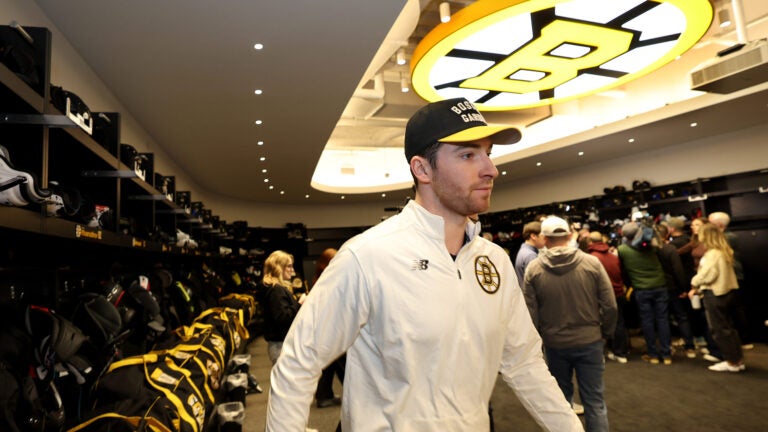
It shouldn’t come as much of a surprise that Hagens — Boston’s potential future franchise forward — has his locker right next to Pastrnak’s in the Bruins’ dressing room.
Pastrnak’s more even-keel approach and knack for navigating the ups and downs that inevitably present themselves over a long season make him an appealing fit for a Bruins team penning a new chapter in 2026 and beyond.
Conor Ryan is a staff writer covering the Bruins, Celtics, Patriots, and Red Sox for Boston.com, a role he has held since 2023.
Sign up for the Today newsletter
Get everything you need to know to start your day, delivered right to your inbox every morning.