It’s not quite correct to say there’s great joy in watching a Warwick Thornton film.
His works can be heavy because they’re having an honest conversation about Australian history and identity, but there are many moments of great beauty.
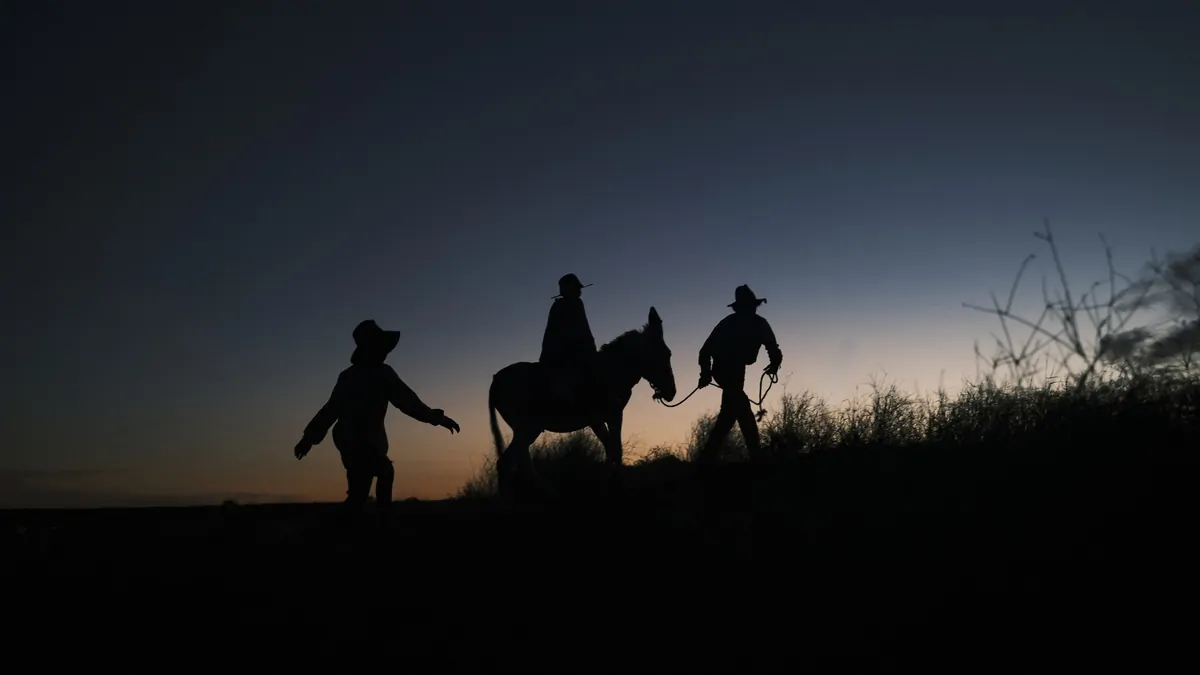
Thornton, who often acts as his own cinematographer, has a particular knack for filming landscapes. The breathtaking frames are genuinely show-stopping, if only you could ask the cinema projectionist (or, more likely now, the person with control of the laptop) to pause so you can just sit with it.
Sign up to The Nightly’s newsletters.
Get the first look at the digital newspaper, curated daily stories and breaking headlines delivered to your inbox.
By continuing you agree to our Terms and Privacy Policy.
Those pictures elicit a feeling of wonder and, dare we say it, joy.
For his latest film, Wolfram, Thornton is offering up more moments of reprieve from the cruelty and violence of Sweet Country, his superb 2017 film set in post-WWI central Australia. But it’s also not stepping back from the truth.
Wolfram is a follow-up to Sweet Country, although you don’t need to have seen its predecessor (but if you haven’t, you should). It exists in the same universe and carries over some of its secondary characters.
Jason Chong and Deborah Mailman in Wolfram. Credit: Dylan River/Bunya Productions
Set in the 1930s, a handful of years after Sweet Country, there are intersecting storylines. One of them is that of Pansy (Deborah Mailman), an Indigenous woman whose young children, Kid (Eli Hart) and Max (Hazel May Jackson), have been stolen to work in the tungsten mines in central Australia.
There’s a personal connection to these characters as Thornton’s great-grandmother and co-writer David Tranter’s grandmother were both child labourers in the mines.
Kid and Max are under the control of an abusive man named Billy (Matt Nable), until they fall under the “ownership” of two homicidal potential prospectors, Casey (Erroll Shand) and Frank (Joe Bird).
Casey and Frank have come into this mining community ostensibly to stake their claim and strike it rich, but the way they throw themselves around as if they’re entitled to whatever they want, including other people, makes them volatile and dangerous people.
They link up with Kennedy (Thomas M. Wright), who has charge of Philomac (Pedrea Jackson), an 18-year-old Indigenous man who dreams of returning to country.
When Philomac meets Kid and Max, the group flees from their captors, setting up a run-and-chase across the vast landscape.
Eli Hart and Hazel Jackson in Wolfram. Credit: Dylan River/Bunya Productions
There are a group of Chinese miners (Jason Chong, Ferdinand Hoang and Aiden Du Chiem) who, like the Indigenous people, have been discriminated against by the white colonialists. It’s a rare, overdue representation on Australian screens of a community that has been threaded throughout the history of Australian nation-building.
Thornton (Samson and Delilah, The New Boy) grew up in and around Alice Springs and it’s so obvious that he knows that country, all of its beauty and brutality, incredibly well. No one else quite captures it on film like he does.
It’s not just that it looks amazing, but the way he is able to frame his characters among the landscape connects humans with the land in a way that makes you stop to appreciate its poignancy.
Tungsten (wolfram is another name for it) mines were all over central Australia and in that interwar period, was instrumental to the military build-up around the world. The material was known for strengthening steel.
Pedrea Jackson and Aiden Du Chiem in Wolfram. Credit: Dylan River/Bunya Productions
The Indigenous contribution – forced – to these tungsten mines often go unacknowledged, another chapter in Australian history that is conveniently forgotten. Children were preferred because they could fit down the small shafts.
Wolfram isn’t a didactic history lesson because its ultimate intention is to tell a personal story about separated families, and it is differentiated from Sweet Country in how it allows for that space to breathe.
The effect of that, though, is that Wolfram is a more patient film in terms of plot momentum. It’s sometimes missing some of that push to move it from one scene to another, and can, at times, feel meandering.
Still, you gain something from a Thorton film that no one else will give you – an affecting, personal story, a wonderful visual tapestry, and a better understanding of this country we all call home.
Wolfram is in cinemas on April 30