

Media
“Way too often, the broadcast sounds like it could be called the World of Will Flemming Podcast.”
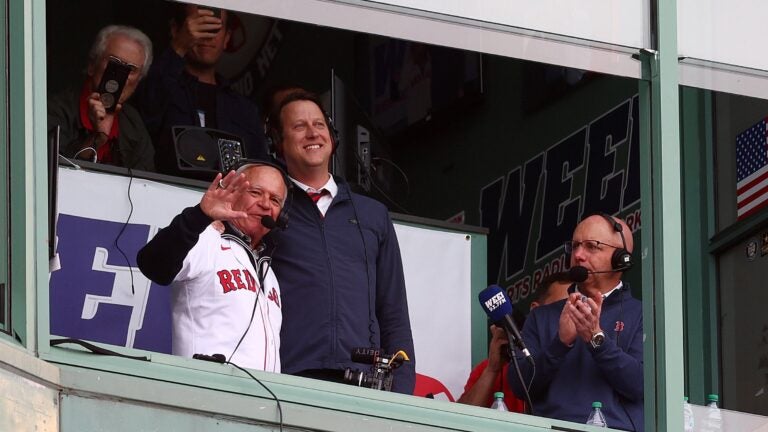
Red Sox broadcaster Will Flemming (center) became the subject of public criticism this week after some critical comments of the Yankees. Maddie Meyer/Getty Images
September 5, 2026 | 4:51 PM
4 minutes to read
Perhaps you heard a word or a thousand about Will Flemming becoming the self-inflicted recipient of backlash and social-media scorn in the aftermath of his play-by-play performance during last Sunday’s Red Sox-Yankees game.
Flemming, who has been part of the Red Sox radio booth since 2019, drew national attention for calling Yankees second baseman Jazz Chisholm a “bush-league player” and suggesting that Red Sox pitcher Jovani Moran should “drill” a New York batter with a retaliatory pitch.
The backlash was deserved, as it should have been instantly regrettable stuff. Flemming did take to social media platform X.com on Monday to apologize, saying the moment got the best of him and “I could and should have used different words,” he wrote.
But it also crystallized a bigger problem, one I’m regrettably late to write about, given that my inbox has been peppered with listener gripes going back to April.
Flemming could and should take a different approach to calling Red Sox games.
Way too often, the broadcast sounds like it could be called the World of Will Flemming Podcast, or perhaps the realization of the opinionated sports-radio-show approach to a game broadcast that the then-WEEI morning show hosts pushed for several years ago.
Flemming sounds like he’s aiming to appeal to the popular Section 10 podcast hosts and listeners rather than the demographics of the audience most likely to listen to a game on the radio. He overflows with hyperbole — if Joe Castiglione’s slogan was “Can you believe it?” Flemming’s might be “That just can’t happen!’’ when a Red Sox player commits a gaffe. The ambient noise of a radio baseball broadcast is buried in adverbs. The game is not allowed to breathe.
Too often, when all of this is happening, Flemming’s analysts — usually the incisive Will Middlebrooks — are sometimes relegated to supporting roles while he regales us with tales of … well, all sorts of things. His golf game, his home life, New Yorkers being unfriendly when he goes to pick up his food order, Yankee Stadium security refusing to let him bring a guest up to the booth.
The last two came specifically from the now infamous Sunday broadcast, a 16-1 loss in what was arguably the Red Sox’ most important game of the season.
Now, it’s fine, even welcome at times over a long season, for a broadcaster to talk about their lives, or things they enjoy. We knew Castiglione was a devout Colgate sports loyalist, for instance. But that stuff never came at the expense of anything in the game.
It’s one reason why I found last Sunday’s broadcast the most frustrating Flemming call of the season, and that’s even excluding the Chisholm/drill ‘em commentary. So many of his exasperating habits were amplified.
I was most frustrated by his multi-inning dwelling on a controversial no-catch by Red Sox center fielder Ceddanne Rafaela. It looked in real time like Rafaela had made one of his typical spectacular catches. It was ruled that he did not catch it by an umpire, and the call held up after replay said it was inconclusive. The game got out of hand for the Red Sox, and Flemming repeatedly harped on the call, adamant that Rafaela caught it, rather than focusing on pitcher Ranger Suarez’s failure to overcome it.
Worse, Flemming’s judgment can’t entirely be trusted in situations like that. His calls don’t always jibe with what the video tells you when you see it later.
But the biggest recurring gripe I’ve heard from fans is that Flemming doesn’t always tell you what is happening, but what he anticipates will happen, which leads to misjudgments.
One occurred on another Rafaela outfield play in the fourth inning of Saturday’s game, with the Red Sox up 1-0. Rafaela got turned around on a fly ball by Heliot Ramos with a runner on second, and the ball dropped in.
Rafaela salvaged the play by throwing a strike to the relay man, who threw out base runner Amed Rosario at home.
Here’s how Flemming called it.
“He was totally turned around there and the Yankees are going to tie the game. An error and a passed ball … relay throw is IN TIME! Whoa! Ramos [it was Rosario] so slow coming around third base. That was spectacular from the outfield. Ceddanne fired an absolute missile, relay throw in time to Rutschman. I thought they had no chance to make that play.”
I was left saying, “Wait … what?” after that play, a blunt reminder that a play-by-play voice’s first responsibility on the radio is to let the listener know what’s happening.
Flemming has a pleasant voice, and a conversational rapport with his analysts. But too often, that rapport becomes a monologue, digression, or recurring grievance, and the specifics of the game become ancillary.
There’s no could or should about this: Pithy, conventional, and accurate is the route to winning over fans as a radio play-by-play voice.
Flemming can do it, but first he needs to stop calling the game like one of them.
Chad Finn
Chad Finn is a sports columnist for Boston.com. He has been voted Favorite Sports Writer in Boston in the annual Channel Media Market and Research Poll for the past four years. He also writes a weekly sports media column for the Globe and contributes to Globe Magazine.
Get the latest Boston sports news
Receive updates on your favorite Boston teams, straight from our newsroom to your inbox.
