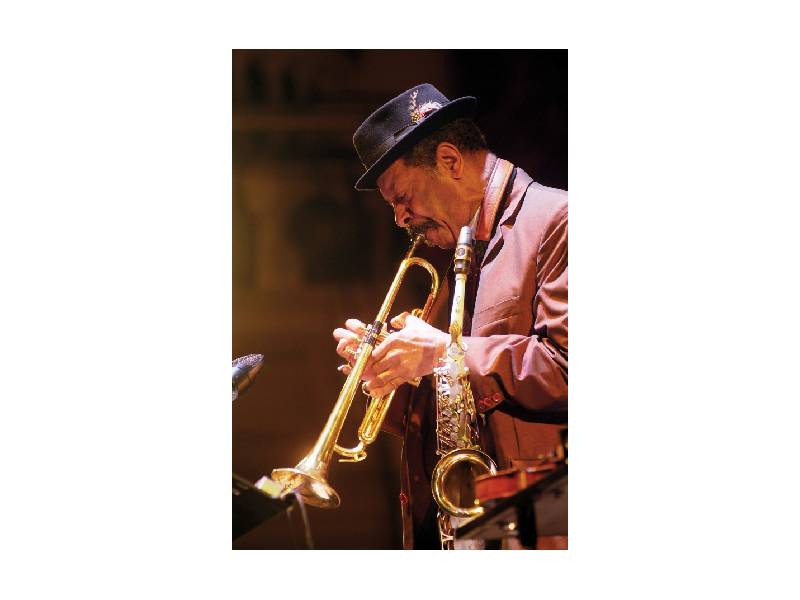
Source: Fort Worth’s I.M. Terrell High School Has a Legacy of Inspiring Jazz Standouts
Chicago in April has a specific energy. The wind comes off Lake Michigan, and the city settles into its role as a historic capital of American sound. This year, that energy is magnified. On April 30, International Jazz Day marks its fifteenth anniversary, and the global focus lands squarely on the American Midwest. Chicago is the official host city for the 2026 celebration. The event anchors a massive global initiative spanning more than 190 countries. The main event is a sprawling concert at the Lyric Opera of Chicago, broadcasting live and bringing together musicians from different generations.
But a fifteen-year milestone requires more than polite applause and city-sponsored banners. We have to stop and ask a basic question about cultural endurance. Why does this single day still matter to Black audiences in the United States and across the African continent? And why is it significant that this specific year centers entirely around Chicago?
The answer lies in both history and present-day reality. International Jazz Day is a tribute concert that also serves as a very real bridge connecting Black cultural memory, artistic innovation, and public education. At the same time, any honest look at this event has to admit the tension built into such a massive institutional project. Critics often point out that global jazz festivals can sometimes prioritize high-profile diplomacy over the quiet, necessary support that local scenes desperately need.
A globally broadcast concert is great, but it cannot pay the rent for independent venues or fund under-resourced school music programs for the other 364 days of the year. Local musicians in Chicago, many of whom hustle between three or four different gigs just to make ends meet, view these mega-events with a mix of pride and skepticism. They know that while the world watches the Lyric Opera, the lifeblood of the music still pumps through small, dimly lit rooms where the cover charge barely covers the band’s parking.
A Legacy of Resistance and Velocity
Understanding why Chicago matters right now means examining the history of Black migration and labor. Over a century ago, musicians brought the rhythms of New Orleans up the Mississippi River. They found a harsh but wildly creative refuge in Chicago. These artists essentially built the “Chicago style” from the ground up. The sound was defined by aggressive solos, tightly arranged big bands, and a fast, urban pace. The city became a crucial sanctuary for Black artistic self-determination. It was the exact place where acoustic Southern traditions crashed into the electric, industrial reality of the North.
Today, that lineage is beyond a museum exhibit. It is highly active. The 2026 programming shows a clear attempt to honor this history while moving it forward. For example, the local April events calendar highlights shows like Isaiah Collier’s tribute to the classic works of John Coltrane, officially listed by Choose Chicago. This specific show points to something vital. It connects young, working musicians right now with the deep spiritual and political legacy Coltrane left behind.
Programming like this proves that jazz is an ongoing conversation. It reminds listeners that the music was created in the reality of Black life in America. It worked as a tool for survival, a way to map out collective memory, and a sophisticated method for improvising against a rigid system.
To ignore the historical weight of Chicago is to misunderstand the music itself. The clubs that lined the South Side in the mid-twentieth century were incubators for a new kind of Black modernity. Musicians, through their notes, were actively theorizing about freedom, structure, and individual expression. This intellectual rigor is precisely what International Jazz Day aims to highlight on a global scale.
The official framing of the 2026 event leans heavily into this historical context. The planners positioned Chicago as an active participant in the evolution of music rather than just a convenient backdrop.
“I’m excited that Chicago, my hometown, is hosting International Jazz Day 2026. It was in my Chicago high school auditorium that I discovered jazz, an event that sparked a lifelong passion and commitment to this powerful art form. Jazz opened doors to creativity, self-expression and freedom. I hope that this Day will inspire young artists and audiences in the same way that I was inspired during those formative years.” Herbie Hancock, UNESCO Goodwill Ambassador
Source: International Day of Jazz 2025: Jazz Day Relay | UNESCO Cities of Music UNESCO Cities of Music
The true success or failure of International Jazz Day 2026 will not be decided inside the Lyric Opera. The real test happens in public school classrooms and small independent clubs located miles away from the television cameras. A major part of the month-long Chicago celebration is a dense, packed schedule of educational masterclasses and pop-up performances. These programs are designed to reach young students across several neighborhoods.
This focus on education is absolute. If the music is going to remain a disruptive and relevant force, it must connect with younger generations. Today’s students bring entirely new sonic vocabularies to the table, heavily influenced by hip-hop, R&B, and electronic production. When a jazz educator walks into a South Side public school and hands a student a trumpet, the music loses its intimidation factor. It stops being a dusty artifact from a bygone era. Instead, it becomes a literal tool that the student can use to articulate their own feelings and frustrations.
But this is where the tension lies. Educational initiatives in April are fantastic, but they often act as a temporary fix. The music community constantly debates whether events like this do enough to challenge the systemic underfunding of arts education. The real, enduring challenge is ensuring that this brief burst of funding and media attention translates into permanent resources.
Public school music teachers and community arts organizers need equitable support every single month, long after the international diplomats pack up and fly home. If the celebration does not leave behind a stronger infrastructure for the local working-class musicians who teach these kids, then the mission falls short.
A Sonic Circuit Across the Black Atlantic
This process of cultural sharing stretches far past the borders of the American Midwest. It echoes across oceans and touches down across the African continent. This builds directly on the recent conversations surrounding the politically charged South African scene, as explored in the piece” Celebrating International Jazz Day: Check out these 5 South African jazz musicians”. We have to recognize that the Black Atlantic is a constant, unbroken circuit of cultural exchange.
Jazz is not a one-way export that America ships out to passive listeners in other countries. It has always been a reciprocal, circular dialogue. The rhythmic DNA that survived the Middle Passage and eventually birthed the blues remains in constant conversation with modern Africa. When you listen to the music critically, you hear exactly how the sound moves fluidly between Cape Town, Johannesburg, Lagos, Nairobi, Accra, Chicago, and New York.
The South African jazz tradition, for example, was forged in the fires of the anti-apartheid movement. Artists like Hugh Masekela and Abdullah Ibrahim used their horns and pianos as weapons against a brutal regime, much like American musicians used bebop and free jazz to soundtrack the Civil Rights Movement. Today, young musicians in Pretoria and Durban are picking up that mantle. They are fusing traditional African modalities with contemporary electronic beats, creating a sound that speaks to the high unemployment and political frustrations of their own generation.
A harsh, driving saxophone solo played in a small Chicago basement club might deliberately pull from the intricate polyrhythms of West African highlife. At the exact same time, a pianist in Johannesburg might blend the aggressive sensibilities of the New York avant-garde with Marabi
Source: Exploring Coltrane ’58: The Prestige Recordings | San Francisco Classical Voice
traditions born in the South African townships. This is the diasporic reality of the genre. It refuses to respect national borders.
Across the African continent and throughout the American diaspora, jazz acts as a shared language. It gives people a way to document ongoing fights for political liberation. It offers a framework for mourning collective losses and carves out a defiant space for profound joy. It connects the highly specific, localized experiences of Black people across the globe, building a collective vision for the future.
The Living Language of Modernity
Right now, the stage is set at the Lyric Opera. The broadcast feeds are ready to reach over 190 nations. The 15th anniversary of International Jazz Day stands as a necessary focal point in a complicated world. It forces us to look backwards at the deep, ancestral roots of the music, while simultaneously pushing us to look ahead at where it is going next.
The friction between a high-budget global holiday and the daily grind of sustaining local arts will always be there. It is the responsibility of critics, fans, and musicians to navigate that friction with total honesty. The music demands active participation from its listeners. It asks us to bear witness to the history embedded in the chords and to support the physical spaces where this art continues to grow. If we want the music to survive another fifteen years, or another century, the work has to happen at the ground level.
But the celebration itself is a powerful assertion. It is a loud, unapologetic declaration that the intellectual and cultural output of Black communities is a central pillar of global art. When the final chords of the Chicago concert ring out into the cool April night, the real work continues. International Jazz Day stands as a bold reminder that this music does not belong behind museum glass. It is a living, breathing language of Black modernity, public memory, and a shared, resilient future.
Anand Subramanian is a freelance photographer and content writer based out of Tamil Nadu, India. Having a background in Engineering always made him curious about life on the other side of the spectrum. He leapt forward towards the Photography life and never looked back. Specializing in Documentary and Portrait photography gave him an up-close and personal view into the complexities of human beings and those experiences helped him branch out from visual to words. Today he is mentoring passionate photographers and writing about the different dimensions of the art world.