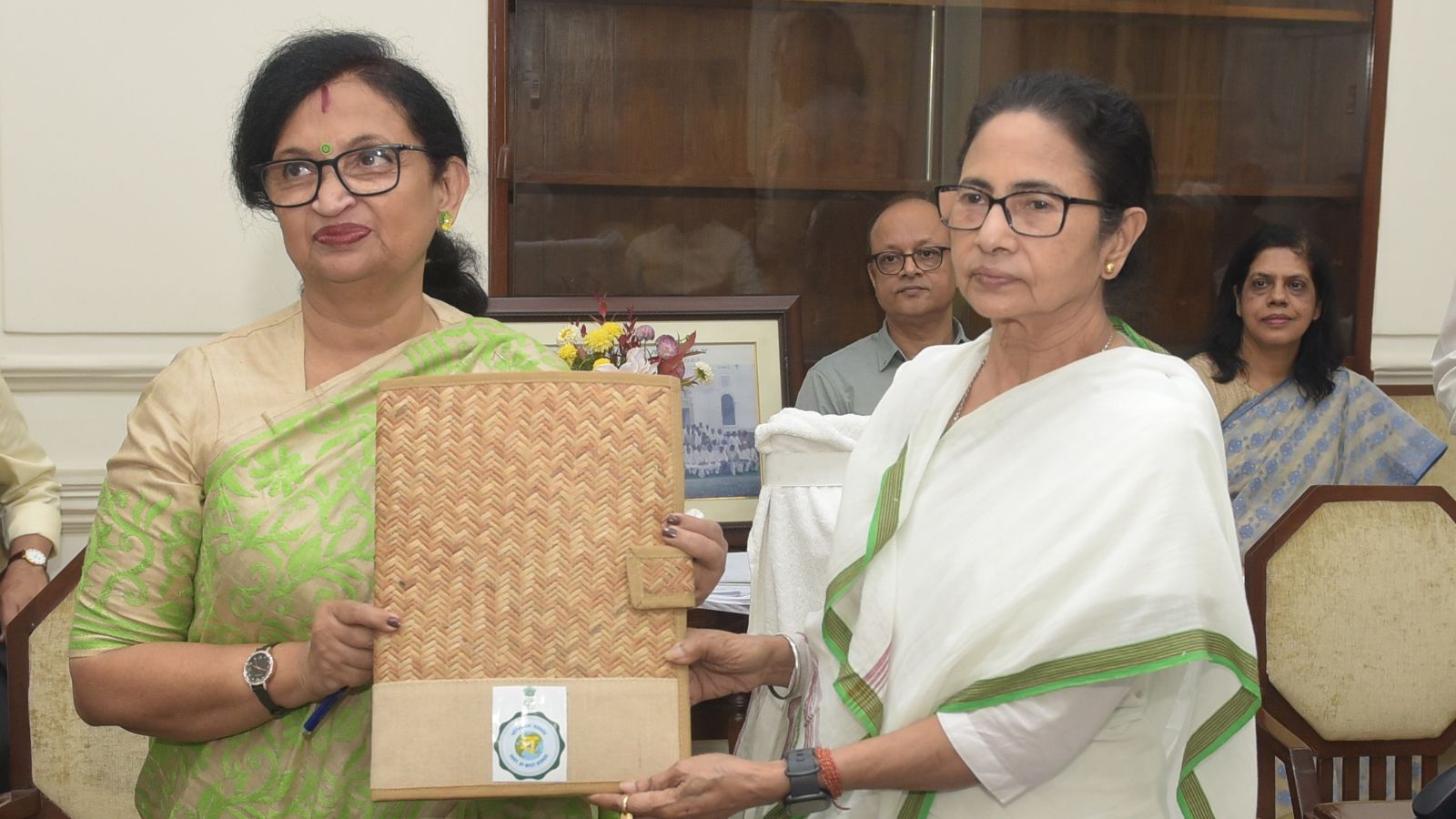
Once a key face of Mamata Banerjee’s women brigade in West Bengal and one of her closest aides, Chandrima Bhattacharya’s exit from the Trinamool Congress (TMC) on Saturday not only fuels the erosion in the party, but also raises questions over the acceptability of the party chief.
A former minister of state (MoS) for finance in the previous TMC government in Bengal, Bhattacharya’s tilt towards the rebel party faction may not affect numbers in the Assembly, given her loss from the Dum Dum Uttar seat in the recent Bengal Assembly elections, but her resignation from all TMC posts has come as another severe blow to the Mamata group’s dwindling morale.
Her resignation comes at a time when Mamata is cornered politically, with 60 of her 80 MLAs choosing Howrah Madhya MLA Arup Roy as the party chairperson and the rebel camp “capturing” the party headquarters in Kolkata. Of its 28 Lok Sabha MPs, 20 have also broken away from the party, led by Kakoli Ghosh Dastidar, to merge with little-known outfit Nationalist Citizens Party of India (NCPI).
Bhattacharya’s exit assumes significance given she was recently appointed the state party president of the Mamata-led TMC, whose election symbol and bank accounts are now being claimed by the rebel camp led Ritabrata Banerjee and Arup Roy, who call themselves the “real TMC”.
According to party sources, on Friday evening, Bhattacharya was at Trinamool Bhawan, the party’s headquarters in Kolkata, and left minutes after rebel MLAs barged in to “capture” the office. Sources added that Mamata was peeved over the lack of resistance.
Soon after resigning from all party posts on Saturday, Bhattacharya went to the Assembly and was seen meeting with rebel MLAs led by Ritabrata Banerjee.
“When one’s loyalty is questioned, there is no way you can stay. There is no point in staying. There is no question of returning,” Bhattacharya told the media after her resignation. “I was told that I allowed them (rebels) to capture the party office. After hearing all that I cannot stay. I consider myself as a failure. I have no allegations against anyone.”
On her tenure as the finance minister, she said, “I read the Budget (in the Assembly), but never made it. It was given to me minutes before the session.”
Notably, when her son Sourav Basu, a councillor in the Kolkata Municipal Corporation, attended a “special session” held by rebel TMC MLAs recently where Mamata was replaced as party chairperson with Arup Roy, Bhattacharya said, “(Sourav) is old enough to make his decisions. I stopped talking politics with him and visiting his office after he held the meetings with the rebel MLAs”.
While some Mamata loyalists have criticised Bhattacharya’s move, the rebel camp has welcomed her decision despite not being a member of the Assembly.
Kunal Ghosh, a TMC MLA in the Mamata camp, said, “When she enjoyed top Cabinet berths and party posts under Mamata Banerjee as chief minister, she had no problems. She held so many departments. Then she had no problems. Yesterday she left the party office and the rebels went in. She could have waited.”
Sandipan Saha, a rebel MLA, said, “She is welcome. She could not bear the insults and left that place. She is with us and we are the Opposition.”
But TMC’s insiders say her exit has dealt a significant blow to the Mamata camp. “Numbers will not be affected since she is not an MLA. But it is an emotional jolt for Mamata Banerjee and her acceptance. Secondly, she was the state president… The rebel MLAs who have declared their own national working committee with Arup Roy as chairperson are contesting for the party symbol and funds with the Election Commission. The rebels will aim to use Chandrima Bhattacharya to their advantage,” said a senior leader in the Mamata camp.
From Cong leader to Mamata aide
The 70-year-old Bhattacharya, unlike Lok Sabha MP Kakoli Ghosh Dastidar who recently led a rebel group to merge with the NCPI, was not with Mamata Banerjee since the formation of the TMC. Bhattacharya began her political career with the Congress, joining the TMC shortly before it first came to power.
With roots in Maimansingha in present-day Bangladesh, Bhattacharya earned an LLB from Hazra Law College under the University of Calcutta in 1976 and began practicing under renowned advocate Sanjay Bhattacharya and later also grew close to Congress leader and former MP Debicharan Pal. She began practising in the Kolkata High Court in 1978 and continued till 2011.
When Mamata quit the Congress to launch the TMC in 1998, Bhattacharya had remained in the Congress. In 2002, Bhattacharya became the Congress’s women’s wing chief, a post she held till 2008, when she resigned from the party. She had also been the Congress’s general secretary of the South Kolkata district and a member of the All India Congress Committee (AICC).
After resigning from Congress, she gradually grew close to Mamata during the Singur and Nandigram movements. In 2009, she joined TMC, and soon became the working president of the women’s wing.
She won her first election as a TMC candidate in 2011, from the Dum Dum Uttar seat. In 2012, after she quit her practice as an advocate, she was inducted into Mamata’s first Cabinet as an MoS. Later, she held key departments including law, health, panchayats, and land reforms.
In 2016, though she failed to retain Dum Dum Uttar, she was fielded from Dakshin Kanthi in a 2017 bypoll and appointed as a minister. In 2021, she contested Dum Dum Uttar again and won. She was subsequently appointed MoS finance 2021, a post she held until she lost Dum Dum Uttar in the 2026 polls against the BJP’s Sourav Sikdar by over 26,000 votes.