

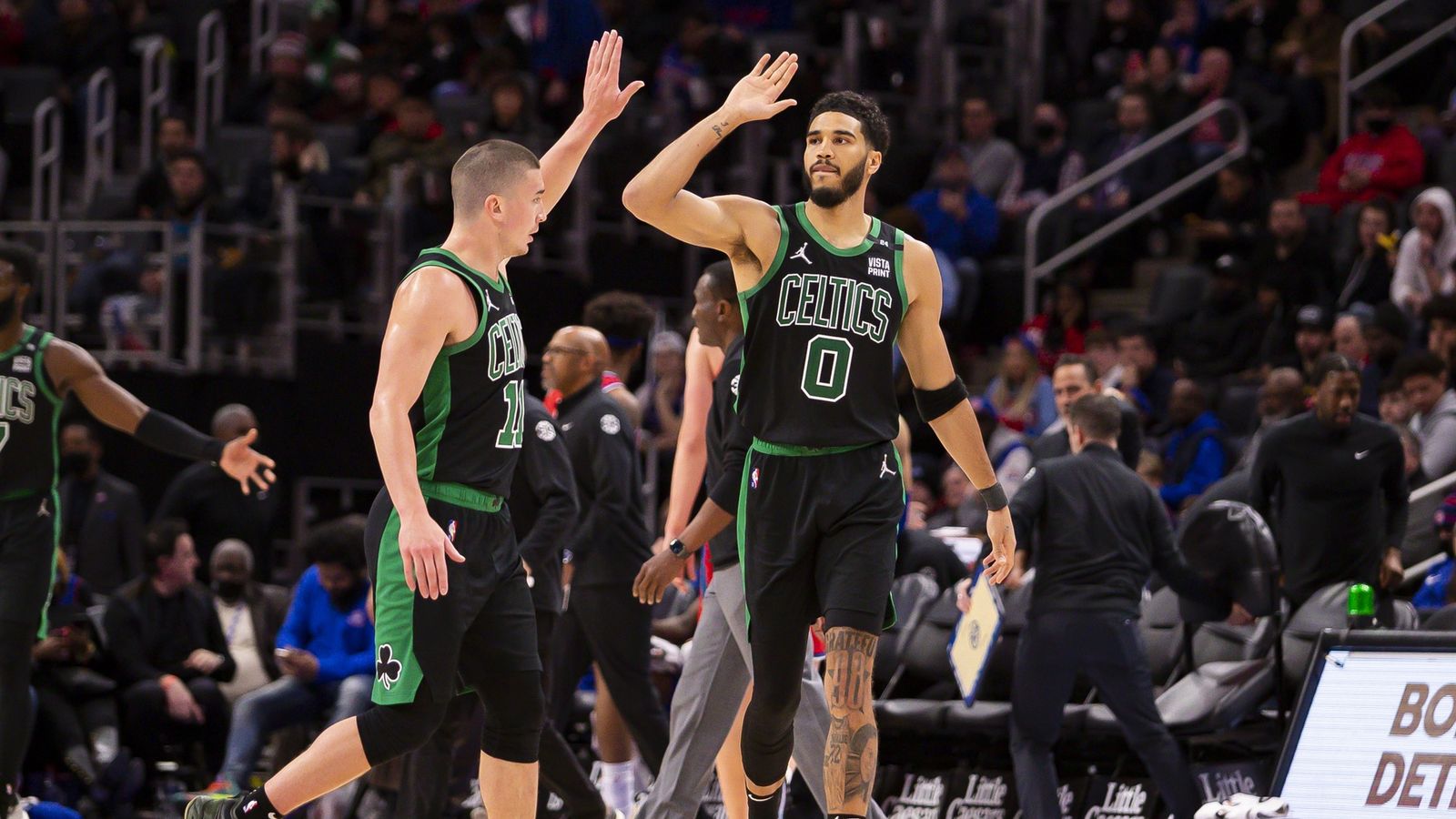
Since what feels like the dawn of time, the Boston Celtics haven’t had a true point guard. At least, that’s been one of the fanbase’s primary complaints. Marcus Smart filled the role for a while. Obviously, before him, there were Kyrie Irving and Isaiah Thomas.
Now, even in the wake of the Jaylen Brown trade, the Celtics don’t have a true point guard ready to lead the charge. Payton Pritchard could fill the void, and Derrick White will have plenty of ball-handling duties, too. But the real answer is Jayson Tatum.
In today’s NBA, true point guards aren’t really a necessity. It’s more about having high-level ball-handlers who can lead an offense. That person doesn’t have to be a guard.
For the Celtics, that’s Tatum. He’s going to have the ball in his hands more than anyone else. His usage rate hasn’t dipped below 30% since the 2019-20 campaign — that was his third season in the league.
And since then, he’s been steadily improving as a playmaker. In the 2024-25 season, he averaged 6.0 assists per game, the highest mark of his career. And his potential assist numbers have been just as impressive.
Potential assists are the number of assists a player would average if every time he passed to a teammate for a shot attempt, that teammate made the shot. Basically, it measures how many chances at a bucket a player averages.
When Tatum averaged 6.0 assists in 2025, he was averaging 15.8 potential assists per 100 possessions. In his 16 appearances since returning from his Achilles injury, Tatum averaged 5.3 assists but also 15.4 potential assists per 100.
The most important part of being a great playmaker is drawing attention. The more defenders who are focused on a single player, the more gravity that player has, and the more teammates that player can get open.
This year, the NBA introduced a gravity stat. It measures how much a player draws in defenders, opening up the floor for others. Tatum didn’t qualify for the metric, as he didn’t appear in enough games, but Jaylen Brown did.
Of the 234 players measured, Brown ranked 20th for gravity score (8.4). That mark put him one spot below Jalen Brunson and one spot above Brandon Ingram. For context, the top gravity scores in the NBA last regular season belonged to Kevin Durant (16.2), Anthony Edwards (15.1), and Shai Gilgeous-Alexander (14.9). Tatum will be looking to replicate those numbers.
Teams didn’t double-team Brown that often. Not until he got into the paint, that is. And at that point, he wasn’t amazing at passing out of pressure. Tatum, on the other hand, gets doubled far more often. Even this year, right when he got back from injury, he was seeing additional pressure.
That’s what playmaking is about. Tatum may not be a point guard in the traditional sense, but he’s elite at drawing a crowd, and his passing instincts are better than ever. And Boston has plenty of guys who can act as secondary handlers behind him.
Pritchard seems ready for an uptick in playmaking duties. Just look back at the potential assist numbers again. Last season, Pritchard was sneakily already blossoming into one of Boston’s most important playmakers.
Brown’s usage rate was 36.2% last season. Compared to Pritchard’s 21.4%, you would assume Brown had a much larger part in the Celtics’ offensive creation. But here are some different numbers.
What about on-ball percentage? How often each player spent with the ball in their hands (holding it or dribbling it) when on the court. Last year, Brown clocked in at 28.8%. Pritchard? 32.4%. He was an even more important ball-handler than Brown last season.
Just take a look at the potential assists. Brown finished the season averaging 13.4 potential assists per 100 possessions, while Pritchard came in at 14.6. And Pritchard’s ball-security was much better, too.
Pritchard’s PASSTOV — the percentage of creation passes that turned into bad-pass turnovers — was just 5.9%. That ranked in the 98th percentile. For comparison, Brown came in at 9.6%.
In the playoffs, Pritchard was also Boston’s most efficient pick-and-roll ball-handler. With this ball in his hands, he scored 1.17 points per possession in the PnR. For comparison: Tatum was 0.78, Brown was 0.76, and White was 0.74. They struggled.
These are all just numbers. A collection of stats that back up an argument for Pritchard to play more pure point guard minutes. But what do they all mean?
Well, when you combine his already-high on-ball usage, impressive potential assist numbers, and lack of turnovers, it shows that the Celtics may
