

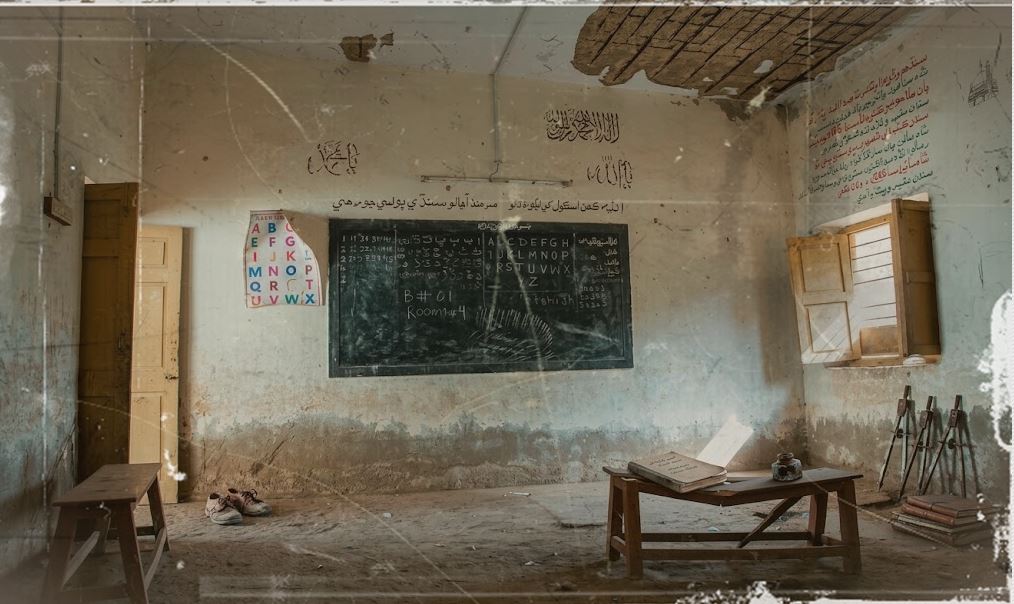
In Sindh, a child’s education can end long before a university gate comes into view.
On paper, the school system is vast. Officials say the province has more than 41,000 government schools and between 12,000 and 13,000 private ones, serving nearly nine million students, yet around 7.6 million children remain outside the system altogether.
The loss begins early. In a 2024 briefing, the education minister told the chief minister that over 4.1 million children were out of school after primary, because the province had only 4,730 middle and secondary schools. The dropout rate after primary stood at 54 per cent.
Those who finish school find a narrow door. The College Education Department lists 343 functional government colleges for a province of well over 50 million people.
The budget shows the priorities. For 2026/27, Sindh set aside Rs446.958 billion for school education, Rs41.414 billion for colleges and Rs9.417 billion for universities and boards. Against a total of Rs497.789 billion, simple arithmetic puts colleges at about 8 per cent and universities and boards at under 2 per cent. Only Rs3.5 billion is earmarked for college development projects. Other reports put the education total higher, depending on what is counted.
The loudest announcements are about school buildings. Officials say 257 of 838 planned schools should be ready by December and 611 by June. Schools matter, but a girl who passes class twelve this year finds no comparable programme waiting at the next level.
The gap is clearest in the south east. The University of Thar at Mithi remains a proposed campus, and students from Tharparkar and Umerkot travel to Hyderabad and Mirpurkhas for higher education. The University of Sindh has said that of an estimated 6,000 school leavers in Mirpurkhas and surrounding districts including Thar, Umerkot and Sanghar, barely 1,000 reach the big centres.
Census figures show who is left behind. Female literacy is 16.77 per cent in Jati tehsil of Sujawal and 19.63 per cent in Chachro tehsil of Tharparkar. In both places, fewer than one in five women can read and write.
Picture a girl in Chachro who has just finished intermediate. This is an illustration, not a named case, but the arithmetic is real for many families. A seat in Hyderabad or Mirpurkhas means rent, transport and a relative’s house. Her brother may be sent. She, in many homes, will be told to wait, and waiting becomes marriage. The unfinished degree becomes one more statistic nobody counts.
Responsibility is not diffuse. The chief minister presented the budget that gave colleges about 8 per cent of education spending. The education minister told him in 2024 that too few middle and secondary schools were driving dropouts, so the leadership has known where the pipeline breaks. The College Education Department and the Universities and Boards Department hold the college and university lines, and the Assembly approved the budget. Yet no public district by district map of missing colleges and universities appears to exist, and no dated plan to close the gap.
Sindh needs that map, a count of seats against school leavers, and budget lines for the districts with the least. Until then, every promise about enrolment stops at the school gate.
After 18 Years in Power Sindh Still Faces Basic Governance Challenges
