Multiple Authors
One of the NFL’s biggest blockbuster trades of the 2026 offseason has suddenly turned into one of the league’s biggest debacles.
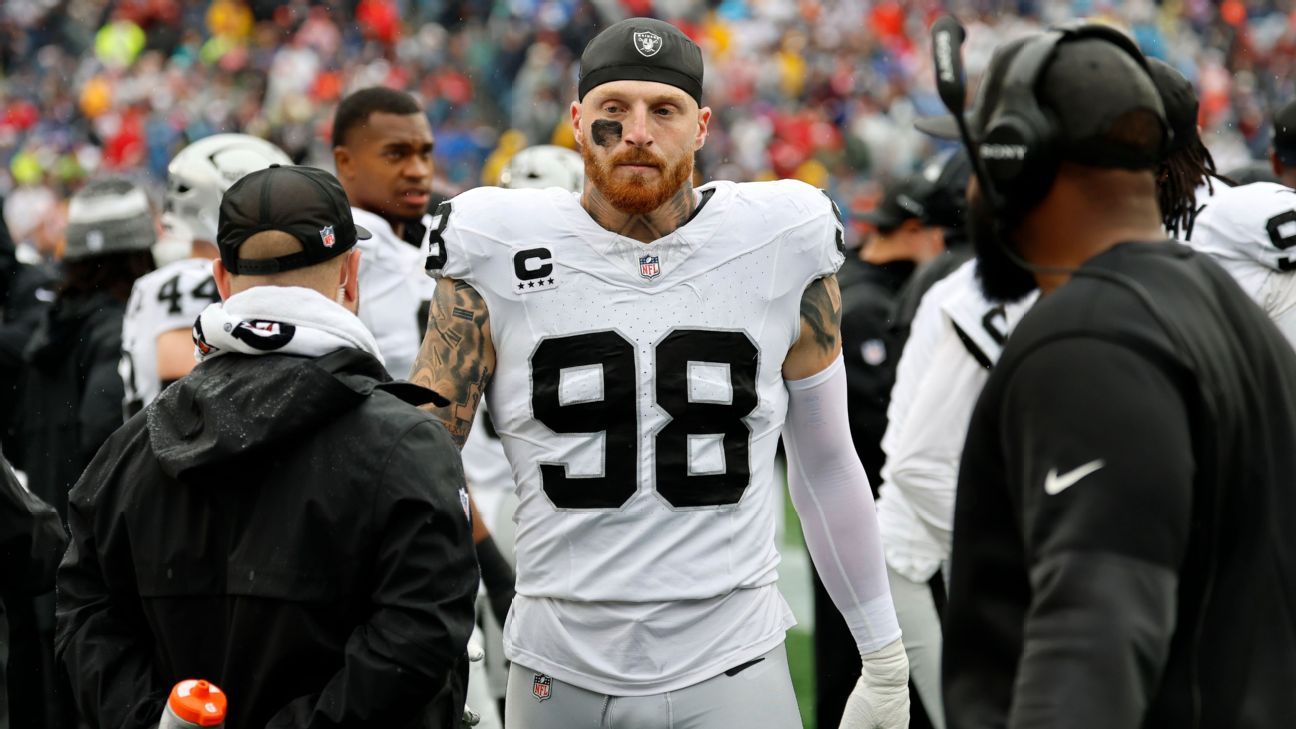
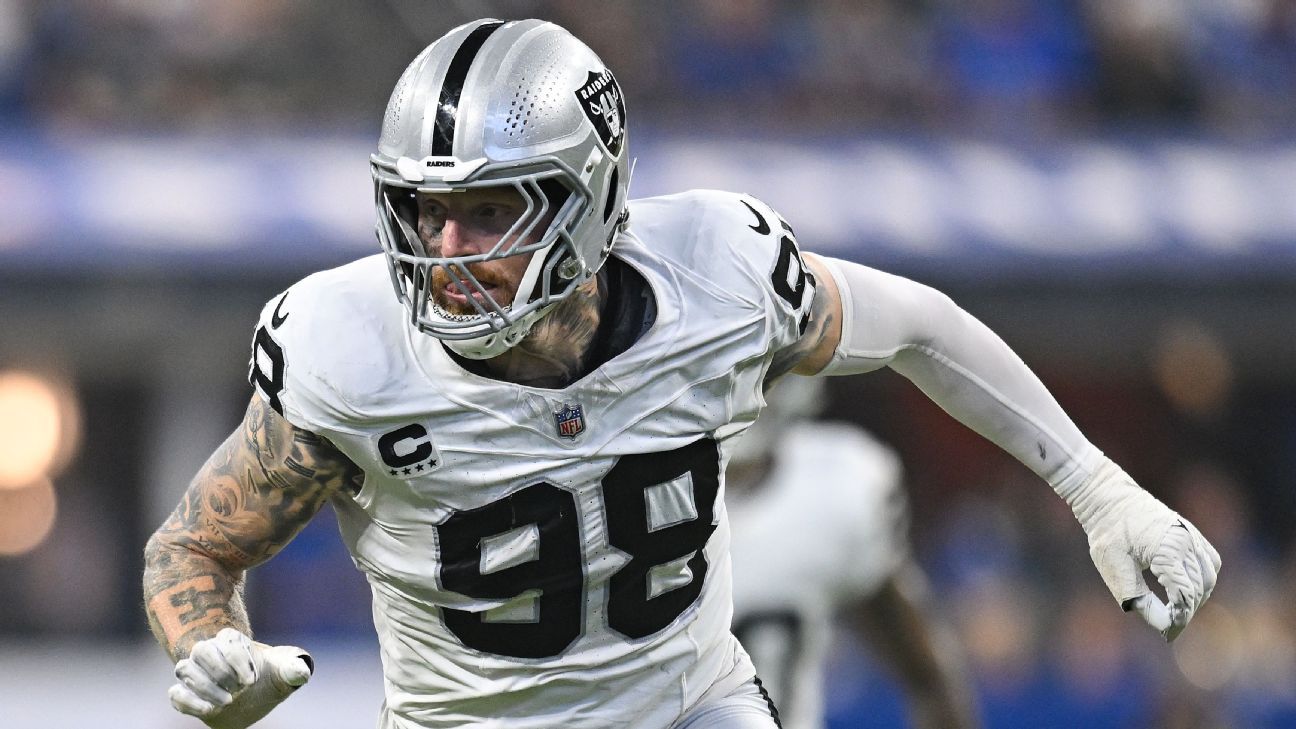
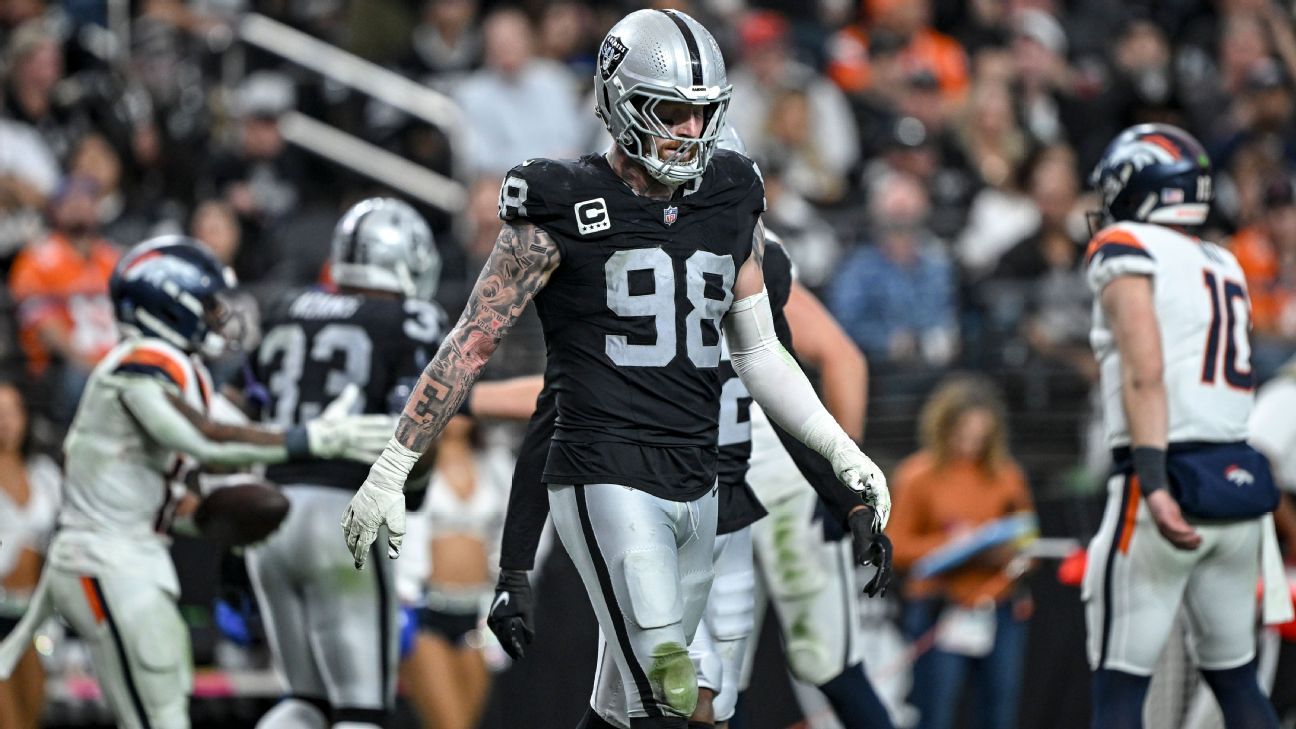
The Las Vegas Raiders announced Tuesday night that the Baltimore Ravens backed out of a trade that would have sent five-time Pro Bowl pass rusher Maxx Crosby to Baltimore in exchange for two first-round picks. League sources told ESPN that the Ravens rescinded the deal because of medical concerns that arose during a physical (trades are contingent on players passing physicals). The specifics of the concerns are unknown.
The unraveling of this trade, which could have been made official Wednesday at 4 p.m. ET, will cause ripple effects throughout the league. The Raiders have to decide whether to keep Crosby or try to trade him again. The Ravens have to determine whether they will pursue another free agent outside linebacker to upgrade their pass rush, which was one of their biggest priorities this offseason.
Editor’s Picks
1 Related
It was only four days ago when the Ravens made the uncharacteristic move to acquire Crosby, giving up a first-round pick for the first time in the 31-year history of the franchise. It looked as if Baltimore had landed its most feared pass rusher since Terrell Suggs and Las Vegas had added two valuable draft picks to its rebuild — one that includes the No. 1 pick in April’s draft.
With free agency beginning Wednesday, the Ravens and Raiders have plenty of questions to answer going forward.
ESPN NFL Nation reporters Jamison Hensley, Ryan McFadden and Kevin Seifert, national NFL reporter Dan Graziano, NFL draft analyst Matt Miller and injury analyst Stephania Bell answer how and why Baltimore backed out of its trade for Crosby.
How exactly can a four-day-old trade just get canceled? What is the precedent for a deal of this magnitude being annulled?
The bottom line is that no trade, and no player transaction of any kind, is final until everyone involved passes a physical.
In the NFL, there is no uniform standard for evaluating the results of a physical. Each team’s decision-makers, in consultation with medical staff, use the information to make a projection about any potential health risks.
In almost every instance, the physical is a formality. But there is recent precedent for NFL teams canceling trades over health concerns.
It’s unclear if the Raiders can revive the trade with Baltimore in some form for Crosby. AAron Ontiveroz/The Denver Post)
One of the most notable cases occurred in 2011, when the Philadelphia Eagles voided a deal that would have brought them running back Jerome Harrison from the Detroit Lions in exchange for running back Ronnie Brown. While undergoing a physical in Philadelphia, Harrison was diagnosed with a brain tumor. The examination might have saved Harrison’s life, according to reports at the time.
Three other recent examples include:
– The Houston Texans backed out of a 2022 trade for Miami Dolphins tight end Adam Shaheen because of concerns about a preexisting knee injury.
– The Minnesota Vikings called off a trade in 2020 for Raiders defensive tackle P.J. Hall, who failed a physical.
– The Texans and Seattle Seahawks amended a 2017 trade that was going to include cornerback Jeremy Lane. When Lane failed his physical, the Seahawks added draft-pick compensation to complete a deal that brought them left tackle Duane Brown. — Seifert
Could Crosby still end up a Raven, but with different terms on the deal?
Anything is possible at this point, but the Ravens’ history says no. There have been three previous instances in which Baltimore has rescinded free agent deals because of issues with physicals — safety Brock Marion in 1997, wide receiver Ryan Grant in 2018 and defensive lineman Michael Brockers in 2020 — and the Ravens moved on from that player each time. This nullified trade is on a different level because Crosby was seen as the ultimate game-changer who could solve the Ravens’ pass-rush woes and help lead the team to the Super Bowl. But it’s difficult to believe the Ravens would still consider trading for Crosby if the risk — and trade compensation — was lower.
What to know for the 2026 NFL draft
• Mocks: Kiper | Miller | Reid | Yates
• Rankings: Kiper | Miller | Reid | Yates
• Best by position | Draft order | More
The collapse of this trade continues a nightmarish start to free agency for Baltimore. Over the past two days, the Ravens watched nine of their free agents go elsewhere, including Pro Bowl center Tyler Linderbaum to the Raiders. But Baltimore could balance out the massive loss with the addition of Crosby. Now, the Ravens have a huge void in their pass rush along with the holes at offensive line, tight end, cornerback, safety, wide receiver and punter. — Hensley
Could Crosby still be traded somewhere else?
It’s unclear if the Raiders can revive the trade with Baltimore in some form. The Dallas Cowboys, who offered a first- and second-round pick, are not expected to pursue a Crosby trade a second time, sources told ESPN’s Jeremy Fowler on Tuesday. “It’s hard to retrace” what has been done, including the Rashan Gary trade, a source said. Dallas is on the hook for Gary’s $19.5 million in 2026, along with several high salaries on offense. The source didn’t totally rule it out but acknowledged it would be a long shot.
A Raiders source expected the team to be open to potentially repackaging a Crosby trade, while noting it’s very early in the process and what has transpired is fresh.
When the dust settles, the Raiders should still have suitors. But the fallout of this situation might hurt the Raiders’ chances of getting two first-round picks for Crosby if they still plan to move on from him. — McFadden
Do the Raiders have any ability to contest the medical?
Not that I’m aware of. No trade can be official until 4 p.m. ET on Wednesday, the start of the new league year. Until that time, any deal that has been agreed to can be backed out of by either party for any reason. In past years, we’ve seen players agree to deals in the negotiating window only to change their minds and back out before the start of the league year. That’s what the Ravens have done here, and it’s their right to do so.
Also, “the medical” is not a black-and-white concept here. It’s not as if there’s some central medical authority that makes judgments on the health of players and all 32 teams must abide by its findings. The Ravens drew a conclusion about what they saw on the physical that convinced them they didn’t want to do the deal. Another team could give him a physical and feel differently, and move ahead with a trade for Crosby.
He could be healthy enough to pass, for example, a Cowboys physical or a Chicago Bears physical or a Raiders physical — even though the Ravens deemed him insufficiently healthy to pass their own. — Graziano
Could Baltimore now pivot to free agent Trey Hendrickson? What are the Ravens’ options?
Signing Hendrickson is the best way for the Ravens to dig themselves out of this mess. Though Baltimore obviously coveted Crosby more, the Ravens can still come out with a dominant pass rusher such as Hendrickson without having to give up two first-round picks. Hendrickson, 31, is a couple of years older than Crosby, but he has more sack production. Since 2019, Hendrickson has totaled 79 sacks, which are 10 more than Crosby over that time.
The problem with the trade falling apart two days into free agency is many of the top pass rushers are no longer available. Jaelan Phillips agreed to a four-year, $120 million deal with the Carolina Panthers, Odafe Oweh reached a four-year, $120 million agreement with the Washington Commanders, Rashan Gary was traded from Green Bay to Dallas and Khalil Mack agreed to a one-year, $18 million deal to stay with the Los Angeles Chargers.
Other than Hendrickson, the top pass-rushers available are: Joey Bosa, K’Lavon Chaisson, AJ Epenesa, Cameron Jordan and Jadeveon Clowney. But none of these free agents come close to making the same impact as Crosby or Hendrickson. — Hensley
The Raiders just spent a lot of money in free agency! Can they even afford all of these players?
This is the big topic in the Raiders’ building now, as I understand it. They committed nearly $300 million to free agents on the first day of the negotiating window, partly with the understanding that they were going to save about $30 million in cap space with the Crosby trade. Depending on the structures of those deals, it’s possible they would have to wait until the Crosby situation is resolved before making some of them official. And if that’s the case, it’s also possible that other teams that were in on these players will be circling to see if they can snag them.
Best of NFL Nation
• Why Miami released Tua and how he fits ATL
• Dolphins sign Willis to replace Tua; now what?
• What Kenneth Walker to Chiefs means for KC
• 2026 NFL free agency live tracker
• Grades for Evans, Walker deals and more
If Tyler Linderbaum, Nakobe Dean, Quay Walker or Jalen Nailor is worried that the Raiders’ cap situation might delay a deal, any of them could decide to take a bird-in-the-hand deal from another interested team instead. This is hypothetical, but it’s realistic, and the uncertainty created by this Crosby news could have ripple effects. The Raiders went into this week with enough salary cap space to be very active and sign a lot of players, so it’s possible they can keep Crosby past 4 p.m. ET on Wednesday and still make all of these other deals official. (All teams must be cap-compliant by the start of the league year.)
But Crosby’s cap number is big enough that it will require further examination — and possibly alterations to the structures of some of these other deals. — Graziano
Crosby wasn’t happy with the Raiders sitting him late in the season all because of a knee injury. What was the extent of that ailment?
Crosby had surgery in early January that was meant to repair a torn meniscus in his left knee. ESPN’s Adam Schefter reported in December that Crosby underwent an additional MRI that revealed if the injury had persisted, then it could have presented long-term concerns if not addressed.
Crosby said on an episode of his podcast, “The Rush,” that aired in late January, that he was aware in September that offseason knee surgery was needed. During the 2025 regular season, he would occasionally sit out practice during the week because of issues with his knee, but it had not prevented him from playing in games. That’s part of the reason why Crosby was so frustrated that the Raiders decided to shut him down for the final two weeks of the season.
When the Raiders told Crosby that he would not play in their Week 17 game against the New York Giants, Crosby left the facility. He walked around on crutches for more than a month before posting a video on Feb. 27 playing basketball in his Las Vegas home. — McFadden
Crosby had surgery in early January that was meant to repair a torn meniscus in his left knee. Tim Warner/Getty Images
What could the Ravens do with their first-round pick now that they aren’t trading it? Can they find their pass rusher in the draft?
The No. 14 pick is a prime spot to add an edge rusher in the first round this year. The expectation is that both Ohio State’s Arvell Reese and Texas Tech’s David Bailey will be off the board by then, but the 30⅞-inch arm length for Miami’s Rueben Bain Jr. is expected to drop him outside the top 10. That could be the best-case scenario for Baltimore. Bain plays with great power and leverage, and he had 9.5 sacks and 71 pressures last season.
If he’s off the board, the Ravens can always target a player who might need a little more time to develop, such as Auburn’s Keldric Faulk or a speed rusher such as Texas A&M’s Cashius Howell, to fill a need off the edge. — Miller
Can deals of this magnitude require a higher bar to be cleared for the physical to go through?
The bar is set internally by the organization, as every deal is a value proposition of risk versus reward.
When a unique, high-value talent is the potential acquisition, risk tolerance becomes a factor. Crosby’s hefty contract and two first-round picks make for a high price and the Ravens would merely be doing their due diligence in leaving no stone unturned during the screening process. Trade physicals are akin to NFL combine screenings, where any previous injuries — even if the player recovered to return to his previous level of play — might warrant further evaluation, including imaging.
The physical is conducted not only to evaluate the athlete at that moment in time, but also in consideration of his long-term playing health. Any concerns emanating from the physical are brought forward to the front office and ultimately factor into the team’s final decision regarding the trade.
Crosby was remarkably durable early on, playing in every game over his first five NFL seasons. In 2024, he suffered an ankle injury early in the season and played through it until Week 15 when he underwent season-ending surgery. The aforementioned knee injury cost him two games last season.
An in-person physical such as the one Crosby underwent in Baltimore would typically include a review of injury history (to have a dialogue between the team physician and the athlete about any relevant medical history) and a manual physical examination. A full physical would be expected, with extra attention to any documented areas of injury and surgery. Additional imaging or other testing could be ordered at the discretion of the team.
In Crosby’s case, of his two notable NFL orthopedic injuries, the ankle had already proved to be fully recovered to the point of successfully returning to play. Still, the ankle joint could be a focal point of examination to assess how well the joint had withstood another year of play.
But Crosby’s knee was a work in progress and in the very early stages of evaluation. To protect the healing tissue, meniscus repairs require a slower return to activity than meniscectomies, in which a damaged portion of the meniscus is simply removed. A full clearance for football activity following meniscus repair can take up to six months, as opposed to just a few weeks for a meniscus trim.
The other unknown part of this case is the health of the cartilage itself (cartilage lines the knee joint to protect the bone underneath). Part of the rationale for opting to repair a meniscus is to protect the long-term health of the knee. Whether there was any cartilage damage associated with the original meniscus injury or as a result of continued play has not been reported, but this would also be something the Ravens probably would take into consideration. Without knowing the specifics of what caused the Ravens to hit the pause button, it is impossible to say whether it would cause other teams to react similarly.
If Crosby’s recently surgically repaired knee is the concern, it could be that something as simple as the timing of this physical is partially to blame. At only two months removed from surgery, Crosby still has benchmarks to clear before being eligible to return to play. Even if he is fully on track with his rehabilitation, a team could still have concerns about his ability to return to his previous level of performance. Imaging can also be complicated at this stage as there might still be changes on the horizon as recovery continues. But a team can definitively evaluate only what is in front of them, and with a multiyear contract in play, the team might not be comfortable predicting longevity at this stage. — Bell