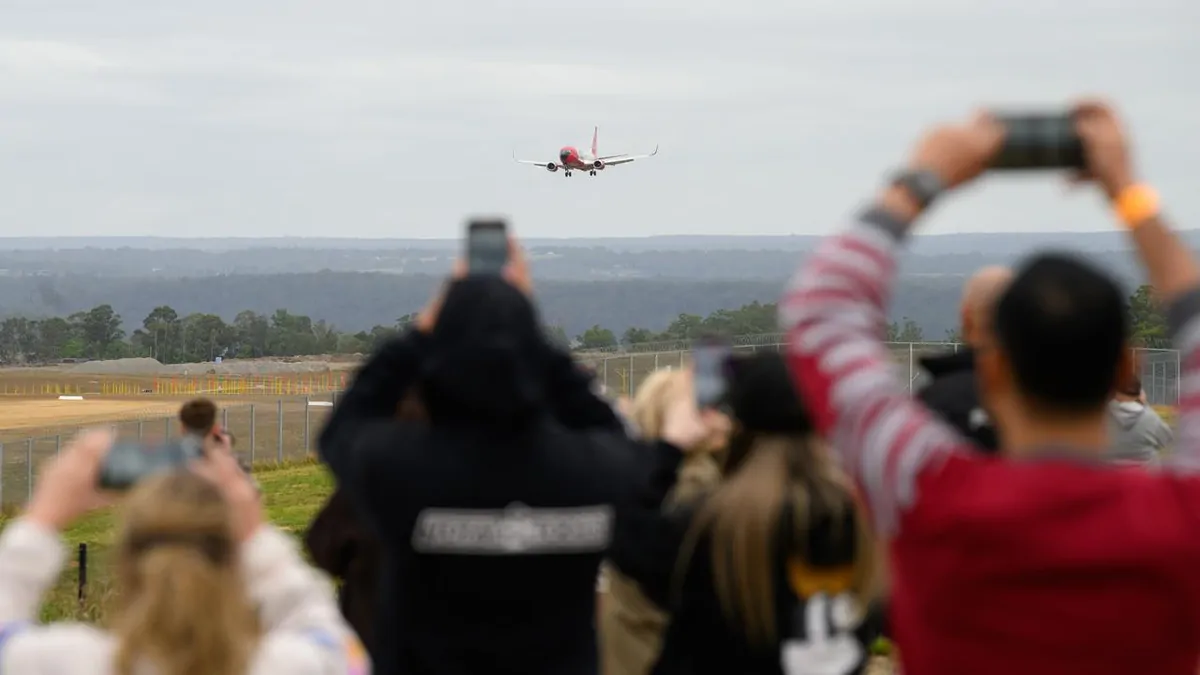
Visitors will land at an airport almost a century in the making as western Sydney’s biggest gamble begins.
Tentiform ceilings, expansive mountain views and tarmac already used by cargo jets will welcome passengers to Western Sydney International (Nancy-Bird Walton) Airport from Sunday.
Master-planned to handle up to 10 million passengers a year, the airport will operate 24 hours a day, seven days a week with no curfew.
Sign up to The Nightly’s newsletters.
Get the first look at the digital newspaper, curated daily stories and breaking headlines delivered to your inbox.
By continuing you agree to our Terms and Privacy Policy.
Sydney’s need for a second airport was recognised in the post-war years, with Badgerys Creek selected as a potential site in the 1980s before decades of disagreements delayed progress.
Twelve years ago, Tony Abbott’s Liberal government officially selected and confirmed the site, ending decades of federal and state-level indecision over where in Sydney a second major aviation hub should be established.
The announcement set the project on course, with Western Sydney International (Nancy-Bird Walton) Airport ultimately completed on budget and ahead of schedule.
For stakeholders who took a massive gamble on the ambitious project, the airport’s opening is the beginning – passengers, airlines and businesses must now deliver on its promise.
Rico Merkert, the University of Sydney’s head of international business, logistics and supply chains, says the airport could take 10 years to become profitable.
He says population growth, better transport connections and continued private investment in the surrounding region will be crucial to making the $5.3 billion public project commercially viable.
A recession, changing attitudes to immigration, competition from nearby freight hubs or a failure to attract passengers could leave taxpayers supporting the airport longer than expected.
“In the future, I don’t see any problems with that airport,” Dr Merkert says.
“But currently, it’s probably not profitable … they will require subsidies.”
For governments, more than cash flow is at stake.
Leaders are backing a Western Sydney “aerotropolis” – an airport-centred economic hub that can attract industry and investment to a region marked by distance and job shortages.
Cheaper land and new transport links are expected to help usher in an era of economic growth, while the planned city of Bradfield aims to provide a base for advanced manufacturing, technology and science innovation in the west.
Business Western Sydney leader David Borger, who served as roads, housing and western Sydney minister in the Rees and Keneally state Labor governments, says that vision is already driving a “real U-turn”.
“There’s a sense of pride that we’re getting our own airport and that’s going to drive the economy … everyone’s looking at opportunities,” he says.
Massive public infrastructure spending around the airport runs into tens of billions of dollars, including the M12 motorway and a rapid transit metro line due to open in 2027.
Reported private investment in nearby areas reached $34 billion in October.
Mr Borger says government and council involvement has boosted business confidence to invest, with the Western Sydney City Deal co-ordinating local, state and federal planning.
Paul Fletcher, who served as infrastructure minister under former prime minister Malcolm Turnbull, says the project’s broader economic ambition was built-in from the outset.
Mr Fletcher oversaw months of negotiations that culminated in Sydney Airport’s owners declining a right of first refusal – established under the Howard government’s sell-off – to build and operate the new airport in 2017.
It cleared the way for the federal government to establish Western Sydney Airport Corporation.
As the airport became a reality, Mr Fletcher says governments began looking beyond the terminal and runways to wider economic opportunities.
“Once (the airport) was moving, we then really turned our attention to what are we going to do to leverage this big investment in an airport so it has a much broader set of policy outcomes?” he tells AAP.
Broader planning was pushed particularly hard between 2016 and 2020, as construction began at Badgerys Creek and governments worked on transport links, housing and the Western Sydney City Deal.
Shaped by Western Sydney mayors alongside the NSW and federal governments, the deal was one of the most significant parts of that wider effort, Mr Fletcher says.
“I think we’re going to see the consequences – and the individual components, the airport, the metro, Bradfield – play out over decades,” he says.
Penrith City Council Mayor Todd Carney, who leads a growth-focused western suburbs alliance, says government needs to boost underlying infrastructure that has lagged the airport development.
“It’s not the sexy thing but it’s the things that are really important to make sure we can build jobs of the future and we can build homes,” he tells AAP.
“I think there’s things happening now but unfortunately, a lot of that stuff should have been done a number of years ago.
“This has been decades of … western Sydney sitting behind when it comes to the infrastructure rollout, so now it’s time to get on board.”
Mr Fletcher understands the scepticism of residents who have witnessed past promises fail to materialise.
During the renewed push to build the airport, one local summed up frustrations: “Oh yeah, mate, I went to a sod turning in 1990.”
But Mr Fletcher backs the project’s long-term promise.
“I am very pleased with where it’s got to … I also think it’ll build momentum as more and more people get to know about it,” he says.
He will not judge success in the immediate term, describing the grand plan as a “10, 20, 30, 50, 100-year project”.
Dr Merket believes the airport has a surer future in public hands if it can navigate the next decade.
Better use of airport land for offices, logistics centres and other businesses could generate revenue beyond passenger and freight charges, he says, while encouraging an airport-based community would build a stronger local market.
“If you look at the growth projections within the next 10 years, the Sydney basin is large enough for two airports,” he says.
“In the future, I don’t see any problems.”
Mr Borger expects further rail connections to major metropolitan stations will also be needed to open up the region to more workers and commuters.
The airport has been designed to expand, with a second runway factored into the plans and the terminal built to grow in stages as passenger numbers rise.
Whether the surrounding economy can grow at the same pace is the much longer test.
Mr Fletcher, a former Liberal MP for the federal electorate of Bradfield, understands those east of Sydney’s city centre – roughly 70 minutes from Badgerys Creek – might not understand the hype.
“We’re not building it for you,” he recalls telling a naysayer.
“We’re building it for two and a half million people who live closer to Western Sydney Airport than to Kingsford Smith.”