

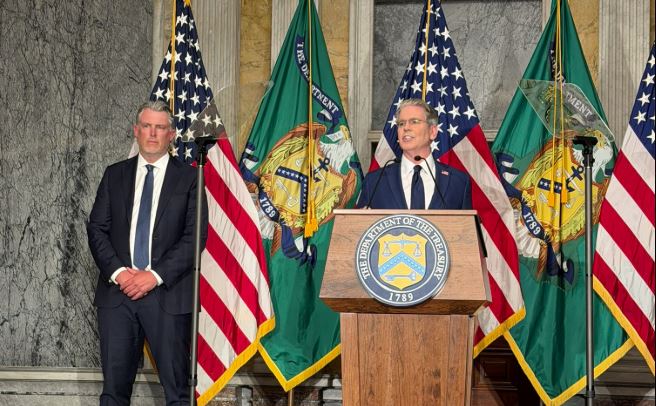
WASHINGTON — US launched new economic offensive against Iran, targeting networks, companies and financial channels Washington says are keeping Tehran’s economy alive after months of conflict.
US Treasury Secretary Scott Bessent announced “Operation Economic Outcast”, calling campaign an unprecedented, whole-of-government drive to push Iran toward economic isolation unless Tehran chooses to re-enter the international system.
The strategy seeks what Washington describes as “zero leakage” by choking off Iran’s remaining revenue streams and imposing greater risks on foreign entities helping the country move oil, money and sensitive technology.
The campaign widens the sanctions battlefield to digital assets, technology, gold, aviation and shipping, potentially exposing foreign companies and individuals involved in Iran-related activity to US penalties.
Washington also announced measures against nearly 60, or more than 60, entities, individuals and vessels worldwide accused of supporting Iranian oil revenues, nuclear and missile procurement networks and cyber operations.
The list includes China- and Hong Kong-linked targets. US officials have identified Sweet Ocean Industrial Limited as an intermediary connected to the transfer of laser optics to Iran’s Malek Ashtar University of Technology. Chinese individuals Li Na, Tian Jianbai and Zhang Limei, along with logistics company Shenzhen Huamei Lianyun International Logistics Co Ltd, have also been named.
Bessent has warned that there will be no safe haven for those helping Iran convert oil into cash. Washington has reportedly given governments and businesses deadlines to terminate identified activities, with failure potentially triggering unilateral US action.
The new offensive comes as Iran confronts a deepening economic crisis.
US-Iran conflict and disruption around the Strait of Hormuz have hammered energy markets and international shipping. The World Bank has lowered its 2026 global growth forecast to 2.5%, warning that worsening disruptions could drag growth toward 1.3%. US second-quarter growth has been reported at 1.5% annualized, while Iran’s currency has plunged to extreme lows, with some reports putting the rial near 2 million per US dollar.
Iranian oil exports have also been severely constrained, with shipments to Asian markets reportedly drying up in recent periods and some crude held aboard vessels or in floating storage.
Yet Washington faces one enormous obstacle, China. Beiing historically purchased roughly 80% to 90% of Iran’s seaborne oil, much of it through smaller “teapot” refineries and networks using discounted crude, shadow fleets, ship-to-ship transfers, front companies and alternative payment channels. That makes Beijing central to the success, or failure, of Washington’s strategy.
US can increase costs for Iranian traders, insurers, shippers and banks, but eliminating the remaining oil trade could prove far harder without Chinese cooperation. The biggest escalation could come if Washington moves against major Chinese financial institutions. Such action could trigger retaliation from Beijing and intensify already fragile US-China relations.
The timing is especially sensitive, with Trump and Chinese President Xi Jinping expected to meet in September 2026. Meanwhile, tougher restrictions on Iranian oil could push global energy prices higher, adding inflationary pressure and weakening growth in fuel-importing economies.
The campaign could further shrink Iran’s revenues and make sanctions evasion considerably more expensive. But Tehran has spent decades developing shadow fleets, front companies, alternative currencies and other workarounds. The coming months will show whether Washington can truly close those channels, or whether Iran and its partners simply find new routes around them.


