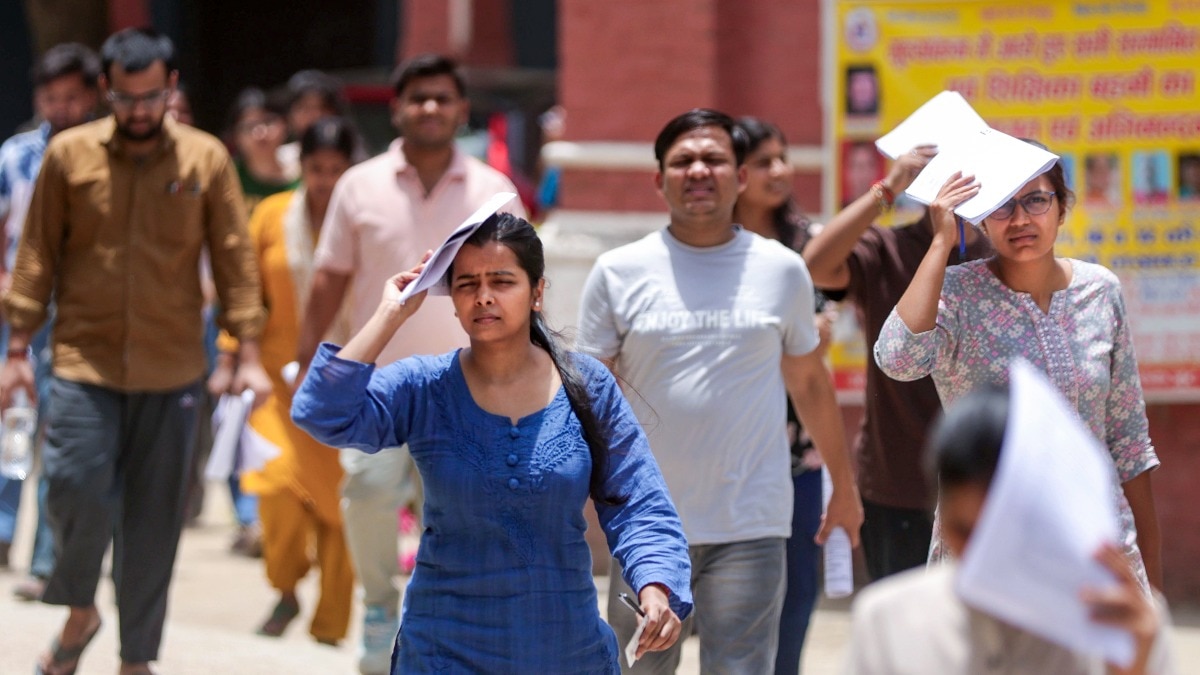
There is a running joke in the circles of UPSC aspirants in Delhi’s Mukherjee Nagar and Old Rajinder Nagar. Even if someone managed to get hold of the UPSC Civil Services Examination paper before the exam, there is no guarantee they would be able to solve it. Jokes apart, aspirants and mentors after the 2026 UPSC Prelims paper on May 24 said that the questions were difficult enough to leave even the best-prepared candidates sweating.
The joke highlighting the exam’s difficult and unpredictable nature throws a question that has gained relevance amid a string of paper leak controversies. How has the UPSC managed to conduct some of India’s biggest examinations year after year without finding itself at the centre of such scandals?
The question came up in the Supreme Court last week as the National Testing Agency (NTA) faced scrutiny over examination irregularities. During a hearing before a bench of Justices PS Narasimha and Alok Aradhe, the court pointed to the UPSC as an example of how large-scale examinations can be conducted without repeated paper leak controversies.
“UPSC has never been in a situation. You need to learn,” Justice Narasimha observed, while questioning the NTA’s handling of exam security.
The observation has turned the spotlight on the puzzle that has long intrigued students and ordinary people alike.
Every year, the UPSC conducts examinations involving lakhs of candidates across thousands of centres. Yet unlike several recruitment boards and exam agencies that have repeatedly battled allegations of leaks and cancellations, the Commission has largely preserved its reputation for confidentiality and process integrity.
What exactly does the UPSC do differently?
Is it simply a matter of experience, or are there institutional safeguards that make leaks far more difficult?
And can other recruitment agencies such as the NTA or the SSC, learn from not just the UPSC, but also premier institutions like the IITs and IIMs, which conduct high-stakes entrance examinations like the JEE and CAT, on a massive scale?
The answers lie in a combination of secrecy, compartmentalisation of papers, use of technology and decades-old decorum, according to experts and stakeholders India Today Digital spoke to.
“The UPSC has an established strictness, established protocols and institutional decorum that makes any attempt to compromise the examination process far more difficult,” Chandigarh-based UPSC mentor Shekhar Dutt told India Today Digital.
THE SCALE OF THE UPSC CHALLENGE? WHICH EXAMS ARE CONDUCTED BY UPSC?
Every year, the UPSC conducts examinations that determine entry into India’s most coveted services, including the Indian Administrative Service, Indian Police Service and Indian Foreign Service. It is the Civil Services Examination or the CSE, which is among the many exams the Constitutional body conducts.
The CSE alone attracts nearly a million applicants annually. Besides this, the Commission conducts examinations for engineering services, combined medical services, NDA, CDS, Central Armed Police Forces and other recruitment tests.
Yet, unlike many state recruitment boards and entrance examinations that have been rocked by leak allegations in recent years, UPSC has largely maintained a reputation for confidentiality and process integrity.
WHO SETS UPSC CSE QUESTION PAPER?
One of the biggest differences lies in who gets access to the question papers and the nature of the UPSC CSE exam.
UPSC mentor and founder of Sleepy Classes, Shekhar Dutt, told India Today Digital that, “A reason the UPSC is less vulnerable to paper leaks is that most of its flagship examinations are conducted in multiple stages. “When an examination has prelims, mains and an interview stage, the incentive and impact of leaking a single paper are far lower than in a one-shot examination,” Dutt said.
He, however, cautioned against viewing the UPSC as a flawless institution. “It has its own share of issues and criticisms,” Dutt added. We would discuss those in this article later.
Another factor that he pointed out is that the question paper-setting is handled through a tightly controlled network of experts. Multiple subject experts prepare questions independently, while moderators and paper setters work under strict confidentiality agreements, who from that pool of questions make question papers.
Dutt said there is no clear public information on the exact process followed by the UPSC. “However, it is generally observed that a dedicated internal mechanism supervises question-paper preparation and related security protocols,” Dutt told India Today Digital.
Dutt argued that the nature of the UPSC examination itself acts as a deterrent against leaks. “The stakes are extremely high. Officials involved in the process are unlikely to put their careers and reputations on the line for something like this,” he said.
By contrast, he said, one-stage examinations such as NEET or UGC-NET create different incentives for the people who leak question papers. Just leaking the paper once is needed in cases of the single-state exams.
“The incentive for a leak can be much higher. There are millions appearing for these exams. In CSE this year, eight lakh aspirants applied, and just five lakh actually took the exam. In the case of exams like NEET, a leaked paper can help a candidate secure admission to a medical college or another institution. In the UPSC, you are talking about selecting people who will go on to form the country’s steel frame. The scrutiny, accountability and consequences are of a different order altogether,” Dutt told India Today Digital.
Several of the accused and arrested in the NEET-UG 2026 paper leak case had direct links to the question paper-setting process. The CBI arrested retired chemistry professor PV Kulkarni, who had served on NTA’s expert panel. Another accused, botany professor Manisha Mandhare of Pune’s Modern College, was also among the experts who had access to the paper.
UPSC’s SECURITY LAYER BEYOND QUESTION SETTERS
The printing and movement of question papers are treated as high-security operations.
Papers are printed in secure facilities under surveillance and transported in sealed packets to examination centres. With UPSC examinations, a positive aspect is that the level of government oversight is high, and the process remains largely shielded from private players.
Dutt pointed to another factor that, in his view, makes the UPSC relatively less vulnerable to paper leaks: the location of its examination centres.
“If you look at UPSC centres, they are largely concentrated in state capitals and major cities. Compare that with examinations like NEET, where centres are spread across hundreds of cities, including smaller towns. That becomes a major logistical challenge when it comes to safeguarding the sanctity of question papers,” he said.
A 32-year-old UPSC aspirant, who didn’t want to be named, told India Today Digital, “Over the years, the Commission introduced several technological and procedural reforms aimed at improving the transparency and security of exams. These include changes in seating arrangements, examination-centre management through 5G jamming and the evaluation processes”.
“Many of these practices were adopted by the UPSC first and are now being replicated by state commissions. For instance, measures such as making answer sheets available to candidates in the interest of transparency were introduced by the UPSC and have since been adopted by bodies such as the BPSC,” said the UPSC aspirant, who has one attempt left, and has been appearing for State Commission examinations as Plan B.
The Uttar Pradesh-based aspirant, who has twice faced the UPSC CSE interview boards, said he hoped the Uttar Pradesh Public Service Commission (UPPSC) would take up such positive steps.
Days after the Civil Services Preliminary Examination was held on May 24, the UPSC released a provisional answer key, marking the first time in its history that candidates were allowed to challenge answers before the final key was published. The move is widely seen as a significant step towards greater transparency.
NOT PAPER LEAKS, UPSC HAS OTHER CHALLENGES TO ADDRESS
The absence of major paper leak scandals does not mean the UPSC is immune to malpractice. “Over the years, the Commission has had to contend with a different set of challenges, including impersonation, cheating through electronic devices, forged certificates and candidates allegedly misusing reservation and disability benefits,” Shekhar Dutt told India Today Digital.
Dutt recalled the most high-profile involving probationary IPS officer Safir Karim, who was caught using a Bluetooth device while reappearing for the Civil Services Examination in 2014 in an attempt to improve his rank and secure the IAS.
Investigators alleged that answers were being relayed to him from outside the examination hall by his wife, Joyce Joy. The case drew comparisons with scenes from Sanjay Dutt’s Munna Bhai MBBS.
Dutt also recalled the case of trainee IAS officer Puja Khedkar, who found herself at the centre of a controversy over allegations of submitting OBC and disability certificates to avail reservation benefits and additional attempts at the CSE.
Investigations alleged that Khedkar had been appearing for the UPSC examination since 2012 and had relied on questionable certificates to remain eligible for further attempts.
Now, with the Supreme Court pulling up the NTA over the NEET paper leak and holding up the UPSC as an example worth emulating, a thing stands out that institutional credibility is not built overnight. It is the product of decades of protocols, oversight and constant adaptation to new forms of malpractice. And perhaps that is why the old UPSC joke continues to survive.
– Ends
Published By:
Sushim Mukul
Published On:
Jun 3, 2026 07:00 IST