President Donald Trump said on Saturday that he planned to maintain a US blockade of Iranian ports if a peace deal with Tehran is not reached, adding that he may not extend the ceasefire after its expiration.
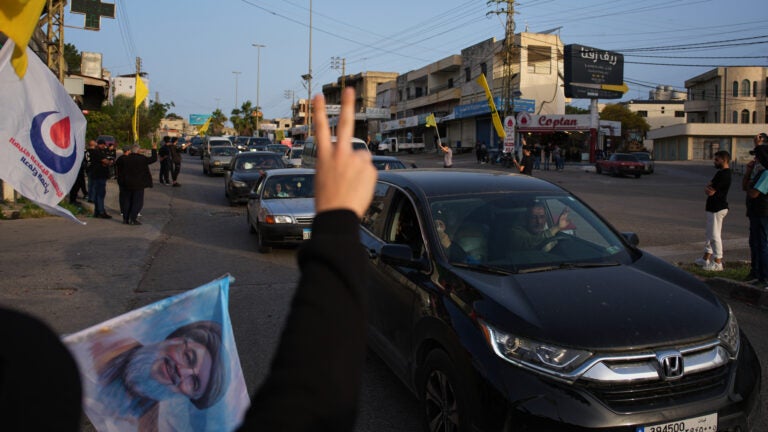
Iran reopened the Strait of Hormuz on Friday in the wake of a ceasefire deal between Israel and Lebanon, though Tehran threatened to close the vital waterway once again if the US blockade continues.
A ceasefire between Tehran and Washington is due to expire on Wednesday.
Trump said that he may end the ceasefire with Iran unless a long-term deal to end the war is agreed by Wednesday.
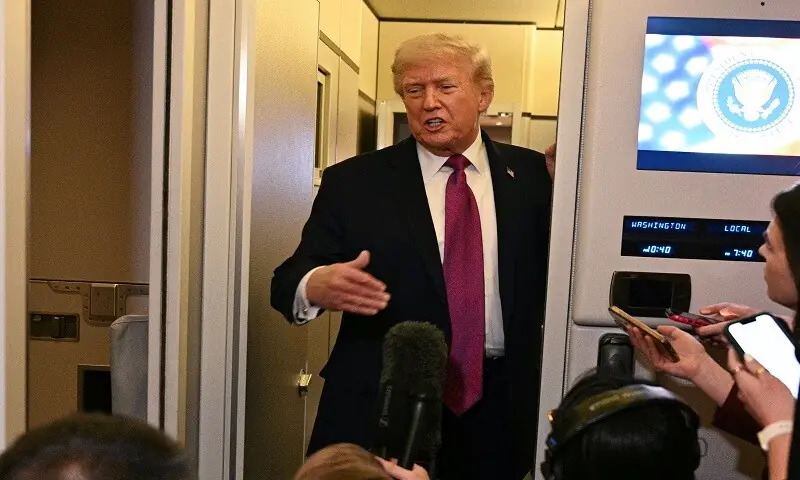
“Maybe I won’t extend it, but the blockade (on Iranian ports) is going to remain,” Trump told reporters on Air Force One on his way back to Washington from Phoenix, Arizona.
“So you have a blockade, and unfortunately, we have to start dropping bombs again.”
Asked about a potential deal, Trump said, “I think it’s going to happen.”
Key differences remain between the demands from the United States and Iran, which earlier failed to reach agreement in talks in Pakistan.
Trump told reporters there were “not going to be tolls” imposed by Iran on ships passing through the Strait of Hormuz – something that the Islamic republic put forward during previous peace deal plans.
In a post on his Truth Social platform, Trump said China’s President Xi Jinping was “very happy” about the global oil chokepoint reopening.
“Our meeting in China will be a special one and, potentially, Historic,” Trump added, referring to a summit planned in Beijing in May.
Trump also insisted that Washington and Tehran would jointly transfer enriched uranium stored in Iran to the United States under the touted plan to end the war, which began on February 28.
Iran’s foreign ministry earlier said its stockpile of uranium would not be transferred “anywhere.”
Iran threatens to again close Hormuz, if US blockade continues
Tehran threatened on Saturday to shut the Strait of Hormuz once more if the United States continues its blockade of Iranian ports, hours after Iran announced it had reopened the strategic waterway in the wake of a ceasefire in Lebanon.
The potential for the resumption of transit had lifted stock markets on Friday and prompted optimism from Washington, with President Donald Trump telling AFP a broader US-Iran peace deal was “very close” and saying Tehran had agreed to hand over its enriched uranium — a key sticking point in negotiations.
“We’re going to get it by going in with Iran, with lots of excavators,” Trump said at an event in Arizona.
Iran, however, pushed back on the claim, saying its stockpile of enriched uranium was not going anywhere.
It also warned that if US warships intercepted vessels coming from Iranian ports, the Strait of Hormuz – a key global trade artery through which about a fifth of global crude oil and liquefied natural gas typically passes — could be closed again.
“With the continuation of the blockade, the Strait of Hormuz will not remain open,” parliamentary speaker Mohammad Bagher Ghalibaf wrote on X, adding that passage through the waterway would require authorization from Iran.
“What they call a naval blockade will definitely be met with an appropriate response from Iran,” said Iranian foreign ministry spokesman Esmaeil Baqaei, calling the naval blockade “a violation of the ceasefire” it struck with Washington for a fortnight to enable talks.
US forces have so far directed 21 ships to turn around since the blockade began this week, the US Central Command posted on X overnight, accompanied by an image of an American guided-missile destroyer patrolling the Arabian Sea.