Boston Bruins
If the Bruins are willing to roll the dice, Elias Pettersson is a potential top-line center operating at low value.
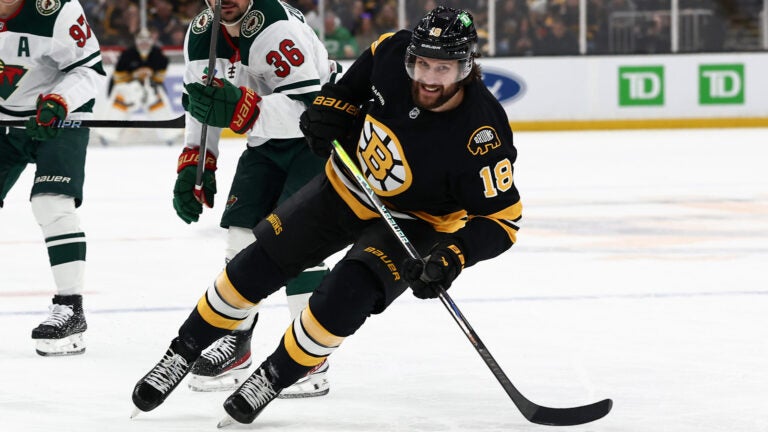
Elias Pettersson has one of the heftier contracts in the NHL. Photo by Bruce Bennett/Getty Images
June 23, 2026 | 7:15 AM
8 minutes to read
The Boston Bruins have several offseason objectives this summer if they want to build off of a brief playoff appearance.
Near the top of the list? Adding a legitimate top-line center.
Beyond waiting for Fraser Minten, James Hagens, and Dean Letourneau to marinate and anchor Boston’s forward corps, Boston’s options of adding a true game-changer down the middle are limited this summer.
A barren free-agent class won’t move the needle for Boston, at least not at the center position.
St. Louis Blues star Robert Thomas is reportedly off the market, while Dylan Larkin reportedly has a limited list of teams he’d approve a trade to.
To make matters worse, several teams across the Atlantic Division are beefing up — with the Panthers adding Brady Tkachuk to an already pugnacious and battle-ready roster anchored by a healthy Aleksander Barkov, Matthew Tkachuk, Brad Marchand, Sam Bennett, and many other difference makers.
But if Boston wants to aim big with a high-upside pivot — without necessarily needing to drain their deeper pool of picks and prospects in the process — could Canucks forward Elias Pettersson be a potential fit?
It’d be a sizable gamble for the Bruins, given both Pettersson’s lackluster play as of late and what might be the most burdensome contract in the NHL.
But is it a risk worth taking for the Bruins? Let’s weigh the pros and cons of a fascinating trade target for Boston.
Pettersson might be one of the more distressed assets up for grabs this summer, given his dip in production over the last few years for a woeful Canucks team.
But if the Bruins are on the prowl for upside, the 27-year-old Pettersson has several seasons on his resume where he entrenched himself as one of the top pivots in the league.
In his eight full seasons in the NHL, the Swedish forward has surpassed 30 goals three times and 60 points on five occasions.
After taking home the Calder Trophy as the league’s top rookie in 2018-19, Pettersson hit his peak in 2022-23 with a 102-point (39 goals, 63 assists) campaign as a 24-year-old star. Across 545 career games in the NHL, Pettersson has posted 508 career points (200 goals, 308 assists).
Beyond his strong offensive production and lethal shot, Pettersson also projects as a solid defensive forward — with one top-10 finish on his resume for the Selke Trophy.
There is still plenty of risk when it comes to targeting a player like Pettersson, all of which we will dive into shortly.
But if the Bruins are focused on trying to bring in a true top-line talent to slot in next to David Pastrnak for the foreseeable future, Pettersson at least checks off several boxes of what Boston might be looking for — and is a more realistic target than a Thomas or Larkin at this stage of the offseason.
Even with a dip in offensive production, Pettersson still has some solid defensive metrics as a solid, if not underperforming, two-way center.
Granted, the Bruins are inviting plenty of risk (and cap-related headaches) if they’re operating with the assumption that Pettersson will hit the ground running as a 90-to-100-point regular in Boston if a deal is struck.
CON: He’s been on the decline in recent years
Given his age, skillset, and established credentials … why exactly is Vancouver looking to move Pettersson?
A lot of it has to do with money. But a Canucks franchise staring at a nuclear winter and a painful rebuild is blowing things up, in part, due to Pettersson’s staggering decline over the last few seasons.
After scoring at more than a point-per-game clip over his first six seasons in the NHL (412 points in 407 games), Pettersson’s game has lagged — posting 96 points across his last two years in Vancouver (138 games).
Over an 82-game pace, that equates to just 57 points per season — numbers befitting of a solid, middle-six forward, but not a top-line, franchise center.
The case can be made that Pettersson might just need a change of scenery, especially if it involves leaving a Canucks team that has floundered in recent years, culminating in a league-worst 25-49-8 record in 2025-26.
If a “bottom-out” season for Pettersson is 60 or so points, the talented Swede, who is still just entering his prime, could be due for a major spike in production on a new club — especially if he has a player like Pastrnak stapled to his wing.
Still, a player like Pettersson — for all of his upside and evident talent — isn’t exactly a player that teams are lining up to take a flier on, not given his contract situation.
CON: He might have the worst contract in the league
A Bruins team already feeling the sting of a long-term contract earmarked with lackluster returns in Elias Lindholm (five years left, $7.75 million cap hit) might be hesitant to take on a majority — if not all — of Pettersson’s current contract with Vancouver.
Once viewed as a top-10 center in the NHL, Pettersson is now playing more like a 2C in the last two years. It’s a bit concerning … until one takes a look at his cap hit.
Then it becomes a legitimate debacle — given that Pettersson is on the hook for a seismic $11.6 million annual cap hit through the end of the 2031-32 season.
For those keeping tabs, only Kirill Kaprizov, Leon Draisaitl, Jack Eichel, Auston Matthews, Nathan MacKinnon, Connor McDavid, Kyle Connor, Mitch Marner, and Mikko Rantanen cost more per year in terms of an annual cap hit than Pettersson.
If Pettersson was still thriving as the same player he was from 2018-24, that $11.6 million cap hit would be the going rate for an elite 1C in today’s market — a cap hit that would age gracefully over time as the NHL’s salary-cap ceiling continues to rise.
But at his current level of play, that contract is an outright detriment to any team realistically looking to contend in 2026-27 and beyond … unless Pettersson regains his form in short order.
The Bruins have the cap space right now ($15.4 million, per PuckPedia) to absorb Pettersson’s contract outright if need be. But it would limit just about any other offseason plans that Don Sweeney and his staff have planned — not without Boston moving out money as part of the deal or any corresponding moves.
And as much as the Bruins are in the market for a 1C, there’s a lot more on Sweeney’s offseason to-do list if Boston actually wants to take a step forward this fall.
Pro: He won’t cost as much in a trade when compared to other top forwards
Even if a 1C like Larkin or Thomas later signs off on a trade to Boston, the cost to pry those players out of their respective teams will be steep.
We’re talking multiple first-round picks — including that 2028 unprotected Toronto first-round pick — to go along with blue-chip prospects or youngsters like Hagens, Minten, Letourneau, Will Zellers, and others.
The Bruins would still need to part ways with some capital to get Pettersson out of Vancouver. But there’s a realistic scenario in which the Bruins add a potential 1C just entering his prime — while still having a few first-round picks, Hagens, and others still in place to supplement the rest of Boston’s retool.
Of course, such a scenario only completely benefits Boston if it can keep its deep prospect pool largely intact, while also revitalizing Pettersson’s career at the same time.
But if Boston is on the prowl for a big fish this offseason — without necessarily needing to sacrifice their future in the process — Pettersson does make some sense if Boston believes that it can drag him out of this sustained slump.
PRO: A rebuilding Canucks team could trade/accept other assets
If Boston wanted to give up a bit more in terms of picks or prospects in order to get Vancouver to retain some of Pettersson’s annual cap hit, adding a flawed center on a $9 million cap hit might be a bit more digestible.
But if Vancouver doesn’t have that much of an appetite in essentially taking a $2-3 million dead cap hit for the next six years, the Canucks — who aren’t going to be contending any time soon — might be willing to play ball with the Bruins when it comes to taking a contract or two off of Boston’s books in order to alleviate some of Pettersson’s outstanding cap hit.
It feels like a lost cause for Boston to get Vancouver or any team to take Lindholm’s contract moving forward.
Could the Canucks have an appetite for an expiring contract like Casey Mittelstadt’s ($5.75 million), which they could flip again at the deadline next spring? Mason Lohrei ($3.2 million) could be a younger player that a team like Vancouver values, while the addition of a player like Pettersson could also make a forward like Pavel Zacha expendable in a separate trade for a quality asset.
Boston has no shortage of contracts it can try to parlay and move off on other teams this summer, including Henri Jokiharju (two years, $3 million AAV), Joonas Korpisalo (two years, $3 million AAV), and Mikey Eyssimont (one year, $1.45 million AAV).
And if the Bruins did want to really get ambitious and part with multiple assets and top prospects as part of a mega-deal with Vancouver, a minutes-eating, right-shot defenseman like Filip Hronek (signed through 2031-32 with a $7.25 million annual cap hit) would be a worthwhile target to pair with Pettersson, if the Canucks are willing to listen.
As much of a gamble as it might be to take on Pettersson’s deal, the Canucks might be more receptive to taking on shorter-term contracts in return — or part with more assets ahead of a longer rebuild.
The final verdict?
Trading for Pettersson stands as a monumental risk for the Bruins, especially as they attempt to navigate a tricky situation of trying to help this current core of Pastrnak, Jeremy Swayman, and Charlie McAvoy without selling the farm.
IF Pettersson arrives and regains his form, the Bruins might have their 1C for the present and future — without needing to completely drain their prospect pool in the process. It might take some finagling, but the Canucks should also be able to take on at least a contract or two to lessen at least some of the sting of the $11.6 million annual cap hit.
The Bruins are in a tough spot — desperate to add talent, but with dwindling options in a competitive Atlantic Division.
Barring the Bruins potentially selling off assets and playing the long game with drafting and development, swinging for the fences with a player like Pettersson could give Boston a potential franchise fixture — without having to sacrifice all of their stockpiled picks and prospects.
It’s a tremendous risk. But one that the Bruins might have to accept if they actually want to try to retool on the fly to help out this current core.
Conor Ryan is a staff writer covering the Bruins, Celtics, Patriots, and Red Sox for Boston.com, a role he has held since 2023.
Sign up for the Today newsletter
Get everything you need to know to start your day, delivered right to your inbox every morning.