The centrepiece of the Government’s $47 billion housing plan has led to the construction of 1432 homes in almost two years, prompting criticism that it’s doing too little, too slowly.
But Housing Minister Clare O’Neil insists progress will ramp up soon and quickly, and that the plan is far broader.
The sprawling Homes for Australia plan contains multiple complex programs and few people understand how it is supposed to get the country to the “ambitious” five-year 1.2 million homes target Labor has set.
Sign up to The Nightly’s newsletters.
Get the first look at the digital newspaper, curated daily stories and breaking headlines delivered to your inbox.
By continuing you agree to our Terms and Privacy Policy.
Anthony Albanese has repeatedly referred to a 29-storey development at 195 Pier Street that he visited with Premier Roger Cook in May as a “prime example” of this plan.
“Two years ago, we stood here when it was literally just a site on a very hot day where there was no construction whatsoever. Now we see the outside of the buildings here all completed and the internal fit-outs well underway,” the Prime Minister said.
The project was fully government funded – $88.6 million from the precursor to the Housing Australia Future Fund and $45.6 million from WA, which also provided the land – and will be sold to a community housing provider once complete.
It comprises 219 new apartments: 109 rented at market rates, 44 rented at “affordable” rates and the remaining 66 provided as social housing with rents set at 25-30 per cent of household income and subsidised by taxpayers.
The Government spruiks its $47 billion housing plan at every opportunity, and even more so in the wake of a budget that contained controversial changes to property investor tax breaks that Treasury says will ultimately reduce construction. It says that ultimately, the plan will lead to 420,000 new homes.
So what is promised for the money?
The Housing Australia Future Fund (HAFF) was established in late 2023 after a protracted fight through Parliament.
It’s a $10 billion investment managed by the Future Fund that is supposed to pay out $500 million annually to be used for grants, concessional loans and availability payments for new social and affordable housing.
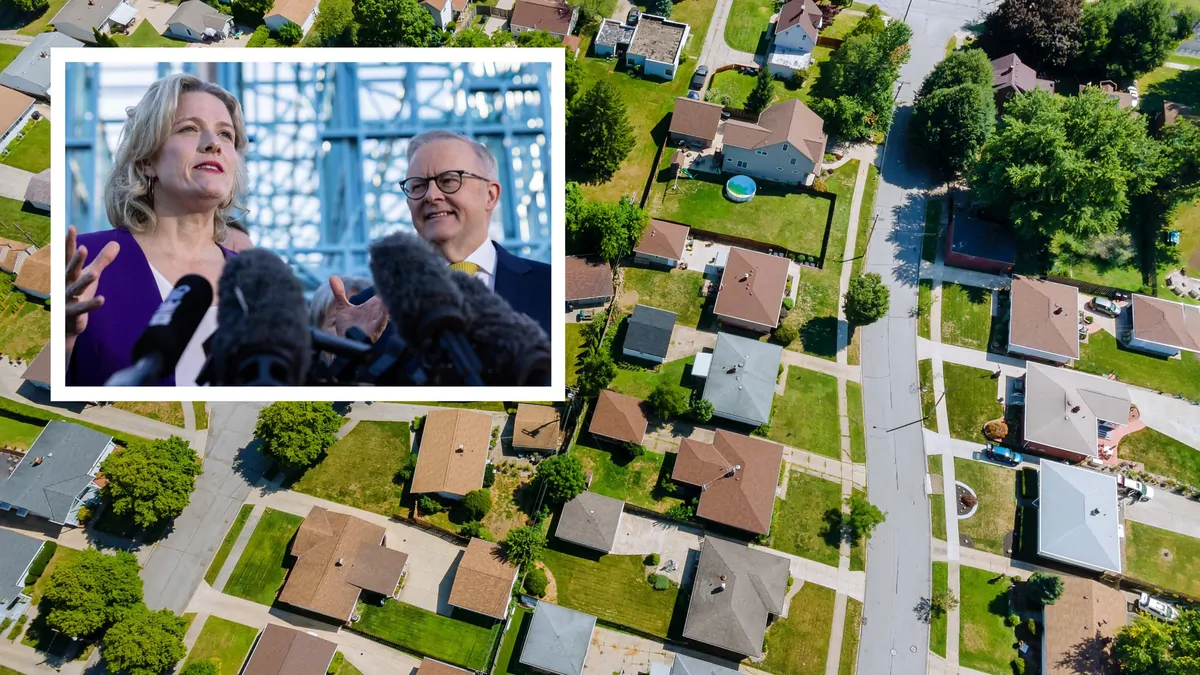
Housing Minister Clare O’Neil (left) insists progress will ramp up soon and quickly, and that the plan is far broader. Pictured with Prime Minister Anthony Albanese. Credit: Jason Edwards/NCA NewsWire
Availability payments subsidise rents over the long-term – typically a 25-year contract – so that developers can offer social housing, as at the 195 Pier St site.
The investment earned about $1.5 billion to the end of March, according to its quarterly performance reports.
Yet it’s only made one $500 million disbursement, in July 2024, according to the Finance Department. Treasury says a second payment will be made before the current financial year ends on June 30.
The HAFF is expected to back the construction of 40,000 affordable and social homes by mid-2029.
Its first two rounds funded 18,399 homes. Of these, 1432 now have people living in them, 6851 are in construction, 4927 have planning approval but haven’t started building, and 5189 are in planning.
Apartment blocks typically take close to three years to build, and freestanding houses about 12 months.
A third round is taking applications and will remain open until it funds 21,350 homes. Treasury officials told Senate estimates last week they’ve received expressions of interest covering 56,711 dwellings, with 12,188 proceeding to a more detailed application stage.
Another $4.85 billion in construction loans for community housing providers and $1 billion for crisis and transitional housing that were previously separate programs have also been brought under the HAFF umbrella, although they’re funded separately from the annual investment return.
Greens housing spokesperson Barbara Pocock said that despite being “the key piece that Labor put on the table”, the HAFF was not sufficient for the 640,000 people who needed social housing.
Anthony Albanese (right) has repeatedly referred to a 29-storey development at 195 Pier Street that he visited with Premier Roger Cook in May as a ‘prime example’ of the plan. Credit: Sandra Jackson/The West Australian
“We have said from the beginning … that the HAFF is too complicated, too slow, and too small,” she said.
Ms O’Neil’s rebuttal is that the housing plan is far bigger than the HAFF.
“Labor has got the most ambitious, reforming agenda for housing since the post-war period, one that’s squarely focused on reforming our housing system at every level to build more homes, and give first home buyers and renters a level playing field at auction time,” she said.
“The reality with housing is that there is no silver bullet. It’s about pulling every single lever to reform the system to build more homes while providing leadership across the entire sector.”
The next biggest bucket of funding is $10 billion in grants and loans to the States under the 100,000 Homes for First Home Buyers scheme.
This was a centrepiece of Labor’s election offering and helps States pay for the infrastructure needed to unlock new housing sites.
To date, the Commonwealth has made agreements with WA, SA, Queensland, Tasmania and the ACT, that are supposed to deliver 42,000 of the 100,000 homes. Deals with NSW and Victoria are anticipated shortly.
However, Ms O’Neil has said this program gives the biggest bang for buck because the homes reserved for first-time buyers will be in developments that build another 200,000 homes for the general market.
The First Home Buyer loans were a centrepiece of Labor’s election offering and helps States pay for the infrastructure needed to unlock new housing sites. Credit: Daniel Wilkins/The West Australian
This makes up the vast bulk of the 420,000 total new homes the $47 billion plan supports.
But it runs over an eight-year period – well beyond the 2029 end of the housing accord – and the Budget papers revealed that by 2030, just $829 million of grants would be released.
The $6.3 billion Help to Buy scheme was another held up by the Greens and Liberals in the Senate, but it started running in December.
It’s a shared equity scheme similar to WA’s Keystart, offering places to 40,000 first-home buyers over four years.
About 6500 applications have been received so far.
Its Budget allocation of $6.3 billion is equity that will be repaid by homeowners, so it’s ultimately revenue-neutral.
Similarly, the 5 per cent deposit guarantee has helped 260,000 buyers get into the market but comes at very little cost to the Commonwealth’s bottom line because taxpayers are only on the hook if the person defaults on their loan, which has happened just 13 times.
Another $4.6 billion has been spent on increases to the Commonwealth Rent Assistance payments.
The Housing Support Program also offers infrastructure funding, with $3.5 billion for State and local governments.
It was originally set up in the previous term with funding aimed solely at helping local government employ town planners to speed up approvals, but has since been expanded twice, including another $2 billion added in May.
The Budget papers said the latest top-up should enable the construction of 65,000 homes that wouldn’t have been built without it. But comes with strings: States have to tackle planning red tape to get any of the money.
The States also share another $2 billion fund, the Social Housing Accelerator, which gives them money to refurbish dilapidated homes that are otherwise sitting empty.
As of December, there were 1608 projects complete, 1952 under construction, and 710 funded but not commenced from this money.
Finally, the Federal government put a $3 billion New Homes Bonuse “carrot” on the table when it got the states to sign on to the national housing accord, promising cash for those that beat their share of the 1.2 million target.
However, housing construction has been running too slowly and Master Builders Australia forecasts that far from topping the target, the nation will miss it by some 200,000 homes.
The Budget papers said, based on the latest forecasts, States would only receive $714.2 million.
Those are the big ticket items, but there are a raft of other programs as well.
These cover things like encouraging takeup of modern methods of construction that can see homes built faster and cheaper, boosting skills and apprentices to tackle the ongoing workforce shortages, tax incentives for build-to-rent developments, and specific measures to support Indigenous people, domestic violence survivors and young people in community housing.