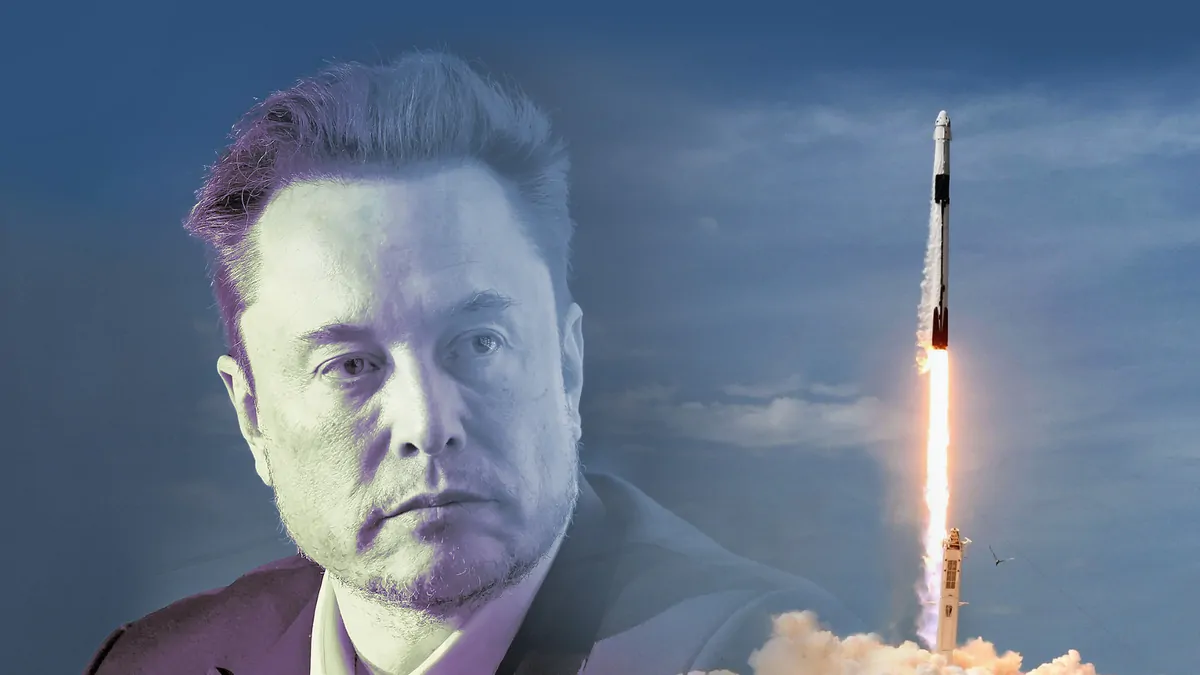
Data centres in space and 1 million people living on Mars are among the spectacular targets listed in the prospectus for Elon Musk’s satellite company SpaceX.
On Thursday, SpaceX filed its prospectus ahead of a Wall Street listing on a valuation reportedly up to $US1.75 trillion, despite the company posting a loss of $US4.9 billion on revenue that grew 33.2 per cent to just $US18.7 billion in 2025.
Potential buyers of SpaceX stock are being asked to place their faith in Musk’s reputation as a business and engineering genius capable of building companies and technology almost nobody else felt realistic.
Sign up to The Nightly’s newsletters.
Get the first look at the digital newspaper, curated daily stories and breaking headlines delivered to your inbox.
By continuing you agree to our Terms and Privacy Policy.
In his favour, Musk did pioneer electric vehicles and self-driving with Tesla, despite its many critics he proved wrong as the company single-handedly advanced the timeline on the carbon-free future of transportation.
Starlink’s spectacular success
SpaceX also already has one impressive business in Starlink. It has launched around 10,400 satellites into space that provide reliable internet connectivity to users across cities, rural areas, battlefields, and more recently long-haul flights between Australia and Europe for example.
Like Tesla, Starlink is bold and disruptive in its single mindedness. It’s also a engineering-based technology breakthrough that delivers human advancement.
As such, it represents the best of Mr Musk’s mix of intellectual and business genius, which allows him to see, before others, where new technologies can bring the widest utility and advancement to humanity.
In the latest quarter, Starlink posted an operating profit of $US1.2 billion on revenue of about $US3.2 billion and is SpaceX’s core selling point for investors.
In total, the internet connectivity business is projected to generate 70 per cent of the company’s revenue in 2026. Its long-term contracts technological edge, and reliable revenue streams mean it shapes up as a good business.
SpaceX’s speculative vision
Otherwise, investors will have to rely on another of Musk’s great talents, as a salesman, to make any profits on a SpaceX investment.
“AI accelerates SpaceX’s mission to make life multi-planetary, to understand the true nature of the universe, and to extend the light of consciousness to the stars,” the initial public offer document says.
A fine line often divides a visionary and fantasist and the prospectus treads it by outlining targets to deliver on Musk’s ambition to ‘colonise Mars’.
A planet as much as 401 million miles from Earth, which currently takes an unmanned probe six to nine months to reach.
Nevertheless, 200 million shares are on offer to Musk on “the Company’s establishment of a permanent human colony on Mars with at least one million inhabitants, in each case, subject to Mr Musk’s continued employment with us through the date on which achievement is certified by our board.”
Data centres in space
Other more realistic targets include the establishment of data centres in space planned to run on solar power and power the AI boom.
If successful, they could presumably boast high profit margins given the demand for terrestrial ones is through the roof as new technologies linked to AI require exponentially more power.
“We believe orbital AI compute is an incredibly difficult technical challenge that only we can solve at scale in the near term,” SpaceX wrote in the filing.
Musk will retain about 42 per cent of SpaceX after the IPO. He will also own about 85 per cent of the controlling shares that grant voting power in a standard structure that allows tech founders to retain control of businesses.
The number of shares issued at the IPO estimated to be worth between $US40 billion to $US80 billion will also only represent around 5 per cent to 10 per cent of total shares on issue based on a targeted market value of $US1.75 trillion.
This limited supply and the huge demand linked to a mania for Musk’s business ventures is what will likely help give SpaceX such a high valuation. Once it trades the very limited free float, a relatively small amount of sellers, and potential index inclusion is what the float’s investment banking deal makers hope will keep the stock at an elevated valuation.