


Entertainment
This new adaptation balances a bizarre plot with sharp humor and a star-studded cast, though its dialogue-heavy pacing occasionally drags.
“We must move with the times,” Botard (Clay Singer) says.
It is bizarre to hear from a man transforming into a rhinoceros. But in the American Repertory Theater’s production of “Rhinoceros,” strange is the point.
Friday night’s performance at the Loeb Drama Center in Cambridge turned Eugène Ionesco’s absurdist classic into a darkly funny examination of conformity, mass hysteria, and the frightening ease with which people surrender their individuality, staged by Tony Award-winning director Diane Paulus.
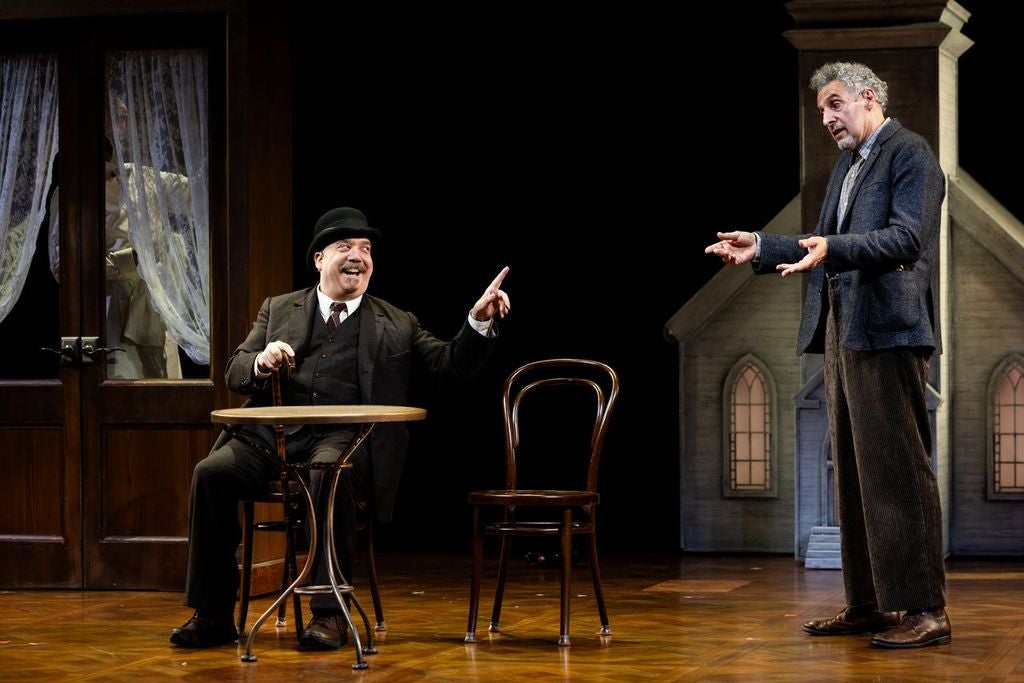
With a star-studded cast led by John Turturro (Bérenger), Paul Giamatti (Jean), and Tatiana Maslany (Daisy), the approximately two-hour production finds plenty of laughs in a story that is ultimately about something much darker: what happens when everyone around you decides to become the same.
The play follows Bérenger, an apathetic clerk in a small French town who watches in horror as his fellow citizens — including his closest friend and the woman he loves — transform into raging rhinoceroses. By the climax, Bérenger is left with choosing between remaining human and facing absolute isolation or surrendering his individuality to the crowd.

The rhinoceroses are, of course, more than rhinoceroses. Ionesco’s 1959 play uses the transformations as an absurdist metaphor for conformity and the rise of fascism in Europe. A.R.T.’s production makes that meaning clear without sacrificing the comedy that makes the story so entertaining.
Award-winning actor Turturro is at the center of that balance. His Bérenger begins as a detached, somewhat disheveled man who seems almost indifferent to the chaos unfolding around him. But as his friends and neighbors transform, that apathy gradually gives way to desperation.
Turturro is particularly effective at shifting between Bérenger’s fear and the absurdity of his situation, often interjecting an intense moment with a quick, witty line that gives the audience permission to laugh at what would otherwise be an unsettling scene.
Turturro also portrayed the emotional range behind Bérenger’s humor and established him as one of the production’s most relatable characters. In one scene, Bérenger breaks down in Daisy’s arms, revealing just how terrified he is of being left alone.
The moment switches Bérenger into the audience’s emotional anchor — as confused and frightened by the rhinoceros epidemic as they are, and the audience begins to feel his fear with him.
Three-time Golden Globe winner Paul Giamatti provides an upbeat, humorous energy as Jean, Bérenger’s best friend. Giamatti’s performance is filled with rapid-fire comedic timing, particularly early in the play when Jean and Bérenger exchange everyday, silly banter.
When Jean begins to transform though, Giamatti gradually makes him stranger and more disturbing, and his physicality becomes somehow both hilarious and unnerving.
Maslany gives Daisy a quieter but equally compelling character arc. As the rhinoceros epidemic grows, Daisy’s perspective on the situation becomes pivotal to the story, and Maslany effectively captures that character development. She brings a vulnerability to the role, particularly in moments when she stares toward the audience with tears in her eyes.
The production’s dialogue stands out as one of its greatest strengths. Characters repeatedly debate whether the rhinoceroses should be considered dangerous, whether becoming one is a personal choice, and who gets to decide what is normal.
In one particularly effective exchange, Dudard (Alex Ross), one of Bérenger’s co-workers, describes the transformation as a “disease” while questioning whether becoming a rhinoceros is actually immoral. Good and evil, he suggests, can become matters of “personal preferences.” It is the kind of conversation that initially sounds ridiculous. Then, a few seconds later, it becomes uncomfortable.
That is where “Rhinoceros” is at its best. The audience laughs at the absurdity of people transforming into animals, only to realize that the conversation underneath the joke is about something much more recognizable — how societies decide what is acceptable and how quickly something abnormal can become normal.
The production design largely supports that idea without overwhelming it. Costume designer Anita Yavich’s costumes fit the period naturally, looking as though they could have come straight from the characters’ own closets.
Scenic designer Riccardo Hernandez similarly kept the set simple, allowing the actors and dialogue to remain the focus. While the production could have used more movement within the set to help break up longer scenes, its simplicity ultimately works in its favor.
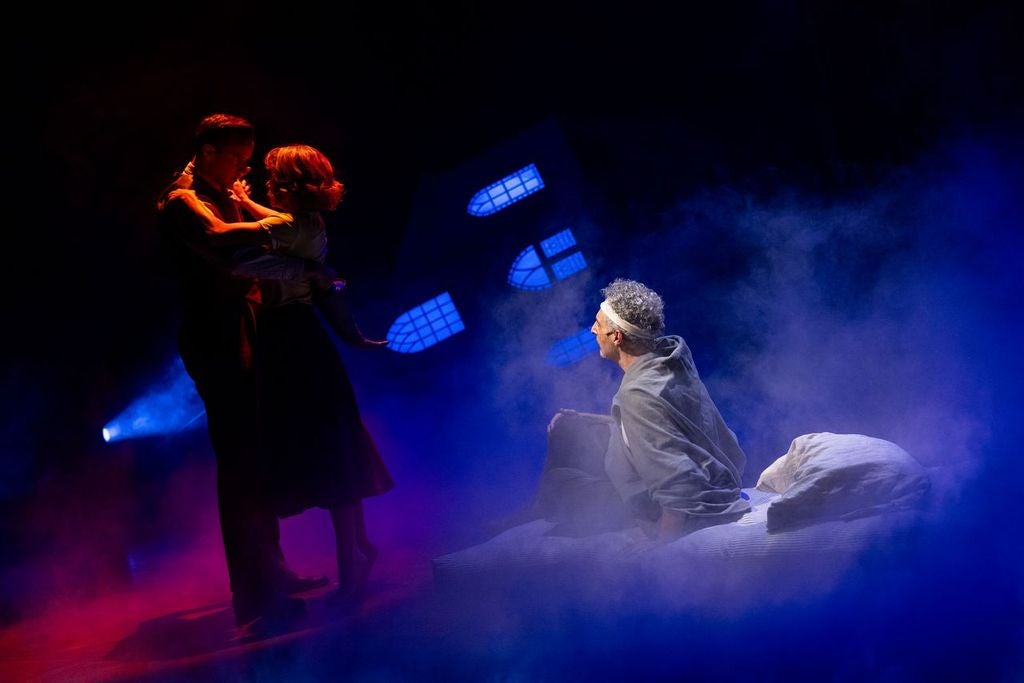
The lighting and sound design are especially effective when they create tension. Dark lighting, eerie sound effects, and ominous music gradually shift the atmosphere from comedic to horrifying as the rhinoceros disease spreads. These moments are some of the production’s most intriguing technical choices, making their limited use somewhat disappointing.
And that connects to the production’s biggest weaknesses: pacing. “Rhinoceros” is intentionally dialogue-heavy, and its humor and allegory depend on long conversations. But even strong dialogue can begin to drag when there is little visual or technical movement around it.
More frequent changes in lighting, sound, or staging could have given those longer exchanges more momentum and kept the audience engaged throughout.
Fortunately, the actors were usually able to bring the energy back with a sharp joke, quick exchange, or burst of physical comedy. The pacing issue is noticeable, but it does not overshadow a production that clearly understands what it wants its audience to take away.
“Rhinoceros” succeeds because it never loses sight of what makes Ionesco’s story so unsettling; the absurdity is funny precisely because the underlying reality is not.
The production’s strength predominately lies in what happens after the laughter fades. It’s the kind of show that leaves you thinking about the bizarre plot long after you leave the theater — and, more importantly, about what that plot is actually trying to say.
“Rhinoceros” will be playing at the Loeb Drama Center in Cambridge through Sunday, Sept. 27. Tickets start at $45 and can be purchased here.
Sign up for the Today newsletter
Get everything you need to know to start your day, delivered right to your inbox every morning.
