Local News
The Bunker Hill Parade takes place on Sunday.
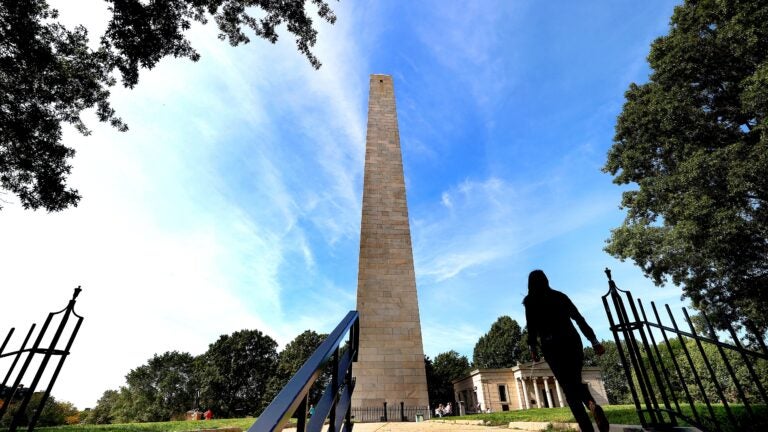
Bunker Hill Monument as seen on Sept. 30, 2025, under sunny fall skies. David L Ryan/ Globe Staff
Hundreds will march in the Bunker Hill Parade this weekend, commemorating the first major battle of the Revolutionary War.
-
Poll finds that as America 250 approaches, fewer Americans see U.S. as exceptional. Do you?
One of the longest-standing parades in the United States, the event honors the Battle of Bunker Hill fought on June 17, 1775. It begins at 12:30 p.m. on Sunday in Charlestown.
The 221-foot granite Bunker Hill Monument, completed in 1843, memorializes the battle fought 251 years ago as well as the birth of America 250 years ago. The National Parks of Boston, part of the National Park Service, is the caretaker of the monument, which is visited by more than 350,000 people annually.
On that fateful day more than two centuries ago, about 1,200 colonial troops fought the British to stop them from occupying the hills surrounding Boston. Parliament and the colony of Massachusetts clashed over unpopular taxes and tensions had risen for years, according to the NPS.
“It was fought by regular people who believed in a cause and died for it,” said Bill Foley, co-president of the Bunker Hill Monument Association (BHMA). “These were people that were fighting for democracy against tyranny.”
The colonial forces that day included farmers, merchants, African Americans, and Native Americans of all ages, Foley noted.
The Bunker Hill Monument made headlines recently when the National Park Service ordered three quotes removed from banners on the site featuring comments about slavery, immigrant contributions, and war memorials. Foley declined to comment about the ordered removal of the quotes.
“Censoring the contributions of any people that came before us would go against the very ideals that were fought for at this place,” Kristen Sykes, Northeast regional director of the National Parks Conservation Association, an advocacy group, told The Boston Globe. “Our national parks belong to all of us. Visitors deserve the chance to learn our struggles and triumphs alike, free of government censorship.”
The British won the battle, but it was “a very costly win,” Foley said. The British troops lost 1,054 men, while the colonial losses were estimated at about 450, according to the NPS. The battle weakened British forces and morale and they were forced to evacuate the city the following spring.
“It was a rude awakening for the British,” Foley said. “Of course the British were not only surprised but they probably felt demoralized because they were considered the number one army in the world.”
British and Colonial soldiers engage during a reenactment in celebration of the 250th anniversary of the Battle of Bunker Hill, Saturday, June 21, 2025, in Gloucester, Mass. (AP Photo/Charles Krupa)
The monument that marks the battle is actually not located on Bunker Hill, but on the adjacent Breed’s Hill.
There was a miscalculation when Col. William Prescott marched the soldiers on the land. The men went too far and set up on Breed’s Hill instead. Though the hills were confused, the battle has always been known as the Battle of Bunker Hill.
The battlefield was untouched for nearly 50 years, according to the NPS, before the BHMA was formed to stop a land owner from selling his portion for development. The group dreamed of creating a monument there instead.
John C. Warren, a doctor and nephew of a Battle of Bunker Hill veteran, formed the BHMA in 1823 with 25 friends. He bought the two acres for sale and then the organization bought 15 acres of the battlefield in 1824, according to the NPS. The group borrowed $25,000 from a bank to pay 10 owners for the land before raising $54,000 in private donations and $7,000 from the Commonwealth of Massachusetts, according to the NPS. The estimated cost of building the monument was about $100,000 (nearly $4 million today).
The Bunker Hill Day Parade marched down Bunker Hill Street to celebrate the 250th anniversary of Battle of Bunker Hill in 2025. – Heather Diehl for the Boston Glo
The BHMA held a contest for the best design and an obelisk was chosen. The cornerstone-laying ceremony for the monument was held on the 50th anniversary of the battle in 1825.
In 1826, the BHMA bought a granite quarry and began building the first horse-drawn commercial railway line in the country for transporting the granite blocks to the monument, according to the NPS. Complications with the railway delayed the beginning of construction to 1827. And then the funding ran out about two years later, when the monument was 37 feet tall.
Construction would start and stop a few more times due to hardships with fundraising.
After a five-year pause, work resumed in 1834 after the BHMA collected $3,000 from women and children through a special drive (accepting donations as small as 25 cents) and nearly $20,000 from the Massachusetts Charitable Mechanic Association, according to the NPS. But then, 17 months later, when the monument was 85 feet tall, construction stopped yet again for another five years due to lack of funding.
Enter Sarah Josepha Hale, who played a significant role in the fundraising efforts, Foley said.
The 19th-century editor, activist, and author of “Mary Had a Little Lamb” (a poem first published as “Mary’s Lamb” in her 1830 book “Poems for Our Children”) organized a women’s fair at Quincy Market and raised more than $30,000 to finish the job. (Side note: she was also the driving force behind making Thanksgiving a national holiday).
“She was a fascinating woman,” Foley said.
The monument was finally completed in 1843 after about 16 years.
“It was the largest monument built in the United States for veterans for many years,” Foley said.
Today there are about 400 members of the BHMA, Foley said. Visitors can learn more about the monument and battle at the Bunker Hill Museum, located across from the monument.
Foley has marched in the Bunker Hill Parade for 30 years and said last year’s celebration — for the 250th anniversary of the battle — was the largest ever. Thousands of spectators will line the streets of Charlestown this Sunday for the parade, which will include local marching bands, military personnel, historical re-enactors, and more.
The parade route goes from Vine Street to Bunker Hill Street to Main Street to Monument Avenue to Monument Square to Winthrop Street to Common Street. There will be a 5K run before the parade and a block party on Saturday.
“A lot of organizations come in from out of state. It’s always done very well,” Foley said.
Kristi Palma
Kristi Palma is the travel writer for Boston.com, focusing on the six New England states. She covers airlines, hotels, and things to do across Boston and New England. She is the author of the award-winning Scenic Six, a weekly travel newsletter.
Sign up for Scenic Six
Navigate the endless possibilities of New England travel with Boston.com.