An Ebola virus outbreak centered in Congo is suspected to have caused over 170 deaths and about 750 infections, according to the World Health Organization.
The outbreak is “spreading rapidly” in eastern Congo, with fears that it is much larger than initial figures suggested, Tedros Adhanom Ghebreyesus, director-general of the WHO, said on Friday.
“We are now revising our risk assessment to very high at the national level, high at the regional level and low at the global level,” he told reporters in Geneva.
Sign up to The Nightly’s newsletters.
Get the first look at the digital newspaper, curated daily stories and breaking headlines delivered to your inbox.
By continuing you agree to our Terms and Privacy Policy.
The WHO had earlier declared the outbreak “a public health emergency of international concern” and warned that it could last months, even if it was unlikely to pose a global threat.
The organization said on Friday that the increase in reported cases was partly because of improved monitoring and laboratory testing. But Tedros also warned that “violence and insecurity” in the region was making it harder to contain the outbreak.
The type of Ebola virus behind the outbreak, known as Bundibugyo, is rare. Fewer field tests for it are available, and it has no targeted vaccine or treatment, making it harder to contain.
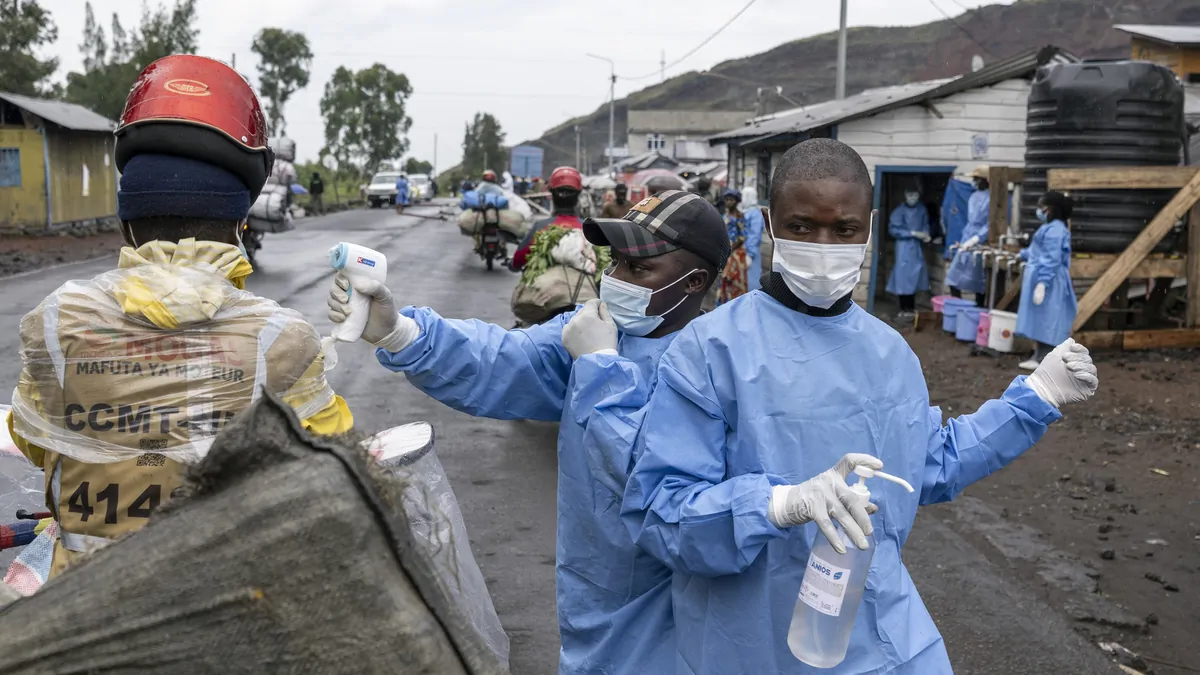
A health worker, deployed in response to an Ebola outbreak, takes the temperature of a truck driver passing through the Kanyaruchinya checkpoint at the northern entrance of Goma, Democratic Republic of Congo. Credit: ARLETTE BASHIZI/NYT
Where did the outbreak start?
It is not yet known exactly when this outbreak started, but it was first identified in May in Congo’s northeastern Ituri province.
Laboratory testing has definitively linked 82 cases to the virus, the WHO said. Two cases, including one death, have been confirmed in Uganda among people who had traveled to neighboring Congo.
Large numbers of people in Ituri have been displaced by conflict, and many migrant laborers are drawn to gold mines in the province. The WHO has said that population movement in the region increased the risk of the virus spreading.
The outbreak is mostly concentrated in two provinces, Ituri and North Kivu. On Thursday, M23, a rebel group that controls a vast stretch of territory in eastern Congo, confirmed a death in a third province, South Kivu.
Early surveillance and testing failed to identify the rare species of Ebola responsible for the outbreak, delaying the response from the health authorities. Dr. Samuel Roger Kamba, the Congolese health minister, said on Tuesday that people had delayed reporting symptoms and failed to take protective precautions when burying the dead, which had helped the virus to spread.
Are travel bans in place?
The U.S. State Department has “strongly” urged Americans not to travel to Congo, South Sudan or Uganda. It also announced on Thursday that all U.S.-bound passengers — including U.S. citizens and permanent residents — who were in those countries within 21 days of their arrival in the country must only enter through Washington Dulles International Airport for enhanced screening.
An order issued by the Centers for Disease Control and Prevention on Monday — which will stand for 30 days — allows the United States to bar foreigners from entering the country if they have been in Congo, Uganda or South Sudan in the previous 21 days.
An American medical missionary in Congo who tested positive was sent to Germany for treatment. The CDC said on Tuesday that an additional six Americans with potential exposure would be transported to Europe.
Uganda, which shares a border with affected provinces, has restricted travel to and from Congo and temporarily suspended all flights to and from the country. At least five nations in the region have started screening travelers or tightening border controls.
Is there an international relief effort?
Public health experts and health workers say that the response to the outbreak has been significantly hindered by the near-absence of the United States, which used to fund robust disease surveillance networks in the region.
The United States withdrew from the WHO in January, and the Trump administration shut the U.S. Agency for International Development, which has played a major role in containing previous outbreaks, last year.
Still, the State Department said this week that it was sending $23 million to Congo and Uganda that would go toward protective equipment and other resources. On Tuesday, it announced that it was funding up to 50 clinics and covering “associated frontline costs” in the two countries to help fight the outbreak
On Friday, the head of the U.N. humanitarian relief coordination agency said on social media that he had allocated $60 million to the response.
The European Union has pledged 100 tons of equipment, the Congolese Health Ministry said. The Africa Centers for Disease Control and Prevention, the public health body of the African Union, urged member states to support those efforts. South Africa’s government has pledged $2.5 million. Congo’s government has also set aside $20 million from its own budget to fight the outbreak, the Health Ministry said.
Ebola is an illness caused by a group of related viruses, known as orthoebolaviruses, first discovered in 1976 in the countries now known as South Sudan and Congo, in a region near the Ebola River. Fruit bats are thought to carry the viruses without being sickened by them.
Ebola outbreaks have mostly occurred in sub-Saharan Africa. Last September, health officials in Congo officially declared the country’s 16th Ebola outbreak since 1976. The largest recorded Ebola epidemic began in 2014, with cases in southeastern Guinea, Liberia and Sierra Leone, and lasted two years.
Four of the six known species of Ebola viruses cause illness in humans and can be fatal.
People stricken with Ebola may first experience so-called dry symptoms such as fever, aches, pains and fatigue before progressing to wet symptoms, including diarrhea, vomiting and bleeding, according to the CDC.
Health workers prepare medicine for patients with Ebola at the Rwampara General Referral Hospital, Ituri Province, in eastern Democratic Republic of the Congo. Credit: ARLETTE BASHIZI/NYT
Ebola can be contracted through contact with the bodily fluids of an infected, sick or dead person and through contact with contaminated objects such as clothing, bedding, needles or medical equipment.
The incubation period for the Bundibugyo species of the Ebola virus ranges from two to 21 days, and individuals are usually not infectious until symptoms manifest. But because the early symptoms — such as fever and fatigue — resemble those of other illnesses, including malaria, early detection can be difficult.
Vaccines and an antiviral drug have been approved for the Zaire species of Ebola, the most common one. But there is no vaccine or specific treatment for the Bundibugyo species.
The Bundibugyo virus was first identified in 2007 after a mysterious illness broke out in the Bundibugyo District in Uganda, which borders Congo. In 2012, another such outbreak was identified in Congo.
Fatality rates during the last two outbreaks of this form of Ebola have ranged from 30% to 50% of those infected, according to the WHO.
There has not been much research done on this species of virus, according to Dr. Jean-Jacques Muyembe, who leads Congo’s national institute of biomedical research and has been a pioneer in Ebola research and treatment. Speaking at a briefing on Tuesday, Muyembe suggested that vaccine candidates will likely be proposed in the coming days.
© 2026 The New York Times Company