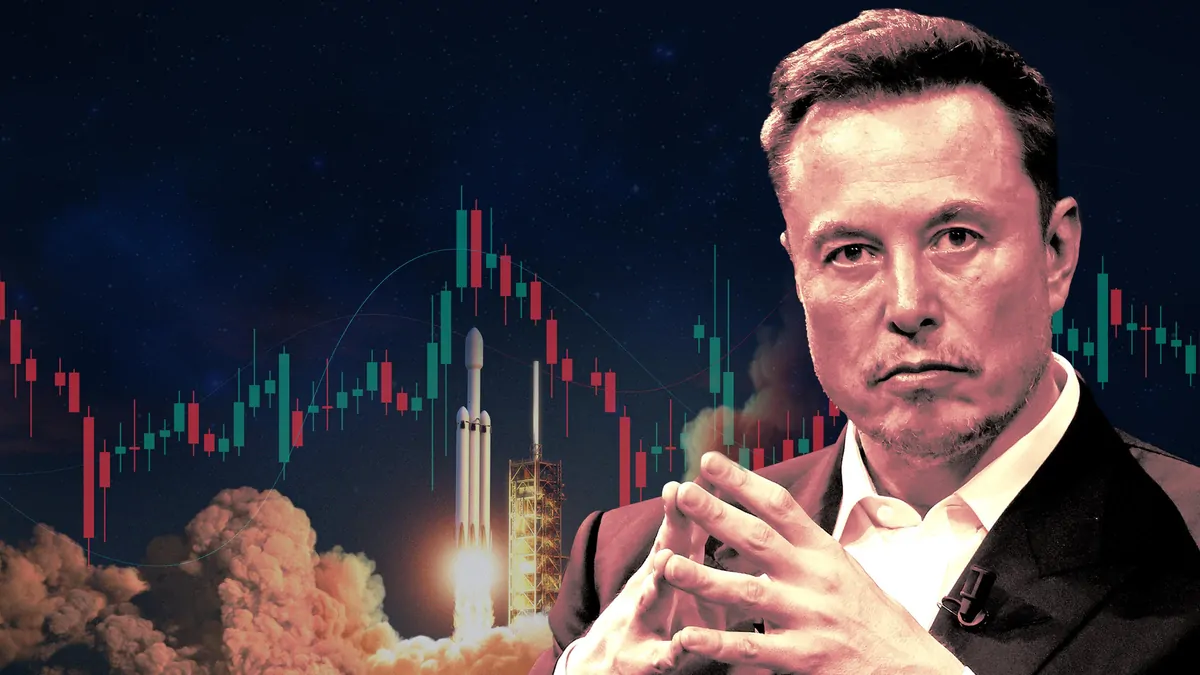
SpaceX, Elon Musk’s rocket maker and artificial intelligence company, set a price for its initial public offering on Wednesday of $135, which would value it at $1.77 trillion and crown it the largest IPO ever.
At that price, SpaceX would raise $74.4 billion from the offering, and its valuation would be more than 40 per cent higher than the $1.25 trillion that it valued itself at in February.
The current IPO record is held by Saudi Aramco, Saudi Arabia’s state-owned oil company, which was valued at $1.7 trillion and raised more than $29 billion when it went public in 2019.
Sign up to The Nightly’s newsletters.
Get the first look at the digital newspaper, curated daily stories and breaking headlines delivered to your inbox.
By continuing you agree to our Terms and Privacy Policy.
Most companies that go public set a preliminary price range for their stock offering before settling on a final number in case investor demand for their shares changes. But Musk and SpaceX sidestepped that and simply declared one price for investors.
SpaceX could still change that price but is not expected to do so. It is likely to begin trading on the Nasdaq next week under the ticker symbol SPCX.
At $74.4 billion raised, SpaceX’s IPO would be just about “more than every US IPO combined in the last two years,” said Matthew Kennedy, a senior IPO market strategist at Renaissance Capital.
A SpaceX spokesperson did not respond to a request for comment.
SpaceX’s IPO is a bellwether for other expected offerings that are set to be enormous, including from OpenAI and Anthropic, the artificial intelligence companies.
Anthropic confidentially filed to go public on Monday, and OpenAI is expected to file in the coming weeks.
Both start-ups have valuations approaching $1 trillion. The three offerings could unleash an avalanche of wealth across Silicon Valley and Wall Street, creating new corporate titans in the process.
Among the biggest winners would be Musk, 54, who is already the world’s richest man.
At $135 a share, the roughly 50 per cent stake in SpaceX that he controls would be worth just over $752 billion. (Musk cannot sell some of the SpaceX shares he controls until the company hits various operational milestones, according to the firm’s filings.)
A large increase in the company’s share price in its first days of trading could turn Musk into the world’s first trillionaire.
Musk, who founded SpaceX in 2002, has remade the space race with partly reusable rockets and transformed communication with the company’s satellite internet service, Starlink.
In February, SpaceX bought his AI company, xAI, which owned his social media platform, X, creating a conglomerate of the tech billionaire’s various interests. Musk separately runs electric carmaker Tesla, as well as other companies.
He has used SpaceX as a kind of piggy bank over the last two decades, securing loans from the company to himself and relying on the firm to shore up several troubled businesses in his orbit.
That was enabled partly because of Musk’s iron grip on SpaceX. He controls more than 85% of its shareholder votes because of a class of super-voting shares, according to the company’s filings.
SpaceX, which has contracts with NASA and other federal agencies, had long been something of a financial mystery.
Last month, the company revealed a full picture of its financial health for the first time in an IPO prospectus.
The company reported that it had lost more than $4.9 billion last year, compared with a $791 million profit in 2024 because of increased expenditures on AI. Revenue was $18.7 billion last year, up 33 per cent from the previous year.
The company plans to use the money it raises from its IPO to fund various moonshots, including Musk’s goals of putting AI data centres into orbit, building a lunar factory and eventually sending humans to Mars.
(The New York Times sued OpenAI and Microsoft in 2023, claiming copyright infringement of news content related to AI systems. The two companies have denied those claims.)
Nicolas Owens, an equity researcher with the investment research firm Morningstar, said that while SpaceX’s IPO was enormous, he would not be surprised if “the records are broken more than once”.
Companies like OpenAI and Anthropic have become larger than ever before going public.
“A trillion-dollar market capitalisation for a company going public used to be unheard-of,” he said, using a term to describe a company’s valuation. “Now it seems normal.”