Somewhere between the breaking and the mending, I met myself.
Not the self that introduces itself at dinner parties, answers emails, catches flights, pays bills and performs competence for the world. Not the self that accumulates accomplishments and anxieties, appointments and ambitions. I met an older self, a quieter self, a self that seemed to have been waiting patiently beneath all the noise of living.
It appeared only after certainty had been stripped away.
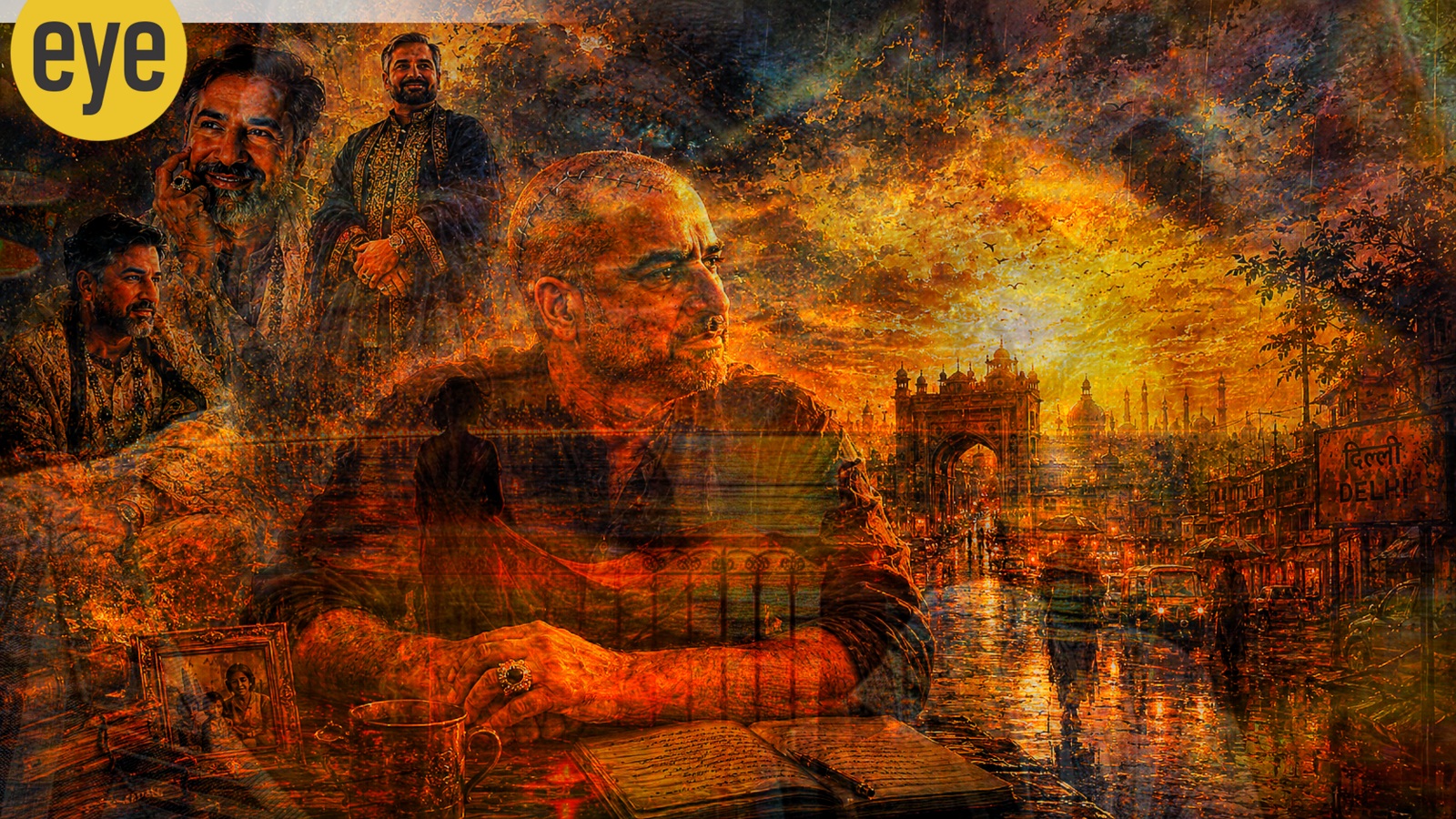
For the past several weeks, I have been healing in Delhi. Time has become both companion and caretaker. Rest, that ancient physician, has soothed what agitation once unsettled. The visible signs of struggle have softened. Strength returns in small, almost imperceptible increments. Recovery continues its quiet work, asking only patience in return.
Yet the deeper healing has happened elsewhere—in that mysterious territory beyond the body where suffering ripens into understanding and pain becomes less a punishment than a teacher.
Outside my window, the monsoon arrives and departs like a wandering mystic. Clouds gather in charcoal processions above the city. Rain darkens old terraces and washes dust from neem trees. Water beads upon bougainvillea blossoms like tears upon a beloved face. The city groans, glitters, floods, forgives, and begins again.
Every old city understands resurrection, and every old soul does too.
As I sat watching the rain one evening, a ghazal returned to me—not as memory but as revelation.
“Mire ham-nafas mire ham-nava mujhe dost ban ke daga na de.” (My companion, my confidant, do not betray me under the guise of friendship.)
At first glance, it sounds like heartbreak. A lament spoken from the ruins of trust. Yet sitting with it now, I hear something larger. I hear humanity speaking to life itself.
Life, do not disguise impermanence as permanence. Do not let me mistake certainty for truth. Do not persuade me that anything here can be owned forever.
Because perhaps every heartbreak begins with the same innocent misunderstanding.
We think things belong to us. A friendship. A dream. A season of ease. A future. A tomorrow.
Then life, in its fierce wisdom, reminds us that nothing truly belongs to us. Everything passes through us. The river never belongs to the riverbank. The bird never belongs to the branch. The dawn never belongs to the night. We are custodians, not owners. Pilgrims, not proprietors, carrying gifts briefly before passing them onward.
And yet what magnificent gifts they are.
What a staggering privilege it is to wake beneath a sky painted anew each morning, to hear a mother’s voice, hold someone’s hand, laugh until tears arrive, smell rain and jasmine after sunset, and be given one more opportunity to love well.
How easily we overlook miracles because they arrive disguised as ordinary days.
Pain restores our eyesight. It reminds us that what is common is often sacred and teaches us to notice what abundance concealed: the warmth of a cup held between grateful hands, the kindness of a stranger, the loyalty of a friend who arrives without being summoned, the astonishing resilience of a spirit determined to rise again.
Suffering is a ruthless teacher, but it is unforgettable.
“Main hoon dard-e-ishq se jaan-ba-lab, mujhe zindagi ki dua na de.”
I stand exhausted by love and pain; do not merely pray for more life for me.
Within that line lies an entire philosophy.
Because the goal was never simply to accumulate years. The goal was to deepen them, widen them, inhabit them fully. Longevity without tenderness is merely duration. Survival without wonder is merely existence.
The prayer was never for more time but for more meaning.
The challenge before every human being is not whether suffering will arrive. It will. No passport, profession, fortune, faith, or philosophy exempts us. Every life encounters grief, every heart knows loss, every soul walks through darkness.
The real question is what happens next: do we become smaller or larger, retreat into bitterness or expand into compassion, build walls or windows?
Anyone can become hard. Pain makes hardness easy. A betrayal can make us suspicious. A humiliation can make us guarded. A loss can persuade us to withdraw from the world altogether. Remaining open-hearted after disappointment requires far greater courage than closing ourselves against it.
The rose blooms despite winter. The ocean continues kissing the shore despite being pulled away twice each day. The earth offers spring after every season of barrenness. Creation itself is an act of optimism. Every dawn is the universe trying again.
And yet there are nights when despair feels persuasive. Nights when grief sits heavily beside us. Nights when loneliness arrives wearing the face of memory. Nights when we question not only others but ourselves. It is then that the ghazal reveals its deepest wisdom.
“Mire dagh-e-dil se hai roshni, isi roshni se hai zindagi.”
The light comes from the wounds upon my heart; it is this light that gives life its meaning.
There may be no more hopeful idea in all of human literature.
The light comes from the wound—not despite it, but because of it. The crack becomes a window, the scar a lantern, the broken place the birthplace of compassion. What seemed like an ending becomes an entrance. What appeared to be devastation becomes a doorway.
Look carefully at the people who have transformed your life—the wisest teacher, the gentlest physician, the most compassionate friend, the artist who gave language to your loneliness, the parent whose embrace steadied your world. Almost all of them have suffered deeply. They have buried dreams, survived disappointments, endured grief, and faced failure.
Yet somehow they emerged more loving, not less.
Their wounds became wells from which others could drink. Their suffering ripened into perspective. Their scars became maps guiding others through darkness.
That is the miracle.
Not that suffering exists.
But that love survives it.
Again and again.
Civilizations collapse and rebuild. Forests burn and bloom. Communities fracture and reconcile. Human hearts shatter and heal. The story of our species is not the story of suffering. It is the story of recovery.
Hope is not naïveté. Hope is memory—the memory of every dawn after night, every spring after winter, every generation that rebuilt, every soul that chose love after loss.
As healing continues, I find myself less interested in what happened and more interested in what it revealed. It revealed the generosity of friends, the devotion of family, the resilience of the human spirit, and the extraordinary capacity of people to begin again.
Perhaps that is where wisdom ultimately arrives—not at certainty, control, or invulnerability, but at gratitude.
Gratitude that we were allowed to love, to try, to fail, to forgive, to heal, and to begin again.
The wounds will soften. The scars will remain. The memories will find their proper place. Yet something larger survives every injury. Faith survives. Kindness survives. Love survives.
And so I choose hope—not because despair is absent, but because despair is not sovereign. I choose grace—not because the world is always gentle, but because gentleness is how the world heals. I choose love—not because it guarantees safety, but because it gives meaning to everything else.
The hand heals. The soul remembers. The heart remains open.
And somewhere beyond the rain, beyond the scars, beyond the sorrow, dawn is already gathering its light—as it always has, and as it always will.