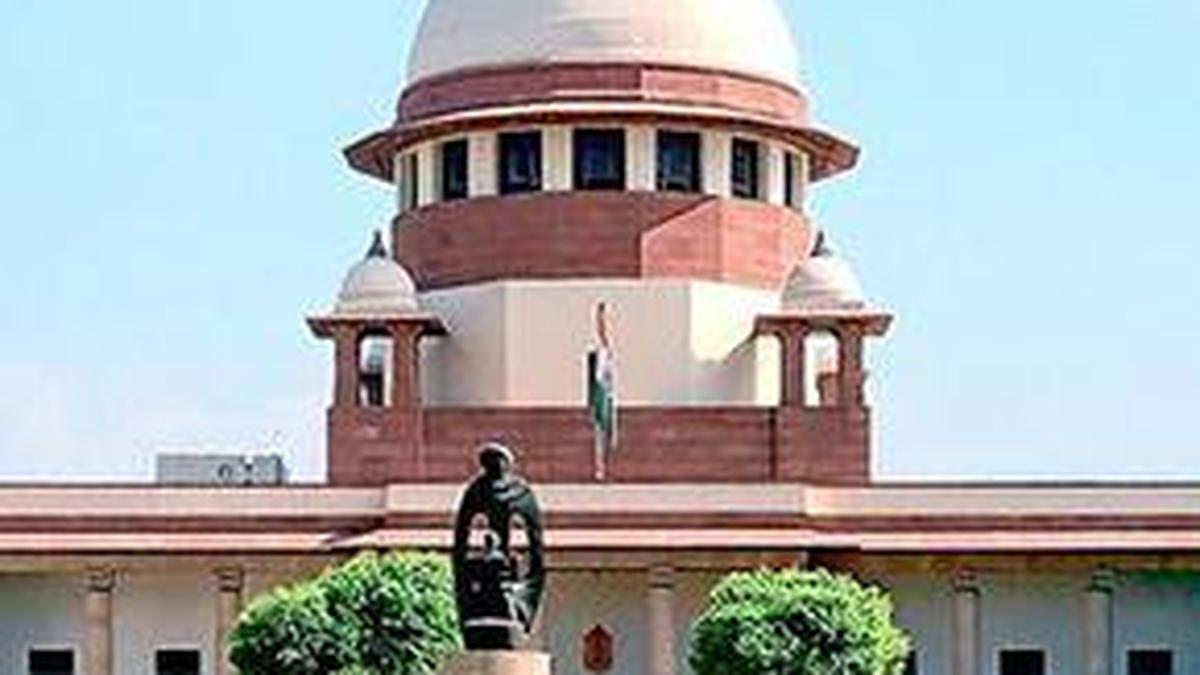
The Supreme Court is the custodian of the Constitution. Hence, it has been given such powers which could be exercised where the law is silent or is found incapable of grievance redressal.
| Photo Credit: S. SUBRAMANIUM
Another milestone in the direction of delivery of complete justice by the Supreme Court of India is its recent decision to elevate the Right to safe travel on National Highways as a fundamental right, declaring it an integral part of the Right to Life under Article 21 of the Constitution. The Court took suo motu cognisance of two road accidents in November 2025, which led to a loss of 34 lives and has issued wide-ranging directives. [In Re: Phalodi Accident vs. National Highways Authority of India and Others (2025)]. The Court has clearly held that safe, well-maintained, and motorable roads are no longer just a policy goal, but a constitutional obligation of the state. It is an alarming fact that while National Highways comprise only 2% of roads, they account for 30% of fatalities. In 2025, National Highways in India saw approximately 26,770 deaths in the first six months alone. The government aims to reduce road accidents by 50% by 2030 and to achieve this goal, it has adopted a strategy focusing on strengthening Education, Engineering (roads/vehicles), Enforcement, and Emergency Medical Service has been adopted. Despite fatalities on the National Highways decreasing by 11% compared to 2024, they still remain alarmingly high. These figures must have been a contributing factor in the Supreme Court’s decision while exercising its inherent power under Article 142 of the Constitution which talks about complete justice.
Inherent power of the Supreme Court
The Supreme Court is the custodian of the Constitution. Hence, it has been given such powers which could be exercised where the law is silent or is found incapable of grievance redressal. Such powers are not conferred by statute but are inherent to its role as the highest court, enabling it to go beyond strict procedural constraints to prevent injustice or abuse of process. Another condition to invoke Article 142 is a manifest error and non-exercise of it might lead to travesty of justice. The Supreme Court in Delhi Judicial Service Association vs. State of Gujarat (1991) has held that the power to do complete justice is entirely of different level and of a different quality. The Court further says that any restrictions contained in ordinary laws cannot act as limitation on the constitutional power of the Court.
Also read: Calling out the criticism of the Indian judiciary
The concept of complete justice
A pertinent question that comes to our mind is whether justice could ever be incomplete. If not, then why has the term ‘complete justice’ been incorporated into Clause (1) of Article 142 of the Constitution? Another question that may arise is whether High Courts may also deliver complete justice.
The power to deliver complete justice is residuary in nature and it may be exercised to ensure the observance of due process of law. This is an extraordinary jurisdiction implicitly vested with trust and faith that it shall be exercised by applying the principle of natural justice, i.e., fairness. The Court also recognises its significance, and therefore, held in Hitesh Bhatnagar vs. Deepa Bhatnagar (2011) that extraordinary care and caution shall be observed while exercising this jurisdiction.
Article 142 empowers the Supreme Court to pass any necessary order to deliver comprehensive, equitable justice, even if existing laws or procedural technicalities do not provide a specific remedy. This power acts as a “constitutional safety valve” to fill legal gaps. It is a well-established fact that the Constitution of India gives precedence to natural justice over other forms of justice. In a landmark judgment, the apex court, in Canara Bank vs. Debasis Das (2003), says that the Constitution intends to deliver substantive justice, which is the removal of injustices and it shall be delivered either by way of legal or natural justice. In a situation where legal justice is incapable of doing so, the principles of natural justice must be followed.
Complete justice and High Courts
The question of whether High Courts could also deliver complete justice may be answered on the basis of the Supreme Court’s decision in Anil Kumar Jain vs. Maya Jain (2009) in which the Court held that the powers of High Courts under Article 226 of the Constitution are certainly not at par with those of the Supreme Court under Article 142. However, justice is a wide concept and shall always be complete. Thus, the High Courts may also deliver complete justice, though in a more circumscribed manner than the Supreme Court, whose inherent powers under Article 142 serve as one of the tools for applying the concept of due process of law in rapidly changing social, economic, political and value systems within and outside India.
Cause for controversy
The exercise of Article 142 is often criticised as judicial overreach that undermines the principle of separation of powers. Critics point out that the Court bypasses the established laws and procedures and may encroach upon the domain of the Executive or the Legislature. However, such criticisms do not have much rationale. It is true that invoking Article 142 makes the judiciary more active. However, judicial activism involves the proactive and progressive interpretation of laws or constitutional provisions. Its constitutional intent is to deliver justice, be it social, economic, political or legal. The idea is to deliver substantive justice as said earlier. The problem arises when new and evolving social realities, such as live-in relationships or matters relating to homosexuality, emerge and established laws and procedures may prove inadequate to deliver justice. In such situations the Supreme Court, as the custodian of the Constitution needs to proactively take steps to ensure that complete justice is delivered. This is the reason why such powers have been dubbed inherent powers of the Court. In such situations the Court applies the principle of natural justice which is integral to the entire constitutional scheme of India.
(C.B.P. Srivastava is President, Centre for Applied Research in Governance, Delhi)
Published – May 27, 2026 07:00 am IST