Giannis Antetokounmpo. The name is being linked to the Boston Celtics like a moth to a flame on the heels of their ugly first-round playoff exit. The name that will inevitably be tossed around all summer until a trade unfolds.
And if no trade occurs, a name that will continue to be slung until the Milwaukee Bucks build a competitive roster again.
On April 8, a report from Sam Amick of The Athletic revealed that Boston is among the possible landing spots being mentioned behind the scenes:
“Even the Celtics, who have the ‘Two Jays’ back now and look fully capable of winning it all, are known to be interested and discussed in league circles as potential suitors.”
“There have been some rumblings at various points during the season that the Celtics could be a stealth Giannis team and a team that potentially interests Giannis. So let’s keep our eye on the Celtics. We know Brad Stevens is not afraid to make big moves and take big swings. So I think we have to be ready for just about anything with Boston.”
And on that same day back in April, I tweeted this:
If you’re the Celtics, trading for Giannis would be a mistake. Don’t care who they give up.
— Jack Simone (@JackSimoneNBA) April 8, 2026
I was wrong about a potential Antetokounmpo trade. I was wrong about why the deal shouldn’t happen. I was wrong about the Celtics not needing it. But I was wrong for a reason most people may not expect.
At the time, the Celtics were rolling. Their cohort of depth, Jaylen Brown‘s All-NBA campaign, and Jayson Tatum‘s return had them poised for greatness. Yet in the postseason, weaknesses were exploited, and problems emerged.
Regardless of the playoff result, the Celtics are a very talented basketball team. They were one of the best regular-season squads in the league, and their top-end guys are elite.
Tatum is a top-five player in the NBA when at full strength. This year, Brown proved he can hug the top 10 when the shots are falling consistently. Derrick White is an elite off-ball defensive connector. Payton Pritchard is a great isolation scorer. And the role players thrived this season, too.
Antetokounmpo is one of the most dominant superstars to grace an NBA basketball court in the 21st century. His ability to get downhill and attack is unlike almost anyone in league history, and, combined with his defensive talent, he’s an unquestionable all-time great.
Most importantly, he has an unstoppable move: His downhill ability.
Against the Philadelphia 76ers, all series long, the Celtics got beaten by the virtually unstoppable. Tyrese Maxey was too fast. Joel Embiid was too strong. Boston has no answers.
At his best, Tatum can provide that. He can find his spots and completely alter a defense’s coverage, creating wide-open looks for his teammates. When Brown’s mid-range feels good, he can inch closer to that level, too.
Past that, the Celtics are lacking.
Pritchard’s isolation scoring was a hallmark of Boston’s offense all year, yet when the postseason came around, it vanished. Outside of a monstrous Game 4, it felt like Pritchard faded into the background.
Whether it was his teammates icing him out or an internal lack of needed aggressiveness, Pritchard’s iso work didn’t show up as much as required under the bright lights of the playoffs.
© Benny Sieu
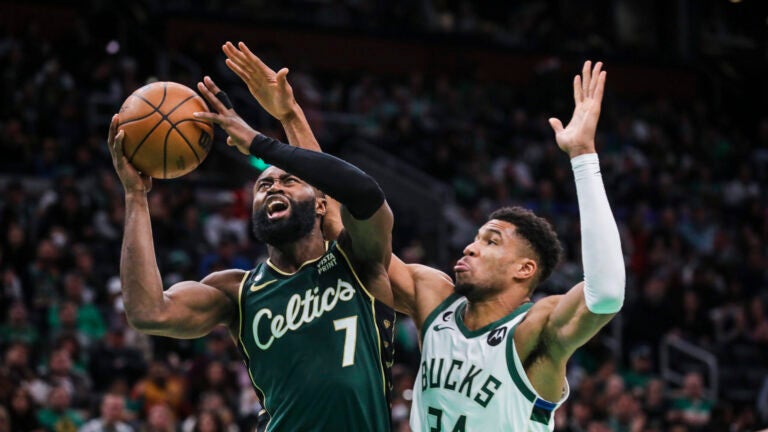
Giannis Antetokounmpo and Jaylen Brown
Brown’s MVP-caliber regular-season offensive skill set also seemingly shifted in the postseason. Philadelphia gave him little space. The mismatches he hunted disappeared, replaced by physicality and a twinge of embellishment to take away the push-offs that, for the most part, went uncalled prior to the postseason.
Even Tatum — by and large Boston’s most impactful player in the series — hasn’t exactly been the peak of efficiency throughout his playoff career. His offensive gravity is undeniable, forcing defenses to bend to his will, but the shot-making can come and go.
The Celtics could use a lot of things this summer. Another reliable big man, ideally someone who can bang down low more consistently. Extra ball-handling at the point guard position.
But perhaps most of all, they need more shot creation. Another guy who can go out and get his own, whether that be a role player or a star to pair alongside Tatum, Brown, or whoever remains after a potential trade.
Shot-making was the biggest problem for Boston in its series loss to the Sixers. It’s easy to point at 3-point shooting, but the real issue was the Celtics’ lack of a backup plan. Or, more aptly, that the backup plan failed.
For all the complaints about threes — not the primary issue in terms of process, but rather, results — the Celtics’ other shot-making methods completely faltered in the first round.
As a team, the Celtics shot just 40.0% in the mid-range. A measly 42.9% in the paint (non-restricted area). And from the corners — supposedly the easiest 3-point look available on the court — they shot 24.1%.
Boston shot an impressive 171.0% in the restricted area but attempted only 17.7 shots at the rim per game, largely due to their lack of big-man spacing. Philadelphia forced the Celtics to kick out, as they were often contested by multiple bodies in the paint.
Brown’s tough shot-making should have been a backup plan. Pritchard’s isolation scoring should have been a backup plan. Tatum’s gravity should have been a backup plan. But none of it was enough. And no one else on the roster could create consistently.
White has never been a self-creation guy, and even his catch-and-shoot looks weren’t falling this postseason. In theory, Nikola Vucevic could have helped in that regard, but he was played off the court by Game 7. So, who would be next up? Baylor Scheierman? Maybe at some point down the line, but not right now.
© Benny Sieu
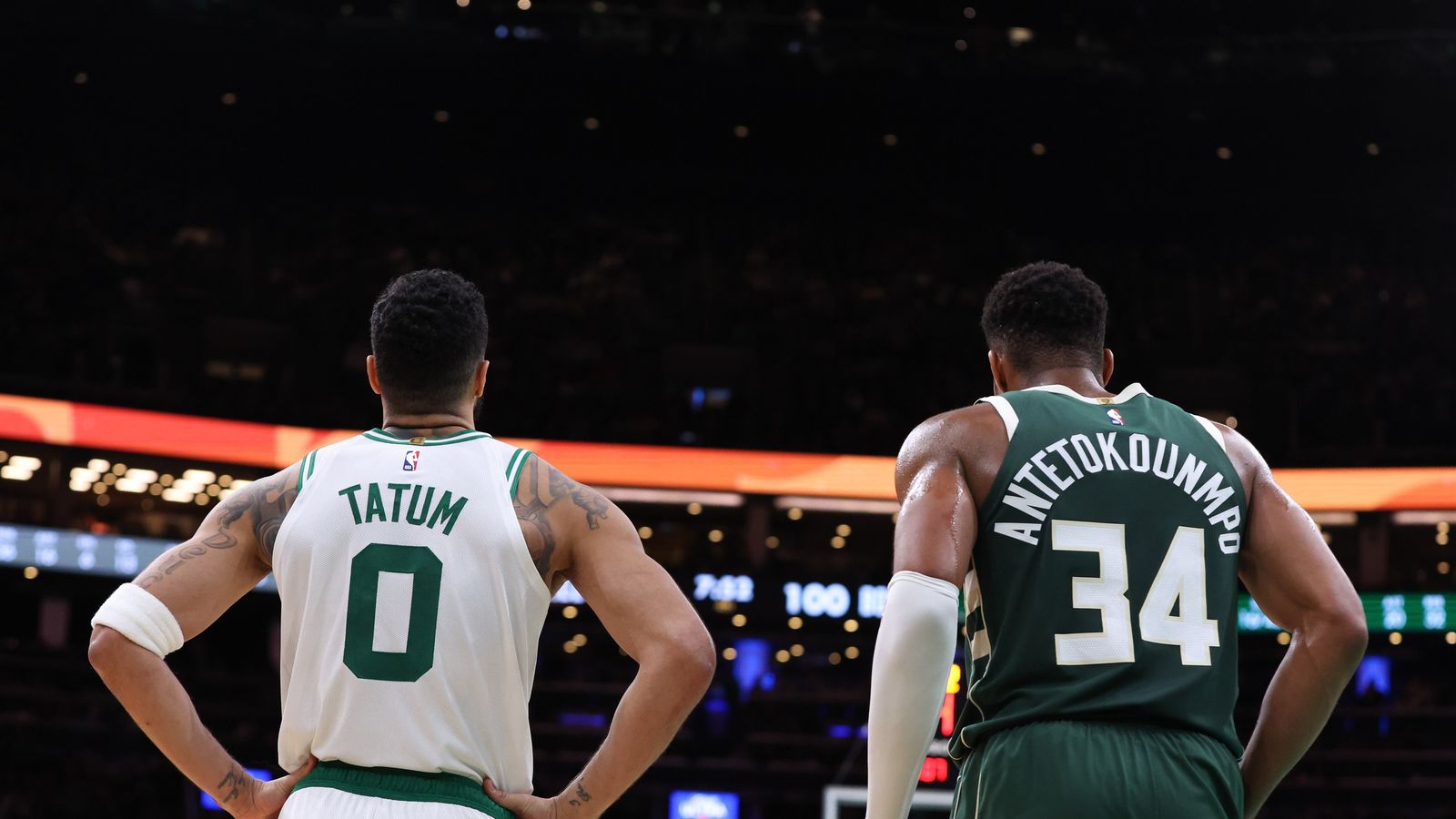
Giannis Antetokounmpo and Derrick White
If the shots are falling at even an average rate on catch-and-shoot looks, the lack of elite creation outside of Tatum and (sometimes) Brown is okay. But for the last two years, the shots haven’t fallen at an average clip. So, enter Antetokounmpo?
In the direct context of a trade, Antetokounmpo still may not make perfect sense. He is still on the wrong side of 30 years old, as he will turn 32 this December. He still doesn’t have the best (recent) track record of staying healthy in the postseason — Antetokounmpo missed the Bucks’ 2024 postseason and had his 2023 playoff campaign cut short — and his injury issues kept him off the court for much of this year.
There are inherent risks involved in an Antetokounmpo trade, and emptying the draft-pick farm for a player like that is always a questionable endeavor.
But the Celtics live in a different world than the one they lived in on April 8, when the first iteration of Antetokounmpo-to-Boston rumblings popped up.