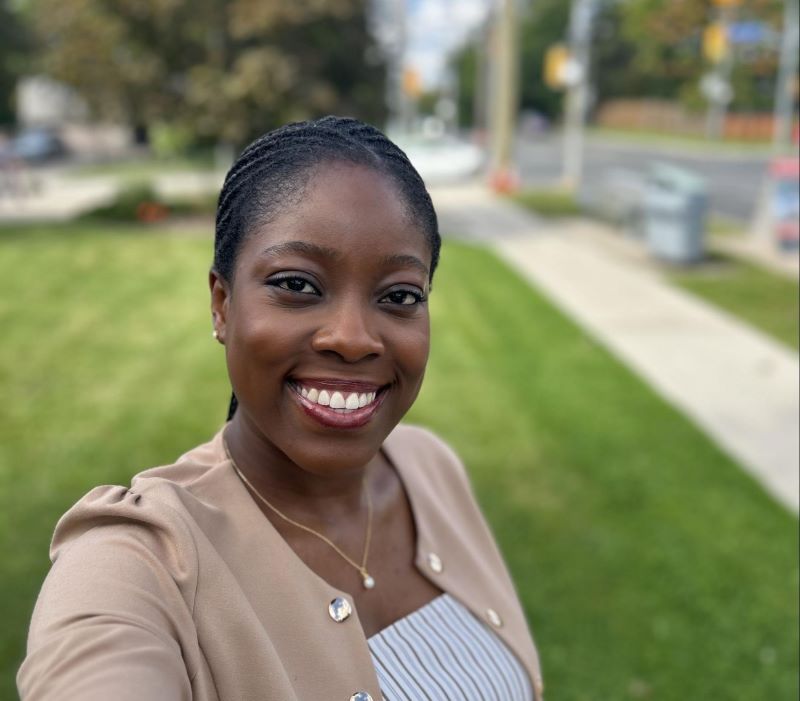
Every Nigerian who has ever “japa-ed” knows the drill. You pick your dream country, you apply, you pray about it, you tell your family, friends, and your church small group to keep it in their prayers too, and then you wait for that one email that decides the next few years of your life. For Chinenyenwa Ezeani, originally from Anambra State, that dream country was Canada. It just didn’t say yes to her, not the first time anyway.
An administrative professional in the property management industry, and outside of her corporate career, Chinenyenwa’s journey has taken her from Nigeria to the UK and now Ontario, Canada. Every move has come with its own lessons, challenges, and small victories. In this chat with FunTimes, she shares how her experiences, along with her Christian faith, keep shaping her into the woman she is today.
When did you leave Nigeria, and where do you currently live?
I left Nigeria in October 2022 to pursue my Master’s degree in the UK after receiving a scholarship. I lived in the UK for almost four years before relocating to Ontario, Canada, where I currently live.
What was life like in Nigeria before you decided to leave? What was the exact moment you knew you had to leave, even if it meant starting from scratch abroad?
Growing up, I always knew that I didn’t want to settle permanently in Nigeria. It wasn’t necessarily because of one defining incident or a particular moment when I decided, “I have to leave.” It was something I had known for a long time. I wanted to further my education, experience life outside Nigeria, and pursue better opportunities. After university, I started applying for Master’s programmes abroad. Interestingly, the UK was never really the plan. Canada was. I applied to several schools in Canada and was rejected by every single one of them. At the same time, I applied to universities in the UK, and eventually I received an admission offer along with a scholarship to pursue my Master’s degree. For me, that felt like God redirecting my path. The opportunity was there, so I took it. Looking back now, I’m genuinely glad I did because my years in the UK became such an important part of my journey, even though it wasn’t where I originally imagined myself going.
What route or pathway did you come through, and what was the process like?
My first move from Nigeria to the UK was through the student visa route. After receiving my admission and scholarship, I gathered all the documents required for my visa application and went through the process, which was relatively straightforward for me. By the grace of God, my visa was approved, and the rest, as they say, is history.
For Canada, however, I was much more intentional because it had always been my long-term goal. After completing my Master’s degree, I took time to properly research the Express Entry route and understand what would be required of me before starting the process. I planned financially and saved towards the different stages of the application, including making sure I could meet the required Proof of Funds. I took my IELTS, had my Master’s degree evaluated, obtained the required police certificates, and made sure I understood the requirements at each stage. Once I met the CRS score requirement, I entered the Express Entry process, eventually received my Invitation to Apply (ITA), submitted my permanent residence application, and, thankfully, it was approved.
It required a lot of research, preparation, patience, and money, but I was very deliberate about doing everything required of me. Eventually, the country I had originally hoped to move to years earlier became home – just through a completely different route than I had initially imagined.
What were the first few weeks like for you, settling in, adjusting, understanding the environment?
I was excited and nervous at the same time. This was my second time relocating internationally, but it felt different because I had to handle everything myself, packing up my life, arranging my belongings and cargo, and making sure everything was ready for the move. When I moved from Nigeria to the UK, my parents were there to help me with all of that, so doing it independently this time made the experience feel very different.
Surprisingly, settling into Canada wasn’t as difficult as I expected. One major reason was that I had already secured a job before relocating, which took a huge amount of pressure off me. I didn’t arrive worrying about finances or immediately having to start sending out job applications and waiting for interviews. I could focus more on actually settling into my new environment. There were still practical things I had to figure out, like getting my SIN, opening a bank account, understanding public transportation, getting my PRESTO card, and sorting out my health card. The welcome information I received when I arrived at the airport was really helpful because it explained many of the things newcomers need to do after landing. Having already lived in the UK also made a huge difference. I wasn’t experiencing life outside Nigeria for the first time, so I think I adjusted much faster. One thing I’m still getting used to, though, is how expensive things can be here. That continues to surprise me!
What were some of the biggest culture shocks you experienced and/or have been the hardest to adjust to?
When I first moved to the UK, one of the little things that surprised me was how strangers would smile at you simply because you made eye contact with them. I also noticed how quickly and efficiently many everyday processes worked. Another pleasant surprise was how affordable groceries could be, especially compared with what I had expected before moving.
Canada has been a different kind of adjustment. The biggest shock for me has definitely been the cost of living. Things can be very expensive, and honestly, I’m still not sure I’ll ever fully adjust to it! Another thing that took some getting used to was sales tax being added at checkout. You see one price displayed, get to the till, and suddenly you’re paying more than you had calculated in your head. Coming from the UK, where the price you see on most everyday items already includes VAT, that was definitely an adjustment.
What has been the hardest part of living abroad? Have you ever experienced loneliness or homesickness, discrimination, or felt misunderstood because you’re African?
Overall, I would say my experience living abroad has been a positive one. I haven’t personally had any significant experiences with discrimination or feeling misunderstood because I’m African, and I’m grateful for that. The time I feel homesickness the most is usually around Christmas. Growing up, Christmas meant being surrounded by family and travelling to our village to celebrate together. Living abroad, I don’t get to experience that in the same way anymore. I still connect with my family through video calls, but of course, seeing everyone through a screen isn’t quite the same as actually being there with them. That’s probably one of the moments when the distance really hits me.
What do you miss most about Nigeria that abroad simply cannot replace?
Definitely my family and the sense of community. There’s something about being surrounded by family and people who share the same culture and experiences that living abroad simply cannot replace. And, of course, Nigerian street food! You can find Nigerian restaurants abroad and even learn to recreate certain things at home, but there’s just something about buying street food back home that doesn’t quite taste or feel the same anywhere else.
How do you stay connected to your Nigerian culture while living abroad?
I stay connected to my culture in many little ways. I attend church, and I’ve made an effort to join Nigerian and Igbo communities wherever I live, because being around people with a shared cultural background gives me that sense of home and community. I also stay connected through Nigerian music, movies, and news, and I love attending Nigerian events and concerts whenever our artists are performing nearby. I still wear my Igbo traditional outfits as well. For me, living abroad has never meant leaving my Nigerian identity behind. I carry it with me and find different ways to remain connected to it wherever I am.
The decision to leave Nigeria is never simple. It costs money, relationships, and more. What did leaving cost you personally, and do you think it was worth it? What sacrifices did you make that people rarely talk about when they discuss “japa”?
Leaving definitely came with sacrifices. It meant spending less time with my parents and family, missing important moments and events back home, leaving friendships and familiar surroundings behind, and having to build parts of my life and career again in a completely different environment. There were financial sacrifices too, and I had to become much more independent because I could no longer rely on having my family physically close whenever I needed them. I think these are some of the things people don’t always talk about when discussing “japa.” We often focus on getting the visa, buying the flight ticket, and finally leaving, but there is an emotional cost to building a life thousands of miles away from the people and places you know. You gain new opportunities, but there are things you inevitably miss along the way.
For me, though, it has absolutely been worth it. The opportunities, experiences, personal growth, and life I have been able to build have made the sacrifices worthwhile. I wouldn’t change the decision I made.
Do you think social media gives a false impression of life abroad? What’s the biggest lie Nigerians believe about life abroad that you want to debunk?
I definitely think social media can give a false impression of life abroad because people naturally tend to share the better parts of their lives. You might see someone travelling, going out, buying things, or earning in pounds or dollars, but you don’t necessarily see the bills, taxes, cost of living, long working hours, job applications, rejections, or the amount of work it takes to build and maintain that life. One misconception I would really like to debunk is the idea that simply moving abroad automatically means you have “made it.” It doesn’t. Moving abroad can give you access to different opportunities, but you still have to work for them, and not everyone’s journey turns out the same way. Jobs are not automatically waiting for you, earning in a stronger currency doesn’t automatically make you wealthy, and life doesn’t suddenly become a bed of roses because you left Nigeria. The reality is that some people thrive abroad, some struggle for a long time, and some eventually decide that returning to Nigeria is the better choice for them. I think people need to approach relocation with realistic expectations rather than assuming that leaving Nigeria automatically guarantees success.
Do you ever regret leaving Nigeria, or feel like you made the wrong choice?
No, I don’t. There have certainly been challenging moments along the way, but I have never regretted leaving Nigeria or felt that I made the wrong decision. Looking at the experiences I’ve had, the opportunities I’ve been exposed to, and how much I’ve grown personally and professionally, I know it was the right decision for me.
What’s the advice you wish someone had given you before you relocated, but no one did?
I wish someone had told me to save more money before relocating. No matter how much you plan, there are always unexpected expenses when you’re starting over in a new country, so having more savings gives you a little more breathing room while you settle in. I also wish someone had told me to slow down and really enjoy my family and my time in Nigeria before leaving. When you’re preparing to relocate, you’re so focused on documents, packing, flights, and everything that needs to be done that it’s easy to forget that the everyday moments you’re used to, being around your family, seeing your friends, or simply being at home, are about to become things you may only experience occasionally. If I could go back, I would be more intentional about enjoying those moments before leaving.
Looking at your life now, is it everything you thought it would be when you were packing up your bags and leaving Nigeria?
Honestly, my life now is even better than I imagined it would be when I was packing my bags and leaving Nigeria. When I look back at where I started and everything that has happened since then, I’m incredibly grateful. I’ve earned my Master’s degree, grown professionally, become more independent, experienced life in different countries, and eventually made it to Canada, which had always been my goal. At the same time, I definitely don’t feel like I’ve arrived or achieved everything I want for myself. I’m still building, still learning, and still working towards bigger goals. I’m proud of how far I’ve come, but I also know there’s so much more ahead of me, and by God’s grace, I’ll get there.
If Nigeria became everything you hoped it could be in the future, would you pack up and go home?
Nigeria will always be home to me culturally. It’s where I’m from, where my family is, and such a huge part of my identity will always be rooted there. If Nigeria became everything I hoped it could be, I would definitely love to spend more time there and have an even stronger connection to home. However, I don’t think that would necessarily mean relocating permanently. I’ve built a life outside Nigeria, and my experiences abroad have also become part of who I am. So, for me, loving Nigeria and wanting the best for the country doesn’t necessarily mean that I have to move back permanently. Nigeria will always be home, regardless of where I choose to live.