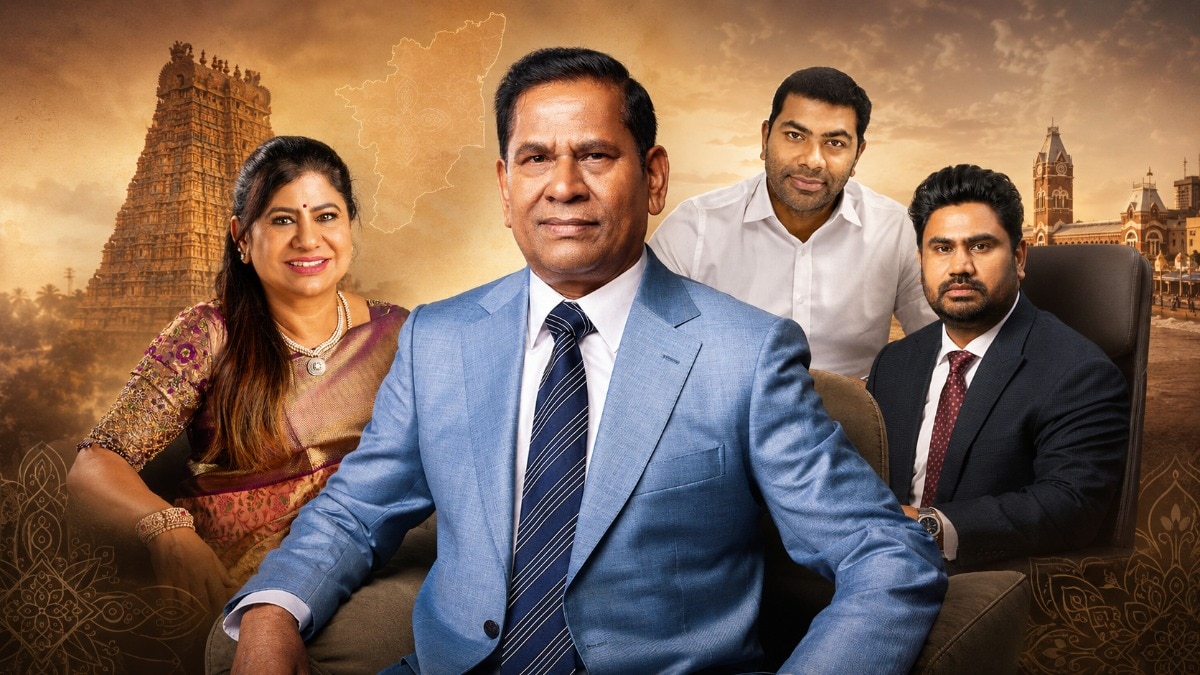
Tamil Nadu just witnessed the grandest lucky draw in its electoral history. Santiago Martin, the man they call India’s Lottery King, did not buy a single ticket, contest a single seat, or deliver a single speech. Yet his family walked away with the biggest prize of the 2026 elections. Wife Leema Rose Martin won on an AIADMK ticket from Lalgudi. Son Jose Charles Martin swept Kamaraj Nagar in Puducherry under his own Latchiya Jananayaga Katchi as part of the NDA. Son-in-law Aadhav Arjuna delivered Villivakkam for Thalapathy Vijay’s TVK.
Three different parties, two states, one extended family — a perfectly hedged political sweepstakes. While new Chief Minister Vijay settles into his chair and old warhorses lick their wounds, the real winner sits quietly in Coimbatore, smiling like a man who just cashed the ultimate ticket.
The draw that changed everything is not new. Across centuries, certain bloodlines have turned wealth into invisible empires, shaping nations from the shadows while selected or elected faces took the applause. Martin’s connections did not invent this game. They simply updated it for the age of electoral bonds, state lotteries and multi-party insurance.
Lotteries have always been more than games of chance. They are instruments of hope packaged as probability, sold by governments desperate for revenue and bought by citizens chasing destiny on cheap paper. From ancient Roman emperors distributing prizes to keep the masses docile, to European monarchs funding wars through public draws, the lottery has long been the tax on people’s dreams.
In the gambling dens of Las Vegas, it is said that the House never loses. Martin took this ancient impulse, industrialised it, and turned it into a cross-border machine that prints money while governments take the cut. In doing so, his own people joined a very old tradition — the quiet art of turning public fascination with luck into private political leverage. What began as a modest venture has grown into an intricate web of distribution networks, technology platforms and diversified holdings that span continents, proving once again that the House always finds a way to stay ahead.
WHEN BANKERS RULED THE WORLD
Lorenzo and Cosimo Medici ran Florence through debt, patronage and strategic marriages. (Photos:Getty Images)
Long before lottery tickets, bankers understood the real jackpot lies in controlling the palaces. In 15th-century Florence, the Medici bloodline mastered this better than most. Cosimo and Lorenzo rarely needed formal titles. They ran the city through debt, patronage and strategic marriages. Their bank became the Vatican’s financial heartbeat, producing popes and queens while Florence’s official rulers danced to Medici tunes. Shadow power at its finest — influence without the uneasy burden of the crown.
The Rothschild connections took the template global. Starting in the late 18th century, this remarkable tribe placed five sons across Europe’s financial capitals. When nations needed money for wars, the Rothschilds provided it — at a price. They helped Britain finance the fight against Napoleon, later played a decisive role in the Suez Canal purchase, and quietly shaped foreign policy by deciding who could borrow and who could not. Capital, not cannons, became their weapon.
Across the Atlantic, the Rockefeller bloodline turned oil into an empire. John D Rockefeller’s Standard Oil dominance gave his connections leverage over entire economies. Later generations used foundations and think tanks to steer policy without dirtying their hands in day-to-day politics. The Du Ponts built munitions fortunes, the Morgans financed railroads and wars, the Koch network poured money into shaping ideology. Even the House of Saud fused family rule with oil wealth into total control.
These were not mere rich men. They were architects of systems where elected governments became clients of. And somewhere in the background, one can almost hear The Godfather Don Corleone murmuring about keeping friends close and enemies closer — the Italian family ethos that the Medicis would have instantly recognised… and which Martin has replicated.
IN TAMIL NADU, FORTUNES FAVOUR FAMILIES AND FRIENDS
Students pay homage to a portrait of the late Karunanidhi. (File photo/ AFP)
Independent India offered its own variations. The Nehru-Gandhi lineage turned politics into inheritance. Three generations held the highest office, proving that charisma and name recognition could function like a family business. The fourth, consisting of a Queen Mother, Son and Daughter, is fighting vainly so far to perpetuate.
In Tamil Nadu, the pattern repeated with local flavour. DMK politics became a constellation of ‘nidhis’ — Karunanidhi, Udhayanidhi, Dayanidhi, Kalanidhi, Inbanidhi, Arulnidhi — each drawing strength from the original patriarch, their very names meaning “wealth” or “treasure” in a telling linguistic coincidence that hints at how political power and financial resources have long been intertwined in the Dravidian ecosystem.
AIADMK developed its own ‘karan’ ecosystem — Diwakaran, Dinakaran, Sudhakaran, Baskaran — orbiting the central star, where loyalty to the inner circle often translated into control over resources and influence. Sasikala’s Mannargudi connections earned the “mafia” tag, a blunt acknowledgement that blood and loyalty often trumped ideology. (If you have read my exclusive series, Time, Tide & Tamil here on India Today, you will have got a fair idea of this. If you have not, do check out from Part 35 onwards.)
FROM ROADS TO RICHES
M Karunanidhi and J Jayalalithaa defined Tamil Nadu politics for decades through one of India’s most enduring political rivalries.
In Chennai’s T. Nagar, at the threshold of a bustling street stand two fruit shops on either side, owned for decades by DMK and AIADMK partymen. As Karunanidhi and Jayalalithaa alternated in power, this symbolic conflict organically zoomed into a full-blown stranglehold. The two families — the Nithis and the Karans — gradually owned everything, with tentacles stretching from roadside teashops to television channels, and from terrestrial cables to satellite empires.
The DMK’s inner circle turned political inheritance into a professional business conglomerate that quietly swallowed large slices of the state’s economy. Alleged land grabs, loan-sharking operations, wineshop monopolies and prime real-estate deals became the invisible scaffolding that propped up the visible power of both. While the karans of AIADMK often relied on raw loyalty and proximity to the throne, the nidhis built their fortunes with corporate polish — media, movies, and money flowing in seamless, almost scientific sleaze, as Judge Sarkaria once wryly noted.
FROM CABLE TO CELLULOID
Kalanithi Maran and Dayanidhi Maran are among the most influential members of Tamil Nadu’s powerful Maran political-business family.
The Maran kindred, the patriarch’s grandnephews, turned Sun TV into a regional behemoth that dominated Tamil screens for decades. Sumangali cable is a virtual monopoly. They spawned the Dinakaran newspaper, magazines and a cluster of regional channels that shaped public opinion as effectively as any party manifesto. When family friction led to the launch of Kalaignar TV after the murderous Madurai fracas involving Azhagiri, the nidhis simply created their own parallel universe of news and entertainment, ensuring no narrative escaped their orbit.
Udhayanidhi Stalin’s Red Giant Movies extended the grip into cinema itself, reportedly controlling theatre allocations, release dates and distribution terms with a firmness that left many producers muttering about “one throat, many knives.” Even Kanimozhi, the articulate MP and daughter, carried the family banner into Parliament while the larger family maintained its iron hold over information and entertainment media. Print, digital, silver screen — every frame, every headline, every reel seemed to pass through this First Family’s carefully calibrated filters.
Stalin’s son-in-law, Sabareesan, has his own grasp on many ventures, notably PEN, a socio-political research organisation ‘committed to upholding democracy with a social scientific approach’. He reportedly has investments and ambitions in space technology, with a media report even calling him the Elon Musk of India. Quite hep indeed.
Professional, relentless, and always one step ahead of scrutiny, the Karunanidhi family played producers, partners, protectors, patrons and often, predators and punishers. They remain deeply entrenched in power, business and culture, their empire humming smoothly even when clouds of controversy — from 2G spectrum whispers to corporate share tussles occasionally gather overhead.
THE KARANS’ FLASH AND FADE
VK Sasikala and TTV Dhinakaran emerged as the most visible faces of the Mannargudi family network that wielded immense influence in post-Jayalalithaa Tamil Nadu politics.
On the AIADMK side, the karans — Dinakaran, Sudhakaran and the rest — operated with a more visceral, almost feudal swagger. Sasikala’s famed Midas touch turned proximity to Jayalalithaa into a goldmine of properties, bungalows and alleged backdoor deals. This included a brewery owned by benami fronts linked to the Sasikala family that supplied liquor to TASMAC, which made the Mannargudi connections the stuff of political legend. The 1995 wedding of her nephew Sudhakaran to Sivaji Ganesan’s granddaughter became the stuff of folklore — a Rs 3-crore extravaganza of silk, silver and state machinery that reportedly sealed public anger and contributed to Jayalalithaa’s 1996 rout.
Jaya’s own “I”-ness flared spectacularly when heroes crossed her ego; Kamal Haasan was told to approach “my court” instead of the High Court over Viswaroopam, while young Vijay had to trek to the Nilgiris and stand outside Kodanadu estate like a petitioner seeking permission for his film Thalaiva — a direct provocation in a land that tolerated only one head. It’s no wonder that as Karunanidhi and Jayalalithaa alternated in power, the flattering fraternity of filmdom was forced to organise grand felicitation functions – alternately.
Yet for all their flash, the karans fought, fragmented and faded once the central patron was gone. The nidhis, by contrast, perfected their reach in tune with the times, turned politics into a diversified portfolio and stayed firmly in the game. In the end, both families proved the same truth: when families treat the state like a family business, the real treasure is never the title — it is the quiet, unrelenting control of everything that moves, speaks, or screens in Tamil Nadu.
These were political families using the state machinery. Martin’s own people took a different route — they first funded the machinery and have now become the machinery themselves.
Martin — From Myanmar to Madras
Santiago Martin rose from a labourer in Yangon to the architect of a sprawling lottery empire whose political donations made him a quiet power broker across party lines.
Here the story loops back to Madras soil with a distinctly modern twist. Santiago Martin began as a labourer in Myanmar’s Yangon, toiling in the bustling streets far from the comforts of home. In 1988, he returned to India and started a modest lottery business in Tamil Nadu with little more than determination and a keen eye for opportunity. What followed was breathtaking expansion — first into Karnataka and Kerala, then into the Northeast, where he handled government lottery schemes with remarkable efficiency.
He later took the enterprise offshore by launching entities in Bhutan and Nepal, navigating regulatory landscapes that many considered impenetrable. The business diversified rapidly into construction, real estate development, textiles and hospitality ventures. Future Gaming and Hotel Services emerged as the flagship, becoming master distributor for several state government lotteries and eventually earning membership in the prestigious World Lottery Association.
Under Martin’s stewardship, the group ventured further into online gaming, casinos and sports betting, transforming a simple ticket-selling operation into a sophisticated, technology-driven conglomerate that operates across multiple jurisdictions. His charitable trust proudly notes an Apostolic Blessing from the Vatican — a symbolic parchment that quietly aligns this lottery empire with centuries-old traditions of patronage once enjoyed by the Medicis.
Martin’s connections did not put all eggs in one basket. Through Future Gaming, they became the largest electoral bond donor in the scheme’s short life, purchasing over Rs 1,368 crore between 2019 and 2024. The distribution was surgical: substantial sums to Trinamool Congress, DMK, YSR Congress, BJP and Congress. Deep pockets made them welcome in every major camp, turning financial contributions into quiet political insurance across ideological divides.
SOLD DREAMS AND BOUGHT TICKETS TO POWER
This is where Martin stands apart. Unlike banker dynasties or oil barons, he built his fortune selling ordinary people the dream of a sudden fortune. State lotteries became his domain. While governments earned revenue, his network handled distribution at scale. Alleged investigations by the Enforcement Directorate on money laundering and losses to state exchequers have followed for years, yet the business kept growing. Legal clouds have not dimmed the glow; instead, it has become part of the legend of a man who rose from labourer to lottery lord through sheer grit and strategic vision. The enterprise now spans physical retail outlets, digital platforms and diversified holdings that generate steady cash flows even as political winds shift.
His extended family’s assets tell their own story. Wife Leema Rose Martin declared Rs 5,683 crore, making her the richest candidate in the Tamil Nadu polls. Jose Charles Martin showed assets around Rs 609 crore. Aadhav Arjuna crossed Rs 534 crore. These are not mere businessmen entering politics. They are a family with stakes in the system itself, their wealth a silent testament to decades of calculated risk and relentless expansion.
THREE PARTIES, TWO STATES, ONE BIG WIN
Leema Rose, Jose Charles, and Aadhav Arjuna emerged as the Martin family’s three political pivots in 2026.
The 2026 results were clinical. Leema Rose won Lalgudi on an AIADMK ticket with a comfortable margin. Reports suggest she played a quiet role in softening AIADMK resistance toward TVK alignment. Jose Charles launched his own party, aligned with NDA, and won in Puducherry. Aadhav Arjuna, general secretary of TVK and married into the family, delivered Villivakkam decisively. Thirumavalavan of VCK, perceived to be close to Martin, extended support by handing over the letter to Aadhav, a former member of his party. One family, multiple flags, zero risk of total loss. A political portfolio perfectly diversified, proving that in the unpredictable arena of Indian elections, the smartest players spread their bets wide and keep their options open.
THE INDISPENSABLE DANGER
This is the crux. Nehru-Gandhi lineage, DMK nidhis and AIADMK karans operated largely within a single ecosystem. Martin’s connections flow across rival camps. They have funded parties that oppose each other. They maintain a presence in Tamil Nadu and Puducherry, in Dravidian, regional, national and even saffron circles. Such multi-party, multi-state influence makes them indispensable.
When every major player owes you gratitude or has cashed your cheques, confronting you carries risk. Deep pockets create soft power that elected governments ignore at their peril. The Martin bloodline has achieved what few business families manage — becoming the quiet constant in an otherwise volatile political equation.
Indispensable. And therefore, decidedly dangerous. In a democracy where money speaks in many tongues, a single family that whispers in every ear — and lines all pockets — holds a leverage that no single dynasty can match.
MACHIAVELLI AND THE PRINCE’S DILEMMA
Machiavelli understood that politics was never merely about kings and crowds, but about the invisible alliances that quietly shaped both. (Photo: Getty Images)
Niccol Machiavelli, writing in The Prince in the 16th century, understood such connections well. He advised the new ruler: “A prince must have no other object nor any other thought than war and its methods… because that is the only profession which befits one who commands.” But he also warned about hidden powers: “Men are so simple and so much inclined to obey immediate needs that a deceiver will never lack victims for his deceptions.”
Machiavelli, who lived among the scheming families of Renaissance Italy, knew that backers who lift a prince to power often expect to pull the strings later. In Chapter Nine, he cautions sharply: “One who becomes prince through the favour of the nobles has more difficulty in maintaining his position than one who becomes prince through the favour of the people, because the nobles are his equals and can therefore oppose him more easily.” He further warns the prince to watch his insiders and ministers with cold eyes, noting that even the most loyal-looking supporters may serve their own ambitions first
Sun Tzu, in The Art of War, offers equally sharp counsel on those close to power: “The wise warrior avoids the trap of over-reliance on allies whose loyalty is bought rather than proven,” and reminds that “there is no greater danger than trusting those who stand nearest when their interests diverge from yours”.
Indeed, is it not a telling truism that the fall of an individual or an institution is inevitably an inside job?
A THIN TIGHT ROPE
Vijay now inherits a state where charisma may win elections, but managing invisible centres of influence determines whether power endures. (Image: Reuters)
To the young Chief Minister Vijay, the new prince on the block, the message carries both counsel and caution. Cultivate strength, build your own loyal connections, and master the art of balancing forces. Yet never forget that those who fund the game can sometimes tilt the table. A Lottery Lord who sits above parties may prove an Achilles heel if left unchecked — or an invaluable ally if wisely managed.
The art of politics lies in ensuring that the indispensable never becomes the uncontrollable. Vijay must navigate this delicate balance, recognising that in the modern power raffle, the house may not always lose, but the prince who forgets the rules of the game risks losing everything he has achieved. After all, his path to power was a dizzying walk on jellies.
Martin’s family has won the biggest draw of 2026. The real question for Tamil Nadu’s future is whether the new prince can write the next chapter — or whether the ticket-sellers will keep printing the script. After all, the ‘Rose’ from another garden brings with it a bouquet of thorns too.
In the end, all politics remains a lottery. The wise man does not merely buy tickets. He learns to own the wheel.
– Ends
Published On:
May 17, 2026 07:00 IST