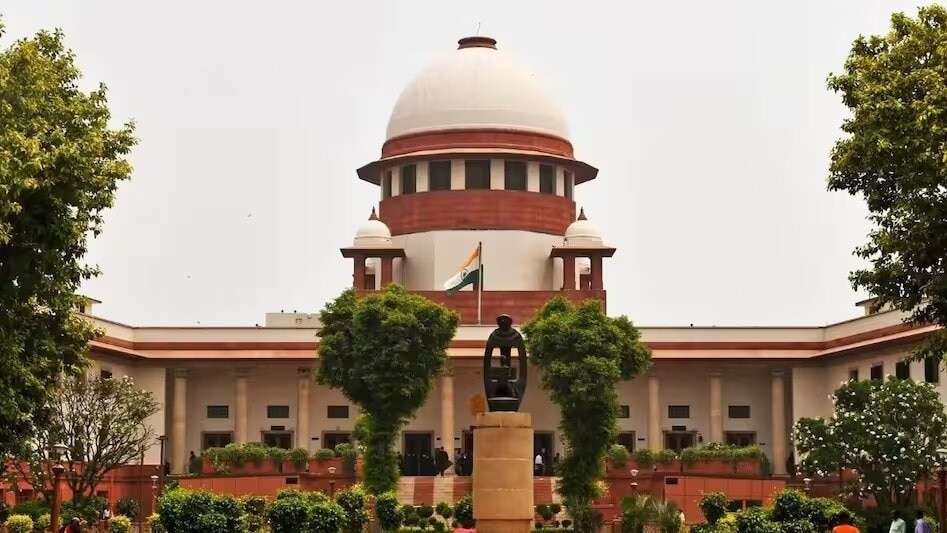
The Supreme Court on Thursday commuted the death sentence of a man convicted of sexually assaulting and murdering his six-year-old stepdaughter in Madhya Pradesh, but directed that he remain in prison for the rest of his natural life without the possibility of remission.
The bench of Justice Vikram Nath, Justice Sandeep Mehta and Justice Vijay Bishnoi upheld his conviction while replacing the capital punishment with life imprisonment till death.
The appellant, Waris, was convicted by the Special Court under the Protection of Children from Sexual Offences Act, Jaora, on December 17, 2018.
He was found guilty under Sections 376(2)(F), 376(2)(N), 376(AB), 302 and 201 of the Indian Penal Code, along with Sections 5 and 6 of the POCSO Act.
The trial court awarded him the death penalty for rape and murder, besides five years of rigorous imprisonment under Section 201 IPC for causing disappearance of evidence.
The Madhya Pradesh High Court subsequently confirmed both his conviction and death sentence. The case concerned the daughter of Waris’s third wife from a previous marriage.
The prosecution relied on the testimony of the child’s mother, medical findings and DNA evidence to establish the sexual assault.
The post-mortem examination revealed multiple injuries on the child’s body, with the medical panel concluding that she died from asphyxiation caused by throttling.
A DNA examination also found that male Y chromosomes recovered from the child’s clothes matched Waris’s Y chromosome DNA profile.
The child’s mother told the court that Waris had sexually assaulted her daughter on multiple occasions and subjected her to physical violence.
She said that on April 21, 2018, he assaulted the child and sexually abused her.
The following day, after hearing the child’s muffled cries, she found Waris withdrawing his hands from the girl’s neck. The child subsequently collapsed.
Waris’s alibi was rejected by the High Court after it found inconsistencies between his evidence and that of his defence witnesses.
The court also noted that the people he claimed to have been with on the relevant date were not produced as defence witnesses.
The courts further found that Waris had attempted to conceal the crime. He did not take the injured child for medical treatment, concealed the clothes she had been wearing during the sexual assault and attempted to have her body cremated before the police were informed.
While the High Court had treated the case as falling within the “rarest of rare” category, the Supreme Court took a different view on the appropriate sentence.
It observed that “the gravity of the crime, and in particular the sustained sexual violation of a child by her guardian and her killing to conceal that violation” made ordinary life imprisonment with the possibility of remission after 14 years inadequate.
The Supreme Court therefore ordered that the sentence be converted to imprisonment for the remainder of Waris’s natural life, making clear that “no remission shall be granted”.
The conviction remains intact, and Waris will consequently remain incarcerated for the whole of his natural life unless the sentence is altered through a subsequent judicial or legally permissible process.
– Ends