Elon Musk is an ideas man. And, whether you like it or not, some of those ideas will shape the future of humanity.
Before writing that statement off as hyperbole, go visit the website of Space Exploration Technologies Corp., trading as SpaceX, the company Musk founded 24 years ago in California.
SpaceX is a hot topic of conversation in this part of the world, after the upper stage of one of the company’s Starship rockets was recovered in a dramatic operation off Christmas Island
Sign up to The Nightly’s newsletters.
Get the first look at the digital newspaper, curated daily stories and breaking headlines delivered to your inbox.
By continuing you agree to our Terms and Privacy Policy.
The 13th Starship test flight lifted off from Starbase on July 24 local time and was never meant to be recovered.
Previous test flights had either not survived the immense heat of re-entry or quickly broken up and sunk in the ocean after a controlled splashdown, but Ship 40 was the first to arrive intact, remain floating and transmitting data back to SpaceX.
Assuming safe passage aboard the heavy-lift vessel Boskalis Forte all the way back to Musk’s Starbase in Texas, Ship 40’s unexpectedly long mission could prove to be a boon for SpaceX’s ambitions to create a reusable rocket program.
Talking about ambitions, it’s hard to imagine the tabs across the top of any other company’s website holding more promise.
In no particular order you’ve got a groundbreaking global communication network, human spaceflight aimed at colonising alien planets, a space-based national security product, artificial intelligence and an initiative designed to spare the Earth from AI’s growing demand on our resources.
Parsing how all of these endeavours fit together, and SpaceX’s chances of successfully pulling them off, is a fascinating exercise.
Determining whether some of them should happen at all is a philosophical one that’s just as important.
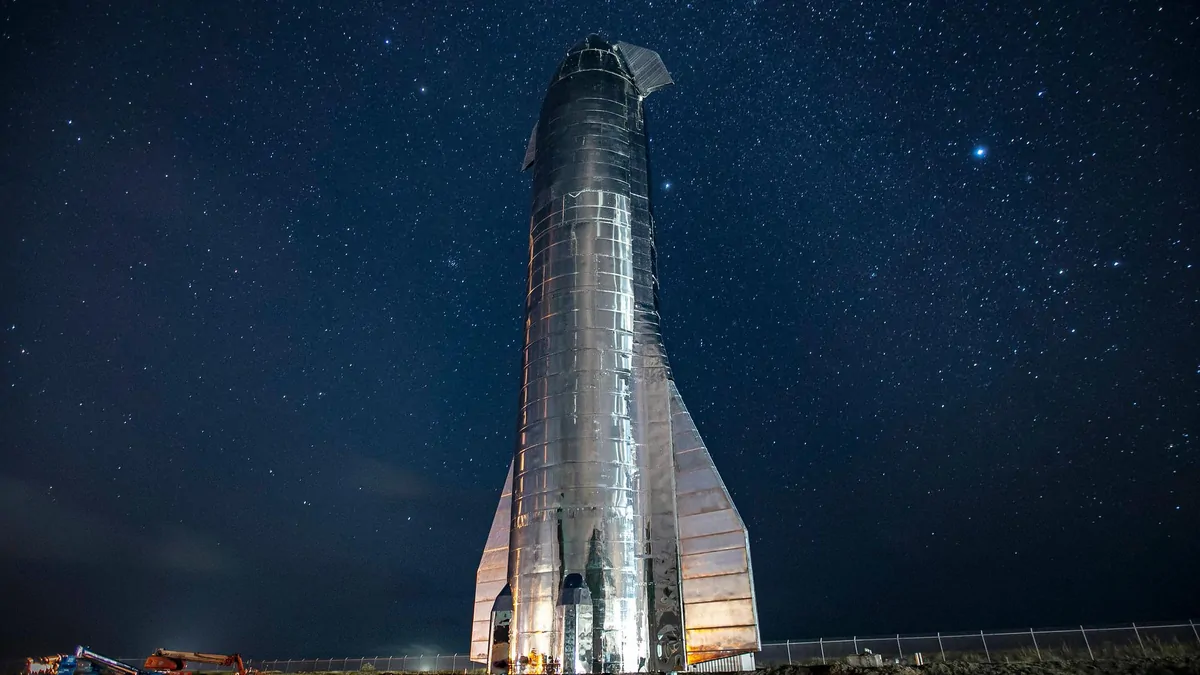
SpaceX Starship SN9 High-Altitude Flight Test. Credit: SpaceX
Starship
Christmas Island locals got an up-close-and-personal look at the upper stage of the largest rocket ever built, which underpins SpaceX’s aspirations amongst the stars.
Unlike the now-defunct NASA Space Shuttle, which required refurbishment at great expense before returning to space, the Starship program is aiming for rapid reuse to make space travel cheaper.
The Starship upper stage and Super Heavy rocket stand 124m tall and are designed to carry 100 metric tons into orbit, and, eventually, a crew of 100 people on long-duration interplanetary flights.
SpaceX will test a Starship lander for potential use in NASA’s Artemis moon mission next year, before a crewed mission to the lunar surface in 2028.
It will give the company another data point in its broader mission to reach the Martian surface, although Musk has said this will take a backseat to pursuing earlier opportunities on the Moon.
In an earnings call this month for SpaceX, Musk waxed lyrical about building factories on the Moon, made possible through the Starship program, and it’s not hard to see the appeal.
A report by Deloitte last week estimated the lunar economy could be worth as much as US$566 billion by 205, and the spin-off benefits could double that to more than US$1.1 trillion.
However, colonising Mars has been the great dream of Musk’s life, and, having pulled SpaceX back from the brink of bankruptcy, he’s not about to give up on that dream easily.
After NASA Administrator Jared Isaacman observed in July that SpaceX’s focus on the Moon would push back any mission to Mars, Musk took to X, the social media platform he owns, and promised to have “people on Mars in roughly five to seven years. Mars lander a few years sooner”.
The endgame, according to SpaceX, is a self-sufficient city of one million people on Mars, with “several thousand Starships” launching 10 times a day, making the 225 million kilometre journey in about six months.
SpaceX Starship Full Stack Taken on January 9, 2023. Credit: SpaceX
Starlink
From providing critical communications in war-torn Ukraine, after existing infrastructure had been destroyed, to allowing West Aussies to watch the footy while camping on a remote beach north of Kununurra, Starlink has connected the world.
But this revolution in providing high-speed internet access in remote areas, achieved by pointing a small, flat “dish” at the sky, doesn’t come cheap.
Starlink connectivity is made possible by a so-called “mega-constellation” of small satellites, which, as of last week, had exceeded more than 11,100 in orbit around the Earth.
That’s approximately 75 per cent of all active manoeuvrable satellites in orbit around our planet, and SpaceX plans to launch even more.
Another 27 entered orbit last week aboard a SpaceX Falcon 9 rocket, marking the 100th Falcon launch so far this year, of which 77 have been carrying Starlink payloads.
Starlink may ultimately hit 42,000 satellites if Musk gets his way, but critics have expressed concern at the sheer volume of SpaceX objects that may one day encircle the planet.
Which brings us conveniently to Musk’s next big idea.
SpaceX Starlink Mission Taken on September 18, 2022. Credit: SpaceX
Starmind
If you thought Starlink was a mega-constellation, Starmind makes it look positively pedestrian.
Musk has revealed plans to place a constellation of one million satellites in a sun-synchronous orbit around the planet, to harness solar energy to power space-based AI data centres.
High-bandwidth lasers will beam data processed by these orbital AI satellites back to Earth, just as Starlink currently does for communications.
The goal, as stated by SpaceX, is to scale up AI capability dramatically, without the serious drawbacks of doing so on Earth in terms of the energy and water requirements of terrestrial data centres.
There’s just one catch – a lot of people aren’t all that enthusiastic about a sky full of SpaceX AI satellites.
The human eye can see about 2500 stars in the night sky under ideal conditions. If Starmind goes ahead, those stars will be greatly outnumbered by Musk’s satellites.
And that’s not even getting into the impact on astronomy or future space travel.
SpaceX acknowledges if not exactly assuages these concerns on its website.
“By prioritising safety and long-term orbital sustainability, SpaceX ensures that our growing AI satellite constellation benefits humanity while protecting the space environment for future generations,” the company promises.
SpaceX expects to launch its first AI1 satellite in late 2027, with full-scale deployment coming the following year.
Tesla founder Elon Musk. Credit: Samuel Corum/Getty Images
Grok
Having been one of the 11 original founders of OpenAI, the company behind ChatGPT, Musk’s interest in developing AI was always obvious.
It began first with the generative large language model Grok, named after a word coined by the American sci-fi author Robert A. Heinlein, which means to understand something profoundly and intuitively.
Ironically, this was the one thing the Grok chatbot was terrible at in its early iterations on Musk’s X platform, promoting pro-Hitler conspiracy theories and creating non-consensual, sexualised images of women and children.
Grok and its parent company, xAI, was acquired by SpaceX in February as part of a US$250 billion merger that brought Musk’s key tech companies, including X, under one umbrella.
In addition to producing frontier models to keep pace with OpenAI, Anthropic and other competitors at the cutting edge of AI, Grok is now also the beating heart of Starlink, handling more than 15,000 inbound support and sales calls every day and fulfilling over 3,000 orders each week.
Grok logo displayed on a tablet screen. Credit: Sheldon Cooper/SOPA Images/LightRocket via Getty Images
Terafab
Earlier this year SpaceX announced its intention to build the world’s largest chip manufacturing facility in Grimes, Texas, to not just rival but exceed the AI chip production of Taiwan and China.
With a 90 million square metre footprint, Terafab will look like something from a sci-fi movie and require approximately US$16.8 billion in capital investments from SpaceX and Musk’s car company, Tesla, which will also depend on the chips it makes.
It will employ 3000 people and house the manufacturing, packaging, and testing of advanced logic and memory devices.
SpaceX Terafab. Credit: SpaceX/SpaceX
Starshield
Starshield is a secure, militarised satellite network designed for government and national security use, which leverages SpaceX’s commercial Starlink technology and launch capabilities.
The Pentagon is a customer and earlier this year it was revealed the UK Ministry of Defense transitioned operational communications to the service.
Reports revealed US attack drones hitting Iranian targets in March were satellite-guided by Starshield, and New Zealand’s Defence Force has admitted it is testing the system.
Having scrapped a previous proposal for developing a sovereign satellite communications capability, the Australian Defence Force probably is too.
SpaceX executives at the Nasdaq closing bell ceremony on the day of the companys initial public offering in New York, June 12, 2026. Credit: ANDRES KUDACKI/NYT