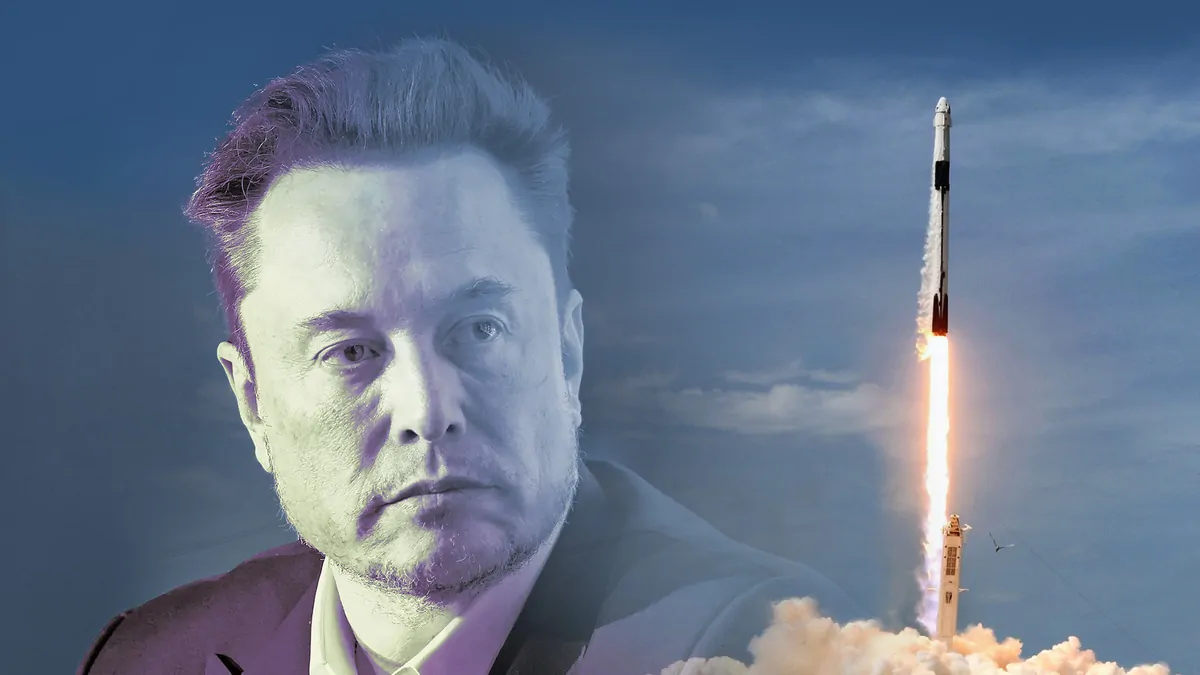
Elon Musk will become humanity’s first trillionaire through the share market float of his space rocket and artificial intelligence company, SpaceX, according to a top Australian technology investor, Martin Rogers.
SpaceX filed an application this week to list on the Nasdaq at a prospective valuation of $US1.75 trillion ($2.45 trillion) to $US2 trillion.
As the founder and 42 per cent owner of SpaceX, Mr Musk’s stake is worth at least $1 trillion based on the valuation of his financial advisers, a figure that will be tested if the company begins trading in about three weeks.
Sign up to The Nightly’s newsletters.
Get the first look at the digital newspaper, curated daily stories and breaking headlines delivered to your inbox.
By continuing you agree to our Terms and Privacy Policy.
“He’ll become a trillionaire; that’s for sure,” said Mr Rogers, the founder of investment fund KTM Ventures.
“The big way to lose money is to bet against Elon Musk.”
Mr Musk’s holdings in his other business ventures, including Tesla, are worth about $475b, an amount that makes him not only the world’s wealthiest person, but potentially the richest person in history who did not derive their wealth from controlling a nation or empire.
Oil baron John D Rockefeller, who died in 1937, is often cited as history’s richest capitalist. Controlling 90 per cent of US oil refining in the early part of last century, his wealth is estimated in contemporary terms around $400b.
The second-richest person alive is Google co-founder Larry Page, who is also worth about $400b, according to the Bloomberg Billionaires index.
Investors’ opportunity
The shift in the source of most of Mr Musk’s wealth from Tesla to SpaceX is due to the rise of artificial intelligence and investors’ belief it represents one of the greatest investment opportunities in history.
Three months ago SpaceX bought Mr Musk’s three-year-old AI startup, xAI, for about $350b in shares. The deal transformed SpaceX from a government contractor supplying space stations into an AI leader through its ownership of Grok, an AI chatbot on the X social media site.
SpaceX’s predicted valuation stretches far beyond almost any conventional company. Still unprofitable, last year it generated $26b in revenue, a little more than Westpac Bank, which is valued at less than one tenth SpaceX’s anticipated market capitalisation.
Mr Musk will maximise SpaceX’s value through a form of legal market manipulation. Approximately 5 per cent of its shares will be available for investors to buy. Too little supply being chased by strong demand could drive the shares up.
The company is contributing to the hype by claiming that its theoretical maximum revenue, based on controlling all the markets for its services, is $40 trillion, or about a quarter of the global economy.
Deca-trillionaire
While such a figure might seem absurd, a US fund manager and early Tesla investor, Ron Barron, last week said SpaceX could eventually be worth $14 trillion to $42 trillion.
“This is going to become the largest company on the planet,” he told the CNBC TV network.
At such valuations, Mr Musk would be the first deca-trillionaire. Extending the boundary of individual wealth to such levels could trigger a debate about the technology, capitalism and global inequality.
Even tech pioneers worry that the wealth being accumulated by Mr Musk and other entrepreneurs could give them too much power in societies struggling with political fragmentation, low birth rates and a growing gap between rich and poor.
“Nobody needs $1 billion and I do not think there is any reasonable argument that any human needs this much money,” said Daniel Petre, an Australian venture capitalist who was once a senior executive at Microsoft, which made Bill Gates into the richest man in the 1990s.
“When you get the hundreds of billions you get people with enormous power to shift democracy. It is not clear that in all (or maybe many) cases these people with huge wealth have the best interest of society top of their mind.”
As many people from his industry campaign against the Budget’s plan to raise the capital gains tax, Mr Petre called for a 50 per cent tax on billionaires unless they donate a significant portion of their wealth to charity. Such a tax in Australia could capture about 150 people.
Others disagree. Mr Musk’s supporters say his dedication to esoteric causes, including the colonisation of Mars, willingness to accept great financial risk and extreme commitment to work suggests he transcends the pursuit of wealth.
“I don’t think he really cares about money like most people care about money,” Mr Rogers said. “The people who want Elon’s wealth don’t want to sacrifice for the life’s he’s had. He’s the guy who literally sleeps on the factory floor.”