Local News
The ex-trooper’s cellphone communications are “staggeringly anti-woman, racist, homophobic, antisemitic, among other things,” an attorney for Read said.
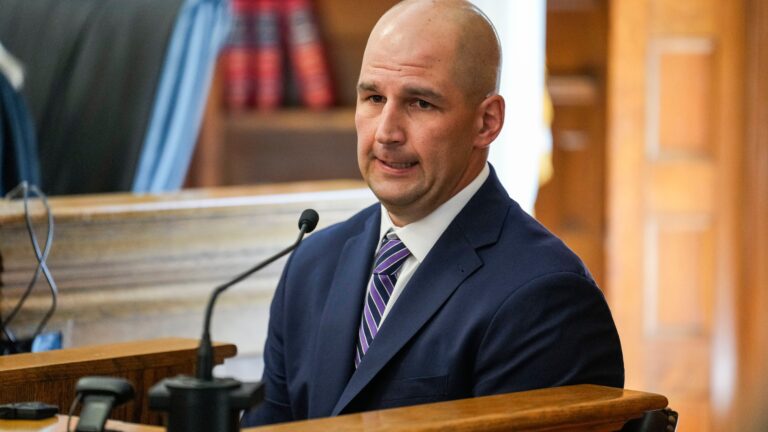
State Police Trooper Michael Proctor takes stand at Karen Read trial. Kayla Bartkowski For The Boston Globe
April 23, 2026 | 4:34 PM
3 minutes to read
Michael Proctor’s crass texts about Karen Read catapulted him to national infamy, but attorneys on some of the former Massachusetts State Police trooper’s other criminal cases say his “vulgar, disgusting” messages didn’t stop there.
Appearing in court Thursday on behalf of two murder defendants Proctor investigated, attorney Rosemary Scapicchio argued the ex-trooper’s cellphone data showed bias not only toward women — as Read has alleged — but also against “Black and brown individuals.”
“He’s a racist, really a racist person from the beginning,” she said of Proctor. “He’ll say things like, ‘It’s kill an n-word in Canton day.’”
Norfolk County prosecutors previously confirmed Proctor’s personal cellphone data contains “images of intimate body parts” and other sensitive information, but the materials remain shielded from public view under court order.
State Police fired Proctor last year over his conduct during Read’s case, particularly his lewd texts commenting on Read’s health and appearance, joking about searching for nude photos on her phone, and expressing hope that she might kill herself. Those messages came to light during a now-closed federal investigation into the 2022 death of Read’s boyfriend, Boston Police Officer John O’Keefe.
Read was acquitted of murder and manslaughter charges last year following a 2024 mistrial, though she still faces a wrongful death lawsuit from O’Keefe’s family.
Separately, Read has a pending federal lawsuit against several witnesses and investigators she says conspired to frame her for murder, Proctor included. Some of those witnesses recently filed a defamation lawsuit against Read and Turtleboy blogger Aidan Kearney.
Aaron Rosenberg, one of Read’s civil attorneys, said Thursday she’ll also be filing claims against Massachusetts State Police and the Town of Canton, where O’Keefe died, “within the coming weeks.” Read first teased those claims in November, but Rosenberg explained a separate lawsuit was deemed necessary after her complaint was moved from state to federal court.
He asked Judge Michael Doolin to give Read more leeway by allowing her use of Proctor’s cellphone data for the new complaint.
“This request is necessary because the communications are highly relevant to the negligent hiring, supervision, and training claims that Ms. Read is bringing against the Massachusetts State Police, as well as the Town of Canton, which she’s going to do in a matter of weeks,” Rosenberg argued.
He said the materials in question “relate to, primarily, Mr. Proctor, as well as Canton Police Sgt. Sean Goode,” who worked the initial investigation into O’Keefe’s death. The Canton Police Department placed Goode on leave last fall amid an internal affairs investigation into allegations of misconduct.
According to Rosenberg, the messages in question “contain images of … and information about women that appear to be unrelated to the people in the conversations and [who are] likely unaware that they are contained — these pictures or messages are contained — within this data.”
He said the existing restrictions on the use and dissemination of Proctor’s cellphone data are “more than sufficient” to protect sensitive material.
“These communications are not private. They’re not personal. They’re not confidential, and they’re not privileged,” Rosenberg said. “But what they are is staggeringly anti-woman, racist, homophobic, antisemitic, among other things. And that description applies to messages from both Mr. Proctor and Sgt. Goode of the Canton Police Department.”
Proctor’s lawyer, Thomas DiGangi, argued there are privacy issues at stake.
“I’m not aware of any employer in the commonwealth and perhaps even nationwide that orders their employees to turn over their private cellphones before they are hired or after they’re hired,” he said.
DiGangi also noted Proctor has never faced criminal charges in connection with his handling of the Read investigation.
“Mr. Proctor’s been through quite enough here,” he said. “I’d state to the court, Your Honor, that this is a gentleman who committed 12 years of his life as a Mass. state trooper. … He worked 40 hours a week keeping drug dealers away from our kids’ schools, murderers away from our family, rapists away from our children.”
Scapicchio, meanwhile, called the protective order concealing Proctor’s cellphone data “ridiculous.”
“He’s not a victim. He doesn’t need protection. No one has threatened him,” she argued. “He says some vulgar, disgusting things, … and shares it with his friends, like it’s ‘please pass the butter.’ That’s the tone of these conversations, judge.”
Proctor “should not be treated any differently than any other witness in any other case. Why are we protecting him?” Scapicchio demanded. “The public should get to know exactly who he is and what he’s done.”
Doolin took the request under advisement.
Abby Patkin is a general assignment news reporter whose work touches on public transit, crime, health, and everything in between.
Sign up for the Today newsletter
Get everything you need to know to start your day, delivered right to your inbox every morning.