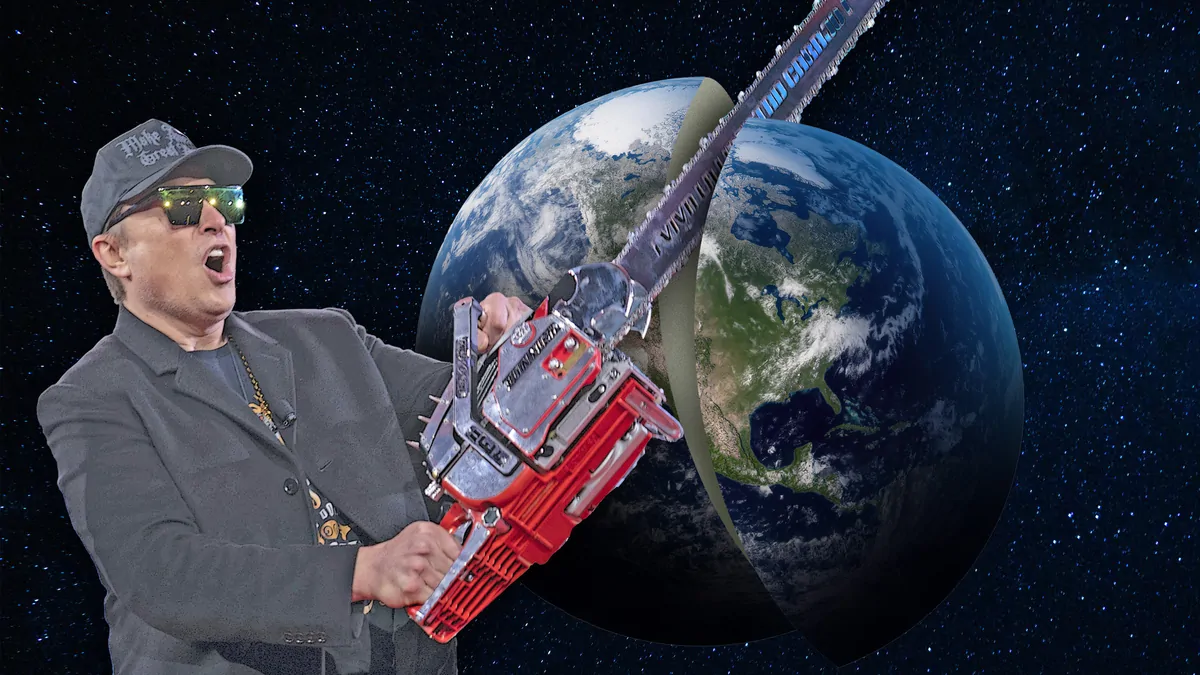
Everyone said I was crazy when I declared I was off to see the Elon Musk documentary.
I was in Venice, it was hot, the spritzes were spritzing and the Cichettis were begging to be eaten. Why would I choose, instead, to sit in a dark room and watch four hours of one of the world’s most odious men, a true villain of our current moment, and who is always present in the news cycle.
“Because, what if it’s only time I get to see it, and as this version?” was my response to the sceptical faces. Also, the air-conditioning.
Sign up to The Nightly’s newsletters.
Get the first look at the digital newspaper, curated daily stories and breaking headlines delivered to your inbox.
By continuing you agree to our Terms and Privacy Policy.
Even before Musk, the unauthorised documentary by Oscar-winning filmmaker Alex Gibney, had premiered at the Venice Film Festival, there had been rumblings about its wider release.
HBO has been involved with the production from years earlier, and had the streaming rights to the finished film (HBO in Australia could not confirm if it has the rights in this territory), but with a looming merger on the cards, the doco’s future was far from assured.
HBO is a subsidiary of Warner Bros, which is in the process of being acquired by Paramount, owned by David Ellison. The transaction is being funded in large part by Ellison’s father, tech mogul and billionaire Larry Ellison.
The Ellisons are friends with US president Donald Trump and have already come under fire for meddling in the editorial independence of broadcast network CBS’s news programs by appointing a right-aligned news boss. It’s been … uh … rocky.
So, the chatter before the premiere was that once the Ellisons had their reigns on Warner Bros (the sale is being held up by a pending lawsuit from 12 US states), there’s every chance the Musk doco would languish in HBO’s vaults.
Larry’s name even has a cameo in the film, as part of an onscreen text chain in which the Oracle founder offered Musk $US2 billion for his Twitter acquisition.
As it turns out, trouble arrived earlier.
Overnight, two stories dropped on The Hollywood Reporter. The first cited sources the international theatrical distributor, Universal, was disinclined to push ahead with a release and was likely to return the rights to the filmmakers, along with a kill fee.
That wouldn’t mean the film wouldn’t be seen at all, rather the producers would have to go back to shopping it around. And the US and Canada cinema release is being led by a different company, Bleeker Street, which has, for now, dated it for October.
Universal Australia did not respond to a request for confirmation as to whether it had the rights to distribute the film locally. Gibney’s Jigsaw Productions also did not respond to questions about Australian distribution.
A second article published hours later said Universal was in internal talks about the film, and could release it after all.
The back-and-forth is interesting not just because of this particular film, but because it’s part of a larger pattern of capitulation from US media players to the tech industry, as well as the American political right, which tech businesses have cosied up to during the second Trump term.
The entertainment and news sector has become increasingly enmeshed with tech as Silicon Valley money is injected into traditional studios, which in addition to the Ellisons has also included Amazon buying MGM, Netflix’s origins as a tech business, Google investing in A24, and tech-associated private equity finance.
Earlier this year, Amazon MGM revealed it would no longer release a dramatised biopic from filmmaker Luca Guadagnino about OpenAI founder Sam Altman, starring Andrew Garfield as Altman and Ike Barinholtz as Musk.
The film, Artificial, was already finished and was expected to be a contender in the annual awards season. Rather than axing it altogether, Amazon put it up for sale, and it was bought by Neon.
Why the change of heart? It didn’t say so but it’s hard to ignore the fact Amazon recently invested $US50 billion into OpenAI, and that Jeff Bezos is pals with Altman.
That initial news of Universal’s hesitancy around the Musk doco was also seen as further evidence of right-wing political influence having a chilling effect on artistic freedom, cowering in the face of legal threats from a petulant, one-time trillionaire with far-reaching connections in a Trump administration who has no qualms about abusing its power.
Disney and Paramount both opted to settle lawsuits brought against them by Trump, despite initially calling them baseless, and considered by many legal experts to be exactly that.
Universal is owned by Comcast, who is under current investigation by the Federal Communications Commission for its diversity, equity and inclusion practices – as in, it dared to have some. The FCC is run by Trump toady Brendan Carr, a long-time, public and private admirer of Musk.
Gibney’s impactful film illustrates just how much influence Musk has amassed over the years.
You – like my friends in Venice – might wonder why anyone needs to sit through four hours of Musk when his exploits are already so ubiquitous.
You can’t avoid him, he’s everywhere. We know he’s powerful, we know he’s dastardly, we know he’s unhinged, and we know he’s wrought great damage through his whims and actions.
But there’s something particularly shocking when all that accounting is presented in one four-hour package by a filmmaker with a keen eye for how power moves, permeates and corrupts.
Gibney goes through how Musk took the credit for founding Tesla (he didn’t, it was Martin Eberhard), and the dodgy claims about the car’s self-driving capabilities as well as the many deaths from it that has been obscured. There’s an examination of SpaceX and Neuralink, his destruction of Twitter, and the tricks used to pump up the value of his companies by folding them into each other.
That corporate chicanery, Gibney contended, has allowed Musk to build the myth of his own genius and financial Midas touch, when he is little more than a con man who knows how to sell air.
There is also his pro-natalist beliefs with 14 acknowledged children (including a transgender daughter who he kicked off his health insurance and claimed was ‘dead’), and the NDAs he has coerced, or attempted to coerce, his baby mamas into signing.
By the time the film comes around to the more recent era, which wasn’t originally part of the doco but which HBO asked Gibney to include after Musk embedded himself within Trump’s inner circle, you’re already enraged and depressed.
That’s even without the truly ghastly Grok coming into play.
Zoë Schiffer, Alex Gibney and Ashley St. Clair attend the Musk photocall during the 83rd Venice International Film. Credit: Stefania D’Alessandro/WireImage
How Gibney pulls together all of Musk’s misadventures in the political realm, first by pumping hundreds of millions of dollars into Trump’s campaign, and then taking a scythe to almost 300,000 government jobs (which actually cost more money than it saved) via DOGE, which led to the axing of aid programs that put countless lives of vulnerable children at risk.
DOGE took particular delight at targeting the departments that had active investigations into Musk’s companies.
Those investigations, not surprisingly, went away. It’s corruption 101, and the increasingly anti-democratic flavour of the US has allowed him to get away with it and more.
But it’s not just about what Musk has already done, Gibney is interested in where this all leads. For example, what will Musk do with all the data that DOGE ripped from the government databases when he and his team had an all-access pass to its systems.
That data is expected to contain detailed information on millions of Americans, which Geoffrey Hinton, a Nobel-winning AI scientist considered the godfather of the tech, postulated in the doco could be used for nefarious, even election-tampering, means.
Perhaps the most damning testimony comes from Ashley St Clair, a one-time right-wing influencer and mother of one of his kids.
St Clair recounted the night of the 2024 US presidential elections and that Musk left the party at Mar-a-Lago before the results came in.
Musk, according to St Clair, “had a degree of certainty” about the outcome that she said she had not seen before. He texted her that he would “unleash the anomaly in the matrix” and that he had 10,000 lasers in space, presumably referring to his Starlink or SpaceX infrastructure.
This St Clair sequence is the one that Musk’s legal team has taken issue with, and threatened to sue for defamation over.
Musk himself has made his displeasure about Gibney’s doco known, which, really, is another reason to watch it.
He called Gibney a “douche”, to which the filmmaker replied, “douche”, adding the accent aigu. Since its premiere in Venice, Musk has called Gibney a “bitter old man”.
Elon Musk’s comes under fire from the mother of one of kids kids in the new doco on his life. Credit: Krisztian Bocsi/Bloomberg
Musk’s philosophy of free speech absolutism clearly doesn’t extend to someone he doesn’t like. Let’s also not forget that he is familiar with defamation, having called Vernon Unsworth, the British cave-diver who helped rescue the trapped Thai football team, a “pedo guy”.
Like many of his powerful but thin-skinned ilk, it’s a case of dishing it out but not taking it.
Whatever Universal ultimately decides in terms of releasing the film in international markets or not, or what an Ellison-controlled HBO might do next year by the time the streaming window opens, there will continue to be drama about Gibney’s doco, which everyone should see.
The four hours (plus 10-minute intermission) will fly by, I promise. You can have a spritz afterwards.
Thankfully, Gibney is no shrinking violet, he’s starred down powerful forces before and his previous docos include Enron: The Smartest Guys in the Room, Going Clear: Scientology and the Prison of Belief, and Citizen K, the latter of which explored the post-Soviet Russia.
If you can take on Putin, you can take on Musk.