

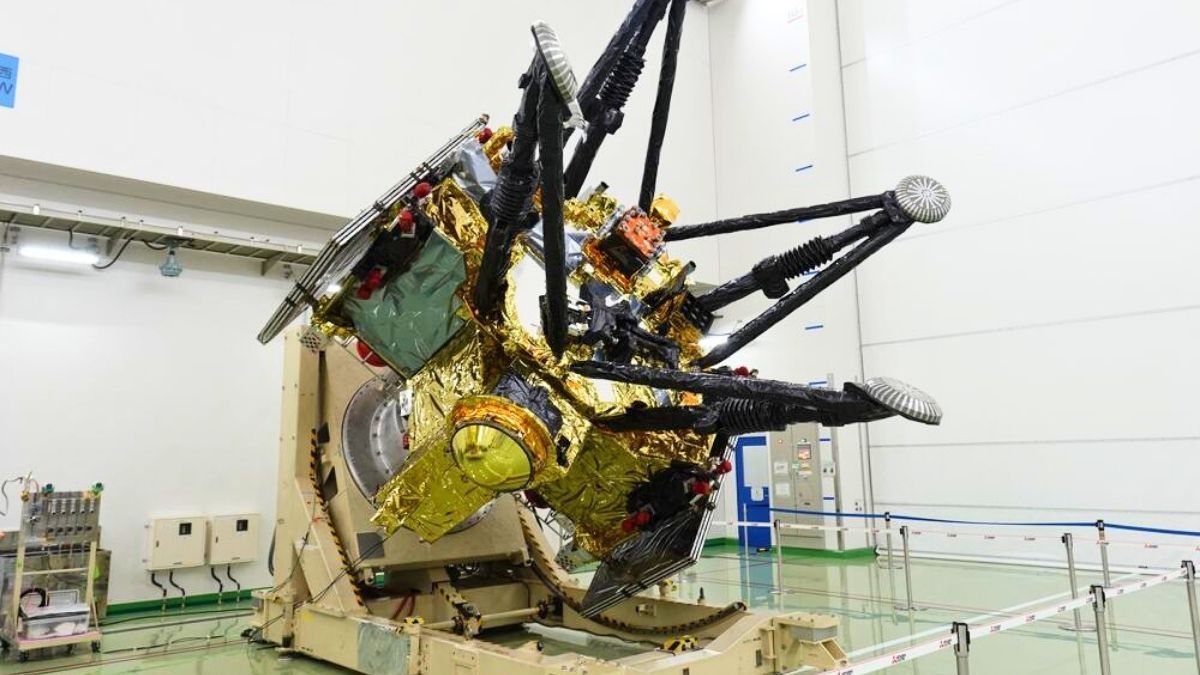
Image credit: JAXA
South Australia’s outback is set to become the landing site for an extraordinary delivery from space, with samples collected from a moon of Mars expected to arrive at Woomera in 2031.
The milestone follows the successful launch of Japan’s Martian Moons eXploration (MMX) mission on Tuesday, 20 October, beginning a five-year journey to explore Mars’ two moons, Phobos and Deimos, and return samples to Earth.
Led by the Japan Aerospace Exploration Agency (JAXA), the spacecraft launched aboard an H3 rocket from Japan’s Tanegashima Space Center, with an international team of space agencies contributing to the mission.
The spacecraft is expected to reach Mars in August 2027, where it will study the planet’s moons before attempting to collect at least 10 grams of rock and soil from the surface of Phobos.
If successful, it will become the first mission to return samples from one of Mars’ moons to Earth, potentially answering questions scientists have been investigating for decades.
The samples could reveal how Phobos and Deimos formed, provide insights into the early history of the Solar System and help researchers better understand the evolution of Mars.
For South Australia, the mission will culminate in an extraordinary homecoming, with a capsule carrying the samples expected to land in the Woomera region in 2031.
It’s not the first time the South Australian outback has played a role in an international space mission.
In December 2020, Woomera’s vast landscape was the landing site for Japan’s Hayabusa2 mission, which successfully returned samples collected from the asteroid Ryugu. The Australian Space Agency coordinated the recovery operation, strengthening the country’s partnership with Japan in deep-space exploration.
South Australia’s Minister for Defence and Space Industries, Chris Picton, said the latest mission demonstrated the state’s growing contribution to international space exploration.
“Having samples from a moon of Mars return to Earth through outback SA demonstrates our state’s growing role and importance in international space endeavours,” Minister Picton said.
The planned recovery will provide further opportunities for Australian researchers and the space industry, particularly in spacecraft recovery, scientific research and technical operations.
The mission brings together JAXA and space agencies from the United States, France, Germany and Europe, with the discoveries expected to contribute to future exploration of Mars.
While the samples are still five years away from reaching Earth, the successful launch marks the beginning of a mission that will once again put South Australia’s outback at the centre of international space exploration.
Related
Previous articleSevere thunderstorm warning expands across SA as large hail and damaging winds threatenNext articleAbandoned supermarket given new life as children’s creative hub in Adelaide’s north
