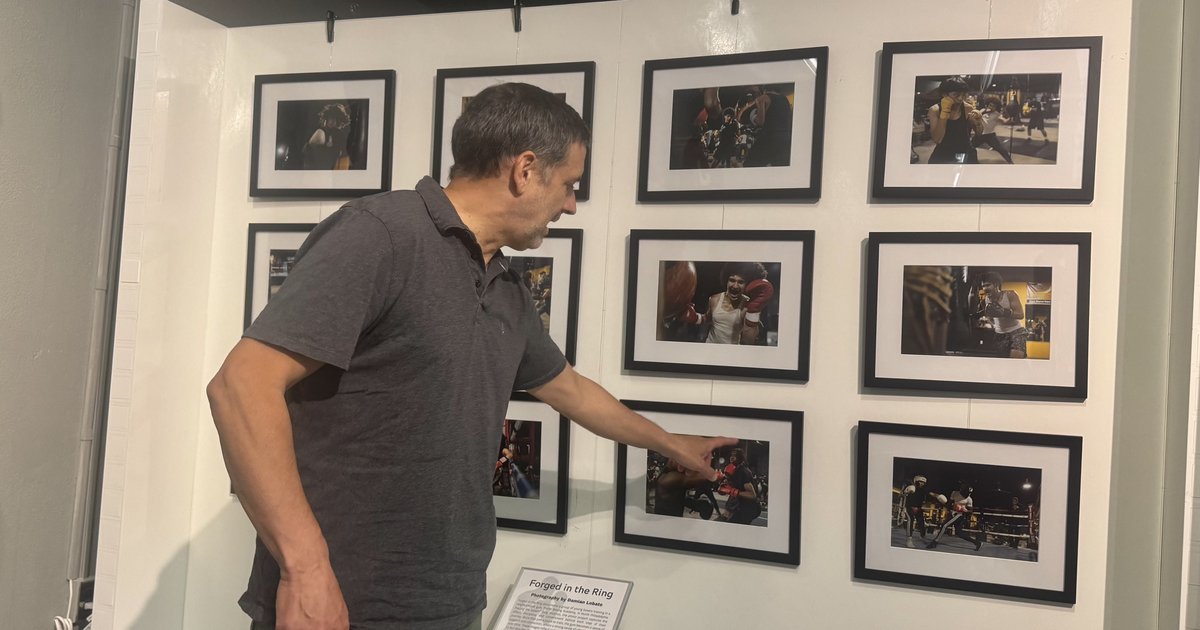
Tucked in a quiet corner of Gladfelter Hall at Temple University is a modest grid of 12 photos depicting late-night scenes at Pivott Boxing Academy.
The exhibit, “Forged in the Ring,” shows the strong sense of community that exists within local boxing gyms. Photographer Damian Stipanovich said he’s drawn to people in strife — he’s taken portraits of people facing persecution, war and exile — but his pictures from the ring in North Philly gave the backdrop of a different scene — one of triumph and perseverance.
MORE: City to designate part of Sansom Street in Rittenhouse as ‘Philly’s Funniest Block’
“People tend to think that bad things happen near Kensington,” he said. “Only when I started going there, I found out that great things happen there. One of those things is boxing.”
Stipanovich is originally from Argentina and moved to Philadelphia with his wife, Sarah, in 2013. He worked as a dentist for seven years before quitting to focus on his creative pursuits. He and his wife now operate a tango studio in Point Breeze and Stipanovich pursues portrait photography on the side.
Many of his photo documentaries have been overseas. He has done work with an Iranian citizen who lost an eye during a protest in 2022, veterans of the 1982 Falklands War and low-income populations in rural Romania. Last year, he spent weeks in Suburban Station photographing people experiencing homelessness who go to the underground Center City spot during the winter.
“I find people who need a photo, who need to be exposed, who need their stories to be told,” he said. “I need to be able to justify the photo.”
Inspired by Philly’s boxing lore, Stipanovich said he visited local gyms across the city to observe how they function in their communities. At Pivott Boxing Academy in Fairhill, he met dozens of kids who viewed the sport as more than just a hobby — they were aspiring to be great.
“It’s like you open a door to a different world,” he said. “They are training to be somebodies. They don’t just go to play and meet friends. They all want to be a champion.”
From September to February, Stipanovich travelled from his South Philly home to the gym twice a week to capture the sweat and struggle. He took over 4,000 photos and recalled speaking to kids who were unhoused, from broken homes or generally in need of guidance. The parents of a 6-year-old boy with autism told him that their son had been struggling at school before he entered the ring. Since getting involved with Pivott, they told him his grades improved significantly.
“Apart from running a business, [Pivott] also has a community function,” he said. “Some of these kids spend the whole day in the gym because that’s where they find their friends, community and the teachers there become an authority in their life.”
Most of Stipanovich’s photos show athletes mid-punch or in their fighting stance among a pack of similarly positioned figures. One shot shows a 6-year-old boy catching his breath in the corner of the ring as his coach encourages him to persevere. Stipanovich said hundreds of people had showed up to watch the fights.
“This neighborhood is being stereotyped as undeserving or as lazy,” he said. “But here you see exactly the opposite. You see a lot of effort, a lot of discipline. … My contribution is tiny, but I want people to see that the neighborhood has been stereotyped.”
Molly McVety/PhillyVoice
Photographer Damian Stipanovich took over 4,000 photos at Pivott Boxing Academy in Fairhill and 12 are displayed in an exhibit at Temple.
Marina Mikhaylova, an associate professor of anthropology at Temple University, met Stipanovich through his tango classes. She heard of his project last year and thought it connected with a class she was teaching called “World Cup, Global Cities and Mobility.” She got his work displayed at the Temple Anthropology Lab and Museum and would show the photos to her students.
“We talked about what the boxing gym means to the community, how it engages young people and I just found that really interesting,” Mikhaylova said. “Especially since Damian and Sarah are also from a tango studio, they’re also doing this community building themselves.”
Mikhaylova and Stipanovich plan to work together this summer on another photo assignment that centers on attendees of the World Cup, specifically how Philadelphia as a host city engages with tourists and immigrant communities gathering for the shared love of sport.
But Stipanovich doesn’t plan on getting too close to the matches. He said he’s interested in joining soccer fans who gather in parking lots, bars, churches, block parties or homes to capture the excitement of the tournament from a more intimate setting.
Mikhaylova plans to interview the subjects that Damian shoots for a class she teaches about the social meaning of sporting events like the World Cup. She hopes to display the exhibit in the same corner of Gladfelter Hall in the fall.
“I have the chance to go back to Argentina, but many immigrants don’t have a chance to go back to their countries,” he said. “When the World Cup comes here, it feels to me that a part of your world is coming toward you. That is a great thing”