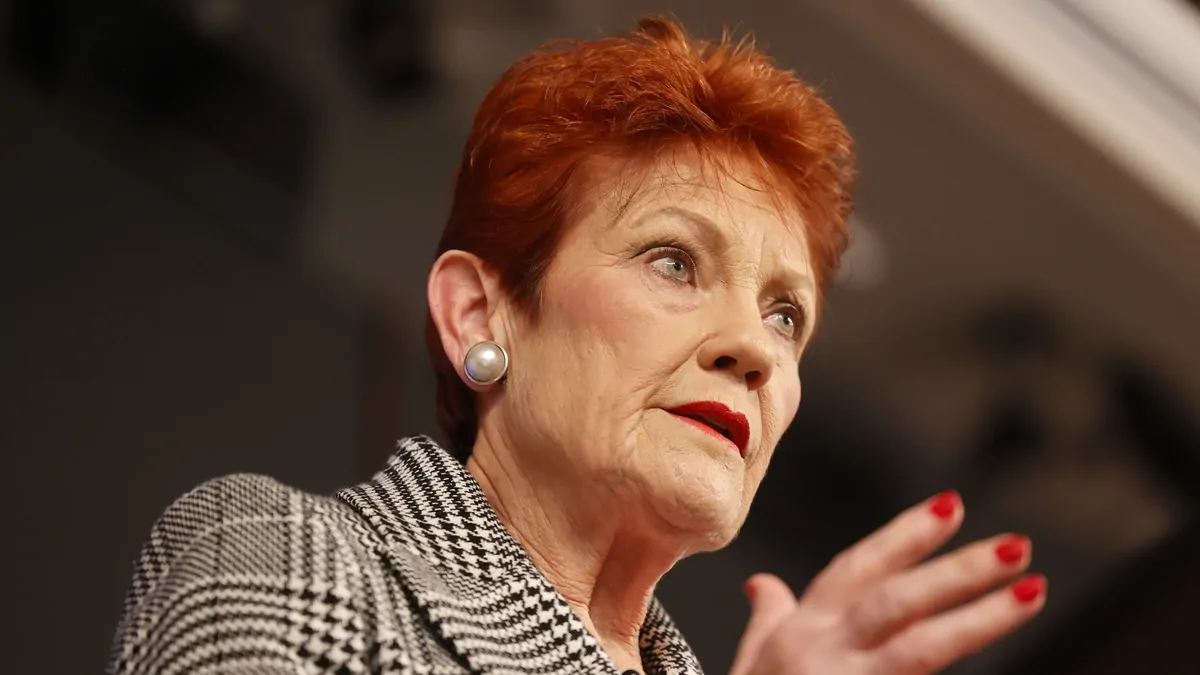
Pauline Hanson has accused the Albanese government of lying about skilled migrant figures and has pushed to reduce net migration to about 130,000 a year.
The One Nation leader called for the drastic cuts in a fiery Sunday Agenda interview when asked about the levels of permanent residents her party would accept in Australia.
Skilled migrants make up more than 70 per cent of Australia’s 185,000 total permanent places and are vital to fill gaps in critical sectors such as health, aged care, regional industries, and construction.
Sign up to The Nightly’s newsletters.
Get the first look at the digital newspaper, curated daily stories and breaking headlines delivered to your inbox.
By continuing you agree to our Terms and Privacy Policy.
“The government has lied to us. I don’t believe their figures,” the Queensland senator said.
“We’re in the predicament we are now at the moment because of the high migration numbers”.
The minor party leader also insisted Australia needed to be more picky with migrants and only take in the “skills that we need”.
She accused some in the skilled migrant cohort of claiming they hold qualification despite only learning on “YouTube”, and has previously called out “Uber drivers, nail technicians, dog walkers” as people who “don’t fit the needs” of the nation.
In the TV interview she also called for dramatic cuts to international student numbers but failed to respond to questioning from host Andrew Clennell on exactly how many she would accept.
“I think the international student industry that’s been set up by the universities is a farce,” she said.
“People are using it to come to the country. Then after they get in the country, they’re only here for a few months. Then they change the courses.
“Then they apply for residence here in Australia. So they’re using (it) as a back door to get into the country.”
Liberal shadow housing minister Andrew Bragg told the same program on Sunday that Australia needs to lower its Net Overseas Migration to match current housing construction rates.
He argued a migration range of 180,000 per year was necessary to close the housing shortfall and bring population growth into alignment with current housing construction rates.
It came after his wide-ranging National Press Club address earlier this week prompted criticism after he claimed he wanted to reduce the number of working holiday makers.
Opposition leader Angus Taylor and other Coalition members had distanced themselves from Mr Bragg’s freelancing at the NPC and labelled his remarks his “personal view” rather than official Coalition policy.
“It’s important to note here that it’s not a target, it’s not a policy, it’s not an opinion,” he told News24.
“If you want to close the housing migration gap over the forwards, it’s got to be around 180,000.
“How you do it is a matter for consultation.
“These are just the facts on the ranges you need to be in if you want to close the housing gap over the four estimates.
“So we’ve got a shortfall of about 350,000-400,000 people, and so if you have a NOM in around that range, then you’re going to get there over the forward estimates.”
He added that the “caps” on skilled migrants in critical areas like construction were “too low” and people like baristas and pastry chefs shouldn’t be prioritised over trades.
Home Affairs Minister Tony Burke was supposed to present Labor’s migration policy at the National Press Club while Anthony Albanese was away on the winter break but abruptly cancelled it and is yet to confirm the rescheduled date.
Mr Burke told a Sydney press conference on Sunday that Cabinet was still working on the policy and the speech would be rescheduled.
The Labor frontbencher pointed to separate schemes when asked the impact a go slow approach to approving visas for working holiday makers would have for sectors which rely on them.
“The processing of working holiday visas at the moment, they are still being processed, but they are being processed more slowly than they were previously,” he said.
“The principal visa for the agricultural industry is actually PALM — the Pacific (Australia Labour Mobility) scheme.”
Australia currently has around 234,000 Working Holidaymaker visa holders, while almost all coming from partner countries with the strongest growth from the UK.