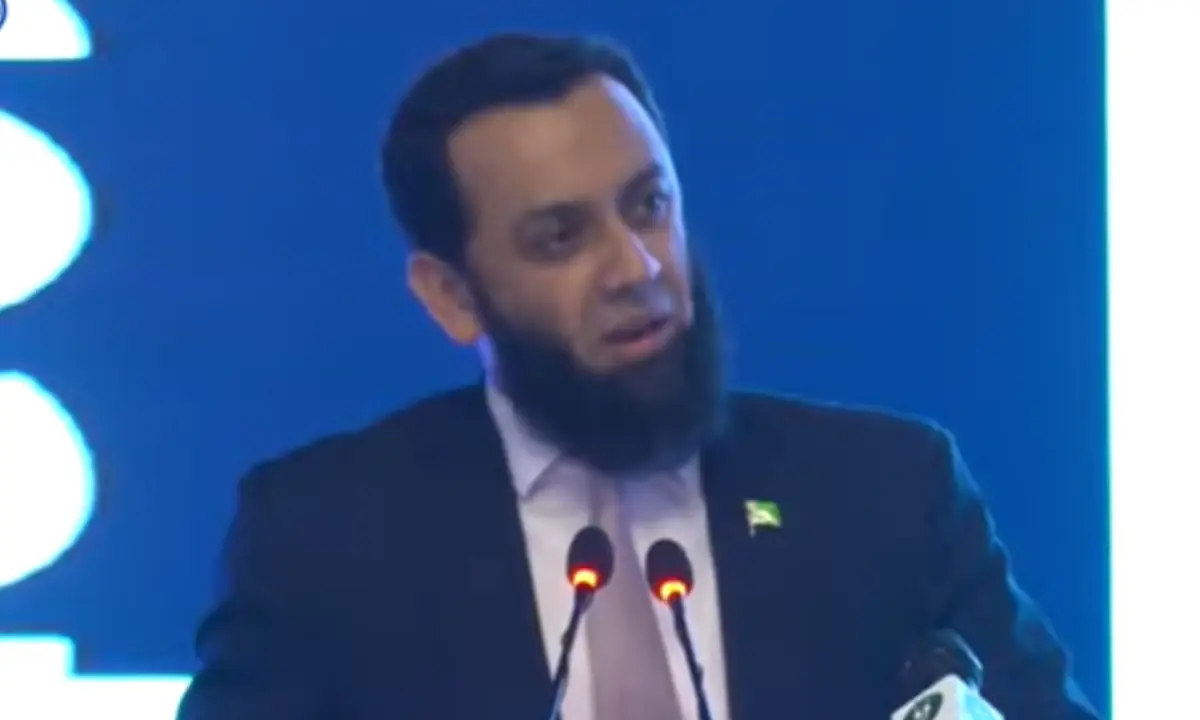
Information Minister Attaullah Tarar said on Tuesday that the 240 million people of Pakistan had an “inalienable right” to water from the Indus River System.
“When we say that Indus is our lifeline and our people, the 240m people of Pakistan, have an inalienable right to the water of Indus, we mean it, from the core of our heart,” he said, highlighting the significance of Indus for the country.
The minister expressed these views at a seminar held in Islamabad to highlight the legal and constitutional framework of the Indus Waters Treaty (IWT), a water-sharing agreement that remains a contentious issue between India and Pakistan.
Tarar began his speech by describing the IWT as “an instrument of peace and regional stability”.
“Today, we are not merely discussing the treaty. We are discussing the lifeline of nearly 240 million people of Pakistan,” he said.
He added, “When we identify ourselves as Pakistanis, we ask a question as to who we are. And if you go back into history, the Indus water [sic] civilisation defines us as a people.
“Whenever I go abroad, I always tell my counterparts that we are the people of the Indus Valley civilisation. Our identification is that we are people based on the banks and tributaries of the mighty Indus River.”
The minister said water was life, and the “Indus has given life to Pakistan”.
For Pakistan, he went on to say, water was simply not a resource but a matter of life itself.
Tarar said the Indus River system had nurtured one of the world’s oldest civilisations for thousands of years. “From the towering peaks of Gilgit-Baltistan to the fertile plains of Punjab and Sindh, these waters have connected our people across geography and history.”
He added that the story of Pakistan was, in many ways, the story of the Indus. It was for this reason that the Indus Waters Treaty of 1960 occupied such a “unique place in international relations”, he said.
He recalled that the treaty was signed under the auspices of the World Bank and had endured wars, political upheavals and prolonged periods of tension.
“Its resilience, for more than six decades, demonstrates an enduring truth that cooperation, dialogue and adherence to international commitments remain the only sustainable path to peace,” Tarar said.
The minister said the IWT stood as a “remarkable example” of the rule-based international order. “It embodies the principle of good faith — pacta sunt servanda — the sanctity of agreements and peaceful dispute resolutions. These are not merely legal concepts, but foundations upon which trust is built.”
Then, turning his attention to tensions between India and Pakistan over the IWT, he asserted that Pakistan’s civilian and military leadership had made it clear that the people of Pakistan had a right to the water of the Indus and the treaty could not be amended, revoked, suspended or held in abeyance unilaterally.
Tarar’s assertion came a little more than a year after India announced that it was placing its IWT obligations in abeyance. The announcement followed an attack on tourists in occupied Kashmir’s Pahalgam that killed 26 tourists — an incident New Delhi blamed on Islamabad without evidence. For its part, Pakistan strongly denied the allegations and called for a neutral investigation.
In contestation of the Indian move, Tarar pointed out that the treaty came into being after mutual consensus between Pakistan and India and could only be amended or revised with the mutual consensus of the two sides.
“India’s failed attempt at unilaterally holding this treaty in abeyance has led to international embarrassment for India at various forums, including legal forums,” he said.
Moreover, he contended that the “moral, social and legal foundations” of any one-sided attempt to hold the IWT in abeyance. “And any structure which has weak foundations will fall flat on its face,” he remarked.
The minister stressed the need to protect the IWT, especially at a time when climate change was accelerating, glaciers were melting at an unprecedented rate and water scarcity was becoming the defining challenge of the present times.
More to follow