World Cup
“It allows you a chance to dream.”
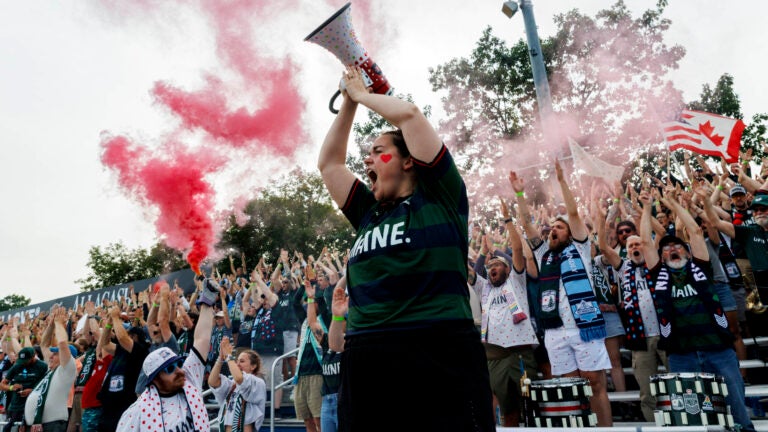
Dana Ricker, head capo of the Dirigo Union, leads Portland Hearts of Pine fans during a game on Aug. 6, 2025. Ben Pennington/The Boston Globe
As commentators looked to make sense of the United States’ 4-1 loss to Belgium in the Round of 16 of the 2026 World Cup, Fox’s television coverage momentarily panned to a fan wearing a Portland Hearts of Pine jersey.
It was a reminder of how far soccer has come in the U.S., and New England specifically.
Major League Soccer (MLS) was a product of the 1994 World Cup, which was the only other time the U.S. hosted the men’s edition of the tournament. Not only has that league grown to 30 clubs, but the United Soccer League (USL) has expanded into markets throughout the country.
The USL currently has three divisions: Championship (the second division behind MLS), League One (a third division focused on smaller markets), and League Two (a developmental league that operates in the summer).
New England is well represented across leagues, with the New England Revolution in MLS; Rhode Island FC (RIFC) and Hartford Athletic in USL Championship; Portland Hearts of Pine in USL League One; and several teams in League Two, including Vermont Green FC and Seacoast United Phantoms.
“New England is probably near the top, if not the top, of the best regions to look at for how this game is growing and evolving,” Hearts founder and chief community officer Gabe Hoffman-Johnson said. “The way the communities – in Burlington and Rhode Island and Maine – are rallying around these clubs, that’s special. That’s a sign of growth.”
“Their success is our success.”
Sean Carey, assistant sporting director and interim president of Rhode Island FC, played in the United States Interregional Soccer League, a precursor to the USL.
Players trained twice a week in the evening – sometimes as late as 9 p.m. – before hopping on a bus on Friday for games, which could require taking the day off from work. To save money, games were often scheduled on consecutive days.
A lot has changed.
RIFC, which began play in 2024, has a full-time athletic trainer, a director of sports performance, and a video analyst. Players receive breakfast and lunch every day, and home games occur at Centreville Bank Stadium, a state-of-the-art 10,500-seat facility built two years ago along the Seekonk River.
“The love of the game hasn’t changed at all,” Carey said. “We all wish we could turn back the clock and be playing now. But we’re happy with the work and the time we put in to get to the point where players now enjoy the opportunities they have.”
Much of Hearts’ inaugural roster was unsure of what to expect from a third-division team in Maine. They soon came to love the state and the 6,000 fans that regularly sell out Fitzpatrick Stadium.
“The first thing I saw was the weather, that it was going to be negative a million degrees,” Ollie Wright, who has been nicknamed the “Maine Attraction,” said with a laugh. “But it’s such an amazing place. Off the field, there are so many beautiful sites and so many beautiful people here.”
The growth of the USL has benefited everyone. For players, it’s created more pathways.
Mamadou Dieng scored 23 goals for Hartford before being transferred to Minnesota United in a club-record sale. Nathan Messer – who spent his collegiate summers with the Green – started his professional career with RIFC. A year later, he had a standout season with Hearts, prompting a sale to the Charleston Battery.
The Green and Phantoms, both semi-professional, serve as stepping stones. Six Green alums were drafted by MLS teams in 2026. Moise Bombito helped the Phantoms win a League Two title before playing in the 2026 World Cup.
“People really get to know these guys in a short but intense way,” Green co-founder Patrick Infurna explained. “We feel so much love and pride for these players. Their success is our success.”
The clubs have also brought national attention to their markets.
Hearts are the darlings of USL League One, in part because of the Dirigo Union, a supporters’ group that has over 1,000 paying members. They set the tone each match day with the help of the 30-person Valentine Band, who plays from start to finish. Hearts gear can be seen at soccer events around the world, and the club’s story is chronicled in an NESN documentary, “Up The Hearts.”
The region’s commitment to soccer was seen when 5,000 deposits to Hearts’ new USL W League team, set to begin play in 2027, sold out in an hour.
The Green, who have earned the adoration of Senator Bernie Sanders, have made headlines with their commitment to environmental justice. Game days include a row of like-minded organizations sharing their ideas, players wearing recycled uniforms, and a program that converts portable toilet waste into fertilizer.
“We engage with the issues that our community cares the most about,” Infurna said. “In the case of Vermont, people are really concerned with the environment, and that’s why our environmental justice mission lives so strongly in our match day experience.”
“It has saved my life in more ways than one.”
Hearts hosted over 150 community events in 2025, including visits to schools, hospitals, and charities.
Though proud of everything the club has done, Hoffman-Johnson specifically highlighted the after-school programming designed to teach children social, emotional, and leadership skills through soccer. Two schools are presently involved, with plans to double that number next year.
“This game can be a conduit,” Hoffman-Johnson said. “If used in the right ways, it can have a remarkable impact. Yes, you can develop players, but I think you can also develop people in really special ways.
“We are focused on finding ways to use this game in our own backyard. How do we, as an organization, use our brand and our resources to help develop Maine?”
RIFC – which uses the slogan “Anchored In Community” – views soccer in a similar light. They recently partnered with the Department of Education to reward students who have high attendance. Players, staff, and mascot Chip visited the winning schools.
“We want to be a club for all of Rhode Island, and to do that, you really have to be out in the community at a variety of levels, reaching people in a variety of different ways,” Carey explained.
Mitchell Ketchen unabashedly says that Hearts saved him. Sports were an outlet for the quiet kid from Maine, so much so that he earned a sports business degree before working for the Maine Mariners.
Ketchen found it hard to cope when the world shut down due to COVID-19. The illness left him with a distorted sense of smell and taste for over two years. The soccer podcast he did with a few friends provided a rare opportunity to interact with others, as Ketchen said he basically became a hermit.
As fate would have it, Hoffman-Johnson reached out, inviting Ketchen to work with the supporters’ group being developed for the yet-to-be-official soccer team. While hesitant at first, Ketchen accepted, helping lay the foundation for the Dirigo Union.
“It has saved my life in more ways than one,” Ketchen said. “It’s given me hope. It’s given me joy. It’s given me my love of sports back. It’s really opened up my eyes to what’s possible when a community comes together. I will forever be thankful for what Hearts of Pine have done and brought to this community.”
Vermont and New Hampshire only have pre-professional teams, but that could change.
The Green, who won the 2025 league championship in an undefeated season, just started a women’s team that plays in the USL W League. Both teams won their divisional championships, another successful milestone for the fifth-year club that is always assessing how they operate.
“We do not see a limit to anything that we’re doing at this football club,” Infurna said. “We don’t see a ceiling. We don’t see any reason that we can’t be bigger and bigger every year, whether that means we eventually go professional or it just means expanding laterally, whether it’s in the youth game or whatever it may be.”
The New Hampshire Soccer Project, an organization looking to launch both men’s and women’s teams by 2029, hosted approximately six watch parties around the state. The largest of which welcomed 600 people to Liars Bench Liars Beer Co. for the United States vs. Paraguay game.
Co-founders Samantha and Caleb Ginsberg, both New Hampshire natives, are excited to develop a community-based club that builds on the state’s rich soccer culture, which includes Seacoast United, Beech Street Soccer, and more.
“I think there’s already so much amazing soccer in New Hampshire,” Samantha explained. “There’s such a high participation level in the youth space. We want to give everybody who grows up playing soccer something to aspire to and look up to.
“And to give an outlet for people to continue to be involved in the sport in some way, whether it’s a fan, a player who actually gets to play on the team, someone who works for the team, or someone who just enjoys the community of it all.”
The growth of soccer in the United States creates opportunities for innovation.
The USL seeks to implement the country’s first promotion and relegation system in 2028. This system, used throughout the world, rewards top-performing teams at the end of the season, allowing them to rise a level. The lowest-performing teams are forced to drop.
There’s excitement about the development.
“I think every soccer purist would be in favor of that because every game counts,” Carey explained. “When we’re watching other leagues play, and you see what’s at stake, that level of pressure makes the games better, makes the players better. But I’m not the owner of Rhode Island FC.”
There are still many questions about what the format will look like, including the standards the league will require from its teams. To help, former English Premier League chief football officer Tony Scholes has been hired as president of the newly-created top division of the USL, called USL Premier. The Championship and League One will play below that.
Hoffman-Johnson said that promotion and relegation could be “fantastic” for this country because it creates captivating storylines.
“I think it’s extremely positive and exciting for us as a club that has aspirations,” Hoffman-Johnson said. “It allows you a chance to dream.”
But everything has to be done logically, as there are risks that come with the change. What happens to fan interest for teams not playing in the top flight? Will owners risk building facilities or buying players if there’s a possibility of dropping down a division?
It will be untested waters for the country, as MLS, the current top division, operates under a single-entity system in which teams don’t move up or down, and owners share profits.
“Does that casual fan get bought in and feel that energy and make them want to come to more games because it’s promotion or relegation?” Carey asked. “We don’t have proof of concept of that yet. So I think that’s one of the questions people grapple with when you look at it. In the end, it’s a game, but it’s a business. And so people have to make responsible business decisions. You want to do things that help the game and the business of the game.”
Sign up for the Today newsletter
Get everything you need to know to start your day, delivered right to your inbox every morning.