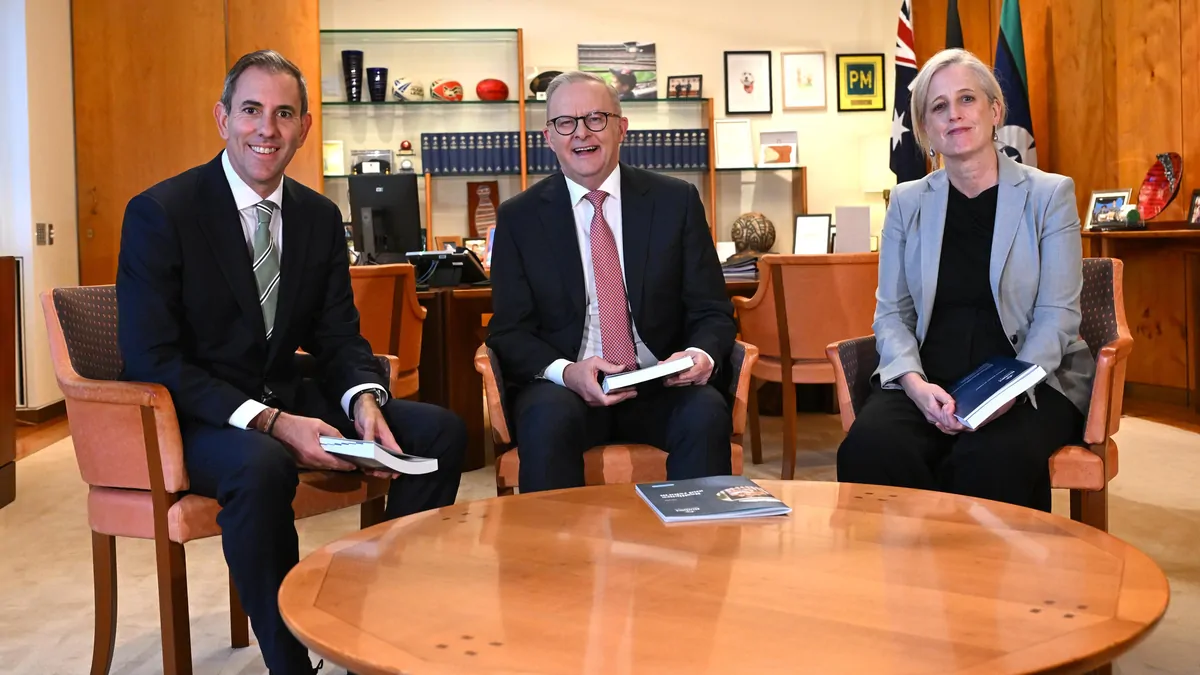
The government will introduce changes to negative gearing, the capital gains tax and the treatment of trusts on Tuesday. What does that mean and how will it impact asset holders?
Negative gearing
Since the 1930s, Australians have been able to discount losses made on assets, such as an investment property, from the tax paid on wages and salaries — this is called negative gearing.
Sign up to The Nightly’s newsletters.
Get the first look at the digital newspaper, curated daily stories and breaking headlines delivered to your inbox.
By continuing you agree to our Terms and Privacy Policy.
For example, Susan owns an investment property which earns her $800 a week in rental income from her tenants. But she pays $1000 a week in mortgage repayments, council rates, strata levies, water rates and maintenance costs. Susan can deduct $200 a week from her annual salary of $190,000 a year, saving her $4856 per year in tax.
Critics argue this encourages property speculation and provides a greater benefit to wealthier Australians.
Analysis by the Parliamentary Budget Office found the Commonwealth would forgo $7.4 billion in revenue to negative gearing deductions in 2025/26 from about 1.1 million taxpayers who negatively gear.
The government is expected to wind back the ability of investors to claim negative gearing on property, potentially limiting it just to new builds, so as not to discourage investment in new housing supply.
Questions also remain around so-called transitional arrangements. Media reports suggest the changes would likely not affect people who already own investment properties, while investors who buy existing homes after budget night could be given a one-year grace period.
Capital gains tax discount
When someone sells an asset, such as a house or shares, they have to pay tax on the increase in value of that asset — the capital gain — at their marginal income rate.
Since 1999, people selling an asset they have held for longer than 12 months have only needed to pay tax on 50 per cent of the capital gain.
For example, Wayne bought an investment property in 2022 for $500,000 and sold it for $700,000 in 2025. The capital gain is $200,000, meaning he only has to pay tax on $100,000 with the discount.
Since Wayne earned a salary of $190,000 in 2025/26, he had to pay the highest marginal tax rate of 45 per cent on the sale, leaving him with a tax bill for the house of $45,000, plus the Medicare levy.
Treasury estimates the CGT discount will result in $21.8 billion in forgone revenue in 2025/26 across all asset types, while around 83 per cent of the benefit received from the discount went to the top 10 per cent of income earners in 2022/23.
Critics argue that since 2000, the CGT discount has interacted with negative gearing to turbocharge investor speculation in the property market and contributed to home prices rising faster than incomes.
The government is expected to revert the discount to pre-1999 settings for all asset classes, meaning the discount level would rise each year in line with inflation, so people would only pay tax on the real capital gain of the asset.
Following the changes, let’s assume Wayne buys another property for $500,000 and sells it three years later for $700,000. Assuming inflation over that period of five per cent per year, his taxable income on the property would be about $121,000, meaning he would pay about $54,500 in tax.
Speculation suggests the government will also allow a one-year grace period, with the 50 per cent discount continuing to apply until 1 July, 2027.
Assets held before then will likely continue to receive the 50 per cent discount on gains until July 2027, and any gains after then will be discounted based on the new indexation regime.
New home buyers will reportedly be able to choose the new regime or continue to apply the 50 per cent discount.
Economists at Commonwealth Bank have forecast the combined impact of the CGT and negative gearing changes would raise around $2 billion in extra revenue over four years and about $20 billion over 10 years, depending on the exact details.
CBA estimates both changes could cause house prices to be about three to six per cent lower than they otherwise would have been.
Trusts
A trust is a legal structure that allows a person or company to manage assets and distribute income to beneficiaries.
It is commonly used by wealthy families to split income between family members and minimise tax.
Let’s use the example of a plumber, Gerard, who runs his sole trader business through a family trust. Gerard makes $230,000 per year and through the trust distributes income to his non-working wife and his adult son, who makes $10,000 per year.
By splitting the income with family members on lower marginal rates, the family’s tax bill is reduced from $69,600 to $44,400, according to calculations in independent MP Allegra Spender’s tax white paper.
In 2022/23, around 1.8 million people reported a total of $71 billion in net income from trusts, according to Treasury analysis.
The top 10 per cent of income earners made up 23 per cent of people receiving income from trusts, and received 63 per cent of all trust income.
Labor could consider implementing a minimum tax on all distributions from trusts of 30 per cent, which it proposed before the 2019 election.
Because trust systems are notoriously opaque it is difficult to calculate how much extra revenue the change could reap, but according to a report in The Australian the proposal is expected to bring in $4 billion to $5 billion over four years.