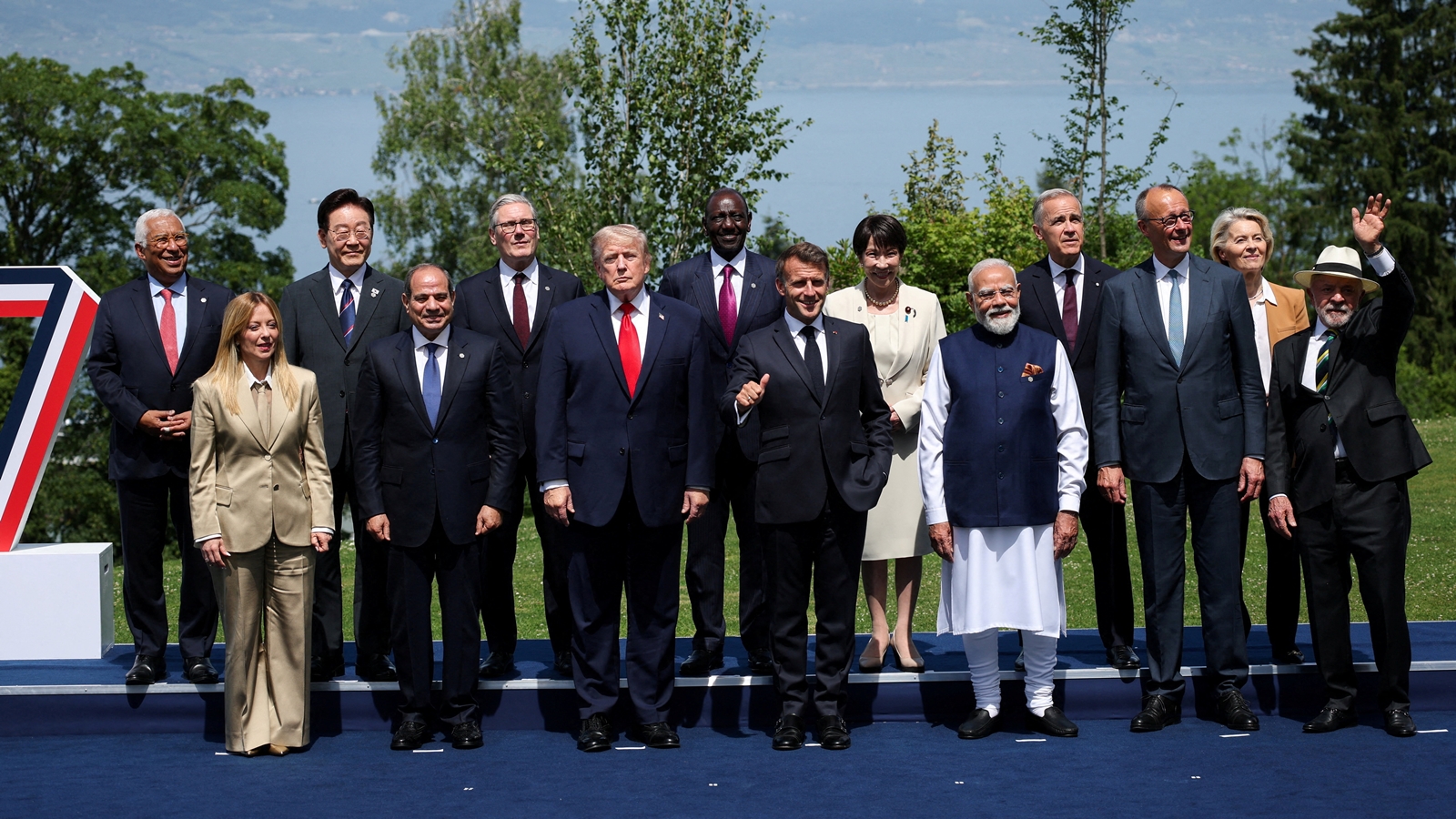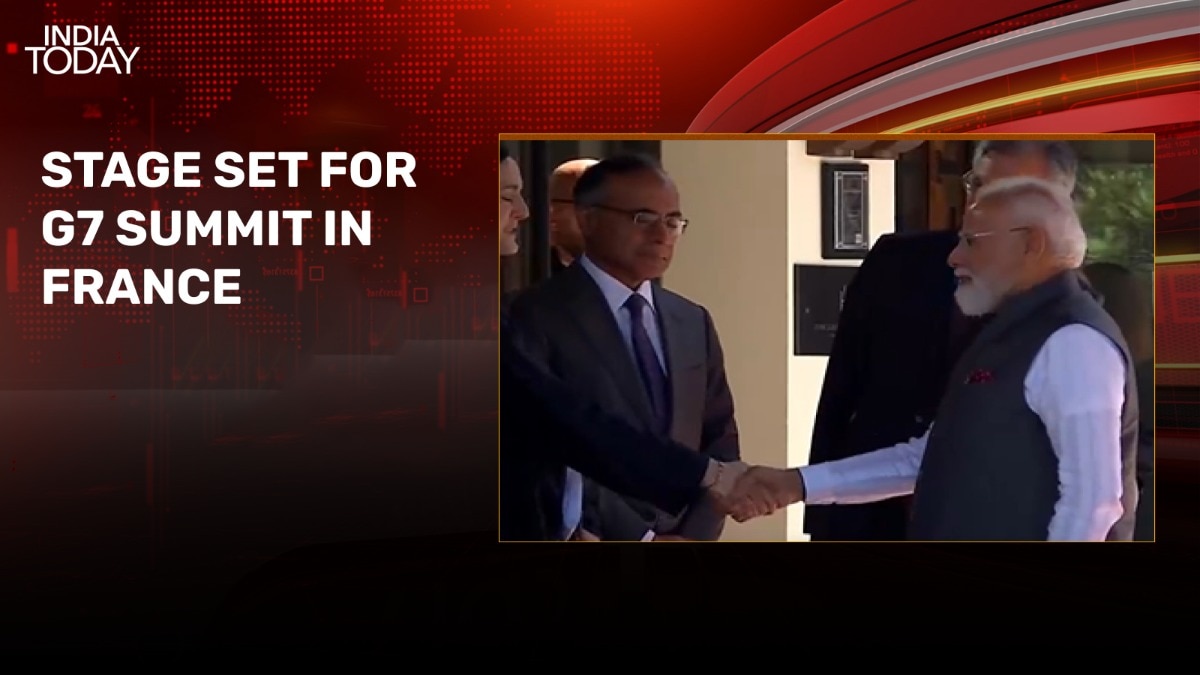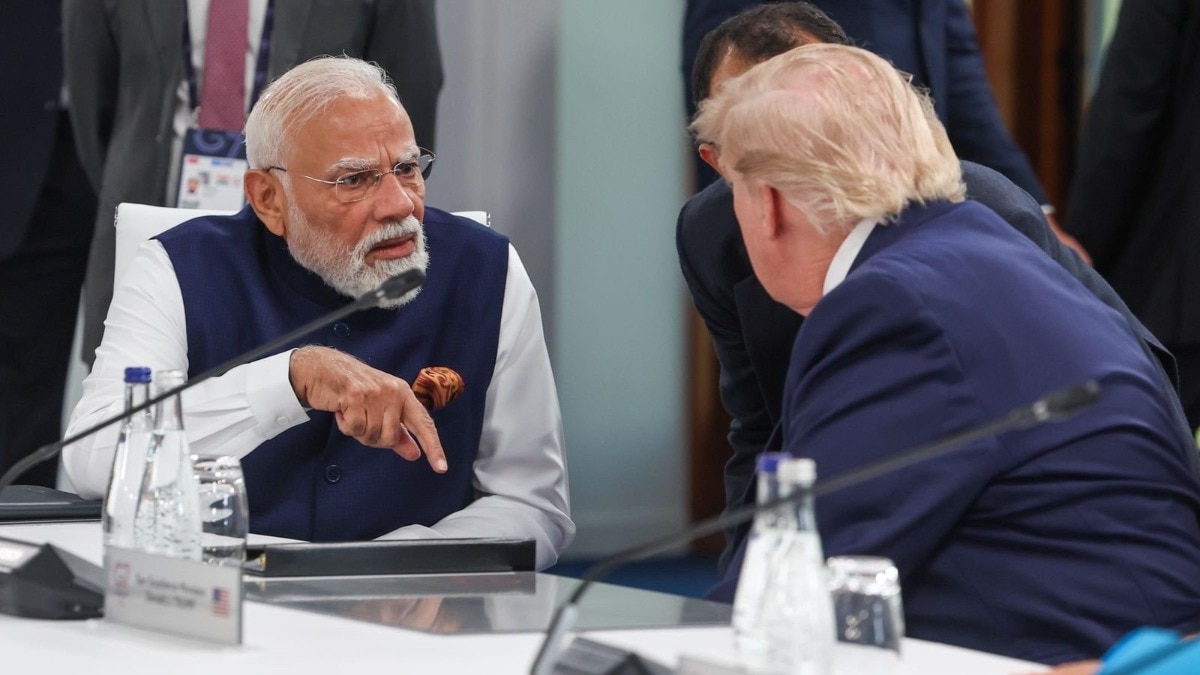
A missing gesture is often a great indicator of ties between leaders. Yesterday, when Prime Minister Narendra Modi came face-to-face with US President Donald Trump at the G7 Summit after 16 months, the trademark bear hug was missing, and so was the warmth that had defined the personal rapport between the two previously. Instead, there was a formal handshake, with Trump also seen patting his “friend” PM Modi on his arm. Even during the group photo session earlier, there was no visible eye contact or exchange of greetings. Overall, there were ample signs of a relationship under strain.
However, hopes of a reset in ties remain, with Modi and Trump set for their first face-to-face bilateral meeting since February 2025 on Wednesday. PM Modi was among the first world leaders to meet Trump after his election victory. Since then, ties have been upended as an unpredictable Trump slapped punitive tariffs on India, cosied up to Pakistan, and enforced immigration policies that have unfairly affected Indian students and workers in the US.
Prime Minister Narendra Modi offers a hand to US President Donald Trump during a family photo at G7 (Reuters)
PM MODI MEETS TRUMP AT G7 SUMMIT
A much-anticipated trade deal has also remained elusive. More recently, the deaths of three Indian sailors in the Gulf of Oman in US strikes have dealt a blow to any hope of a recalibration in ties that was starting to stabilise with the May visit of US Secretary of State Marco Rubio.
It was against this backdrop that PM Modi and Trump came face-to-face on Tuesday at the G7 Summit in France. However, more than the lack of hugs or warmth, PM Modi’s stinging remarks highlighted the strain in the India-US ties.
With Trump beside him, PM Modi underlined that the world today “suffers from a shortage of trust” and the “future of our partnerships depends on rebuilding this trust”.
“The world is not suffering from a deficit of resources; it is suffering from a deficit of trust,” PM Modi said.
Without explicitly referring to the deaths of Indian sailors, PM Modi flagged that the US-Iran conflict had cost Indian lives, and countries must ensure the safety of maritime routes and the lives of seafarers.
Here again, the context of PM Modi’s speech was missing as he didn’t name any particular country. However, the remarks require little explaining for whom it was intended.
What further embodied the growing rift was the US’s sudden move to drop ‘Indo’ from the name of its largest military command – the US Indo-Pacific Command. Moreover, the map used by the US to make the announcement showed POK as part of Pakistan.
Interestingly, it was during Trump’s first term that the command was renamed as Indo-Pacific Command. It was then seen as a sign of the growing importance of India to the US.
However, Trump 2.0 is different and somewhat more bellicose. It is why PM Modi’s first bilateral meeting with Trump in over a year will be closely watched, and their body language minutely analysed. The trade deal, which has been hanging fire for quite some time now, is expected to feature prominently in the talks.
“Trump’s meeting with PM Modi won’t lead to a reset. There’s too much mistrust on the Indian side, despite (Marco) Rubio’s recent damage-control visit and (US envoy) Sergio Gor’s relentless rapprochement efforts. The relationship has stabilised of late, but may not fully recover until post-Trump,” tweeted geopolitical expert Michael Kugelman.
HOW INDIA-US TIES CAME UNDER STRAIN?
But how did India-US ties come to such a point? India has always been seen by the US as a key ally required to counterbalance an aggressive China in Asia.
But, under Trump, a master of political theatre who thrives on spectacle and flattery, India has been at the receiving end of his compulsive bluster.
It started with Trump unilaterally claiming to have ended the India-Pakistan military conflict in May last year by threatening both with steep tariffs. However, India has maintained that the fighting ended at Pakistan’s request.
PM Modi’s repeated refusal to acknowledge it, or nominate him for the Nobel Peace Prize, has also created friction.
However, the most severe damage of the downturn in ties has been economic. Last year, Trump singled out India for its purchases of Russian oil, doubling India’s overall tariff rate to 50%. Caustic remarks by Trump, calling India a “dead economy”, and sharing a post that described Delhi as a “hellhole”, have further added to the tensions.
The tariff rate has been reduced to 18% after the two sides agreed to a framework trade deal this February.
At the G7 outreach session, there was only a formal handshake between PM Modi and Trump
Defence ties have also remained stagnant, with delays by American aviation major GE in supplying engines to power the Tejas Mk1A fighter jets being a major bone of contention.
However, India has been handling Trump’s bluster maturely and pragmatically. PM Modi never joined the war of words with Trump over the past year.
Earlier this year, as Sergio Gor took charge as the US envoy to India, he asserted that “real friends can disagree, but always resolve their differences in the end”. For Modi and Trump, the friendship might be stressed, but it’s far from broken.
It is why the bilateral between PM Modi and Trump on Wednesday evening will be closely watched. It will decide whether Modi and Trump’s personal chemistry once again becomes the driving force of India-US ties
– Ends
Published By:
Abhishek De
Published On:
Jun 17, 2026 12:49 IST