Local News
While the video may look like a simple — and adorable — moment of play, trainers say it also highlights the intelligence and curiosity of harbor seals.
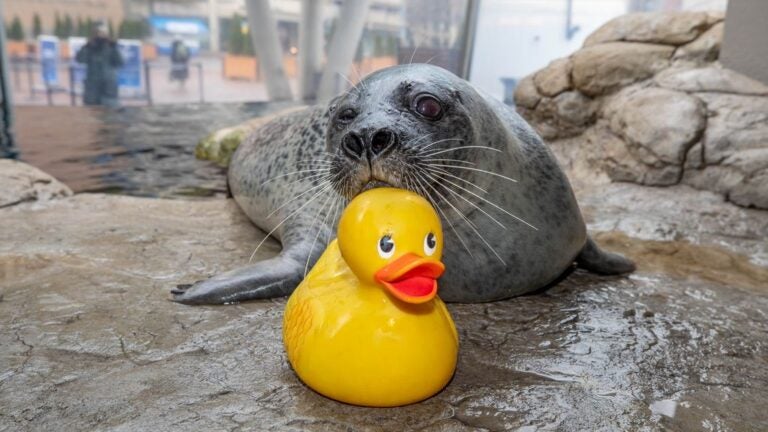
Reggae, a harbor seal at the New England Aquarium, poses with his rubber duck toy. Vanessa Kahn/New England Aquarium
A harbor seal at the New England Aquarium is making waves online — with a little help from his rubber duckie toy.
In a video that quickly went viral, Reggae, one of the aquarium’s harbor seals, can be seen gently petting, hugging, and swimming with a bright yellow rubber duck while working with his trainers in the water.
The playful moment has resonated with viewers, becoming one of the organization’s top-performing posts, said Marisa Bernal, the aquarium’s social media manager.
“It’s currently our second-best performing post on Instagram, with nearly 500,000 views and almost 100,000 engagements, and it’s still growing,” she said. “I love videos like this where multiple people and departments collaborate to make something special, and I’m so ecstatic Reggae is getting so much love.”
The idea for the video came out of a monthly meeting between the aquarium’s social media and animal care teams, who staff brainstormed ways to showcase the animals and the work the trainers do behind the scenes.
While the video may look like a simple — and adorable — moment of play, trainer Mollie Collins said it also highlights the intelligence and curiosity of harbor seals.
Reggae plays with his rubber duck in the water. – Vanessa Kahn/New England Aquarium
Collins, who worked with the marketing and communications team on the video, said the aquarium’s training staff regularly engages the five Atlantic harbor seals in cognitive enrichment activities.
“Harbor seals are naturally curious, so they love to interact with new things in their exhibit,” Collins said. “That really enriches their lives, because it has that new, novel sensation.”
One activity trainers use is called “Find It,” Collins said. During the exercise, trainers introduce objects into the exhibit and ask the seals to locate a matching item elsewhere in the exhibit.
The activity encourages the animals to use multiple senses, Collins said.
“They can explore [objects] with their vibrasae, which are their whiskers,” she added. “They can use their eyes and look for it. They can bump up against it.”
Just as importantly, the seals are given the option to not participate — which trainers call “choice and control,” Collins said.
“Marine mammals are incredibly intelligent. Reggae, of course, is no exception,” said Patty Leonard, the aquarium’s associate curator of pinnipeds.
Searching for objects mirrors behaviors the mammals would use in the wild, Leonard said.
“In the wild, they would be looking for food,” she said. “They are curious by nature, so we can really harness that experience with their training.”
Leonard said when seals participate in the activities, trainers use positive reinforcement, such as food, tactile stimulation, or scratches, to reward them. Because the rubber duck has been used frequently in Reggae’s enrichment sessions, he’s developed a positive association with it, Leonard added.
“I think he does have a positive association with it, even more so than some of the other objects,” she said.
Reggae holds onto his rubber duck, with another one by his side. – Vanessa Kahn/New England Aquarium
The aquarium’s trainers rotate through a wide variety of enrichment activities to keep the animals mentally stimulated. Some involve spraying water into the exhibit or playing different sounds for the seals to react to, Collins said.
The animals have even been known to respond to pop music, Collins said, including songs by Celine Dion and Harry Styles. One trainer has also played the recorder for them, Leonard added.
Reggae, however, tends to take a more laid-back approach, Collins said.
“He’s a pretty chill guy,” she said, explaining that high-energy activities like porpoising or dancing require more motivation for him. “He’s like, ‘Oh, you know, I’d rather go find a rubber duckie.’”
Leonard said enrichment plays a key role in the animals’ wellbeing.
“Because they don’t have some of the things in the wild that they would experience … we want to give them things to harness their mental capacity and really allow them to grow in the environment they’re in,” Leonard said. “These animals are incredibly smart, and we want to make sure that they’re taken care of mentally as well as physically.”
For trainers, moments like the viral video are a chance to show the public what goes into caring for the animals each day.
“It’s not just, ‘Alright. Here’s your fish,’” and that’s it. We’re with them throughout the day,” Collins said. “It’s so important for their welfare that we do engage them throughout the day to keep their minds going [and] to keep them curious.”
“Any opportunity to show our visitors our animals and what our animals are capable of is something that we’re incredibly proud of,” Leonard added.
Sign up for the Today newsletter
Get everything you need to know to start your day, delivered right to your inbox every morning.