

Local News
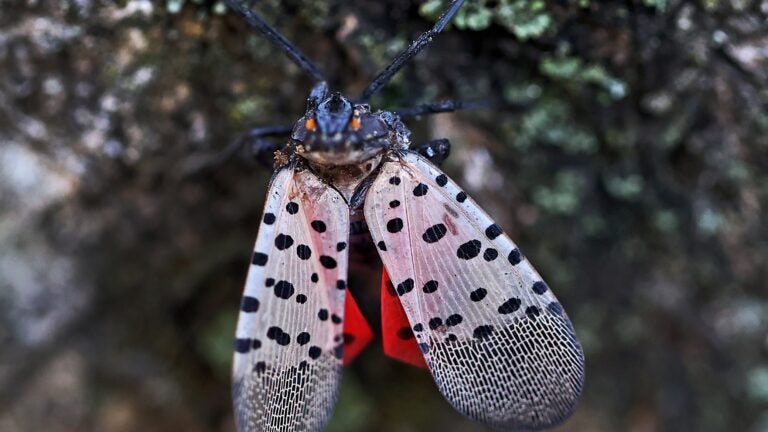
Spotted lanternflies are identifiable by their gray wings with black spots and red hindwings.
The Massachusetts Department of Agricultural Resources is urging residents to kill an invasive insect.
Residents should kill spotted lanternflies, identifiable by their gray wings with black spots and red hindwings, as the species enters its egg-laying season, the department said Wednesday.
Although the insects do not pose a threat to humans or pets, they feed on the sap of more than 100 plant types and can seriously injure certain plant species, including grapevines, tree-of-heaven, and black walnut saplings, officials said.
The lanternflies have been found in 145 cities and towns across the state and in every region except Cape Cod and the Islands, the department said. The insects are commonly found in large groups on trees or buildings and produce a sticky substance when they are feeding, known as honeydew, which can lead to the growth of a dark fungus called sooty mold.
Residents should inspect vehicles before leaving an area infested with lanternflies to avoid spreading the species across the state. At home, homeowners can vacuum up the insects, setting up traps, and removing their preferred host plants, including tree-of-heaven, officials said.
Residents should also destroy egg masses, which are one-inch long, flat and gray or beige, and often resemble a smear of mud, and are mostly found on flat surfaces or near host plants.
“As populations of spotted lanternfly continue to expand, we anticipate that more residents will encounter SLF activity at home or where they work,” said Ashley Randle, commissioner of the Massachusetts Department of Agricultural Resources. “Public partnership is an essential part of this effort, and we encourage everyone living or working in active areas to take a moment and inspect their vehicles before traveling to avoid the accidental spread of [spotted lanternflies].”
If a resident finds a spotted lanternfly in a community that does not have a confirmed sighting, they should file a report with the Department of Agricultural Resources.
Sign up for the Today newsletter
Get everything you need to know to start your day, delivered right to your inbox every morning.
