

Local News
There are a half-dozen active lawsuits against Suno in U.S. District Court of Massachusetts.
Two major record labels are suing Cambridge-based AI music-pgenerating platform Suno for copyright infringement, the latest in an onslaught of a half-dozen lawsuits pending against the company in the U.S. District Court for Massachusetts.
Universal Music and Sony Music allege Suno used an “enormous” amount of their copyrighted music to train its AI model. The lawsuit, which the labels filed Sept. 18, specifically focuses on the company’s newest v6 model.
The record labels previously filed a lawsuit against Suno in June 2024, and that suit is ongoing. This time, however, Universal and Sony aren’t accompanied by Warner Music Group, which settled out of court and created a licensing agreement with Suno.
While Suno said the partnership with Warner and other labels was the basis of its newest v6 model, which the company released Sept. 9, Universal and Sony say the company continues to use their copyrighted music.
“At its core, this case is about ensuring that copyright continues to incentivize human invention and imagination, as it has for centuries,” the lawsuit reads.
Representation for Suno did not respond to Boston.com’s repeated requests for comment.
The latest lawsuit comes less than a month after Grammy-winning Americana artist Jason Isbell and three others sued Suno for the commercial exploitation of their identities.
Suno, which is headquartered on Dunster Street near Harvard Square, launched in 2022 and now boasts more than 100 million users, according to its website. The company could reach $1 billion in revenue by 2028, Billboard reported.
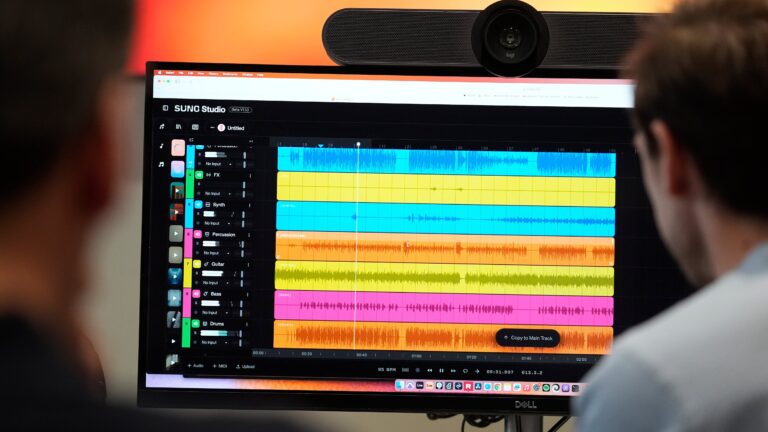
Suno users can type lyrics, a melody, a genre, or themes into a prompt, and the platform will generate a song, according to its website. Users can then refine, extend, or regenerate the song.
The lawsuit comes at a time when AI-generated music is proliferating. Deezer, an online music streaming site, announced in July that more than 50 percent of new music uploaded on the site is AI-generated.
Universal and Sony allege Suno has stolen more than 60,000 songs to train its AI model. However, the actual number could be in the millions, according to the suit.
Suno allegedly used “user interactions” with previous models to train the v6 model, per the filing. Since Suno allegedly trained the previous models on copyrighted music from Universal and Sony, the record labels say the company is still stealing their music.
“Such AI offerings will erode the value of the artistic works that comprise the essential raw materials that allow them to function in the first place,” the suit reads.

Further, the two record labels argue Suno’s new licensing agreements with Warner and other labels prove “the unlawfulness of its decision … in the first place,” according to the lawsuit.
Suno wrote in a news release that the partnership with Warner is the “blueprint” for how AI and the music industry can work together.
A June 2025 lawsuit alleged Suno violated the Digital Millennium Copyright Act by going around protections to access copyrighted work used to train their model.
In July, a German court delivered one of the first major rulings against Suno, saying the company infringed on copyrights, Forbes reported.
Christopher Wares, assistant chair of the music business/management department at Berklee College of Music, told Boston.com in a previous interview that the music industry is still working through a framework for permission, attribution, consent, and more as AI expands.
“The industry is experimenting,” Wares said. “For me, it’s always going to be, no matter what, artist first.”
There are currently no court dates set for the lawsuit.
“If left unmoored from existing and longstanding legal constraints, AI services like Suno’s, and the mass of substitutive outputs they generate, could supplant, rather than support, genuine human creativity,” the lawsuit says.

Sign up for the Today newsletter
Get everything you need to know to start your day, delivered right to your inbox every morning.
