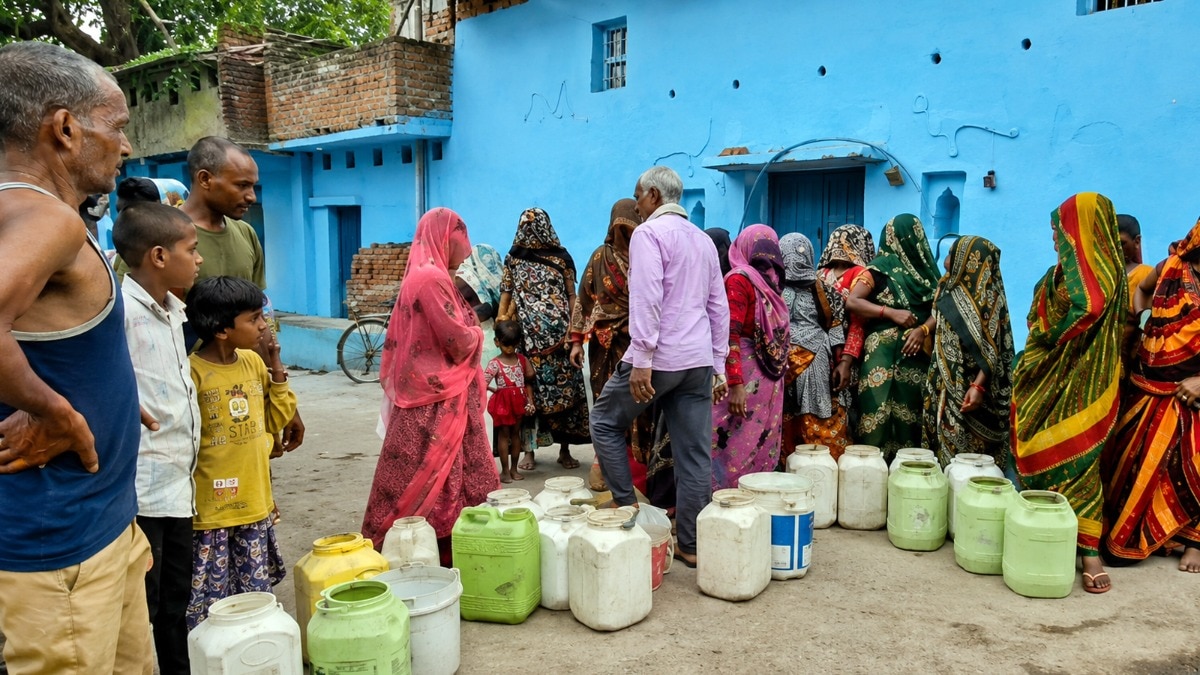
Every morning in this village in Uttar Pradesh’s Mahoba district, the day begins not with work, school or farming, but with a race for water.
Children clutch plastic containers, the elderly wait patiently under the blazing sun and women spend hours carrying buckets back home. And for dozens of young men in Mudhara, the water crisis has become something else entirely — the reason they remain unmarried.
Mudhara village presents a stark picture of life in Bundelkhand’s parched landscape. Despite government claims of piped water reaching every household, villagers have alleged that not a single drop has flowed from taps installed under a multi-crore drinking water scheme.
The consequences, however, are being felt far beyond thirst.
“There are around 40 men of marriageable age in the village. But no one wants to marry their daughters here because there is no water,” said a villager.
For families searching for brides, the conversation often ends the moment prospective in-laws learn about Mudhara’s water woes.
“They tell us, ‘How much water will our daughter have to carry if she comes to your village?'” said an elderly villager. “People openly say they don’t want to marry their daughters into a village that doesn’t have drinking water.”
CRORES SPENT, EMPTY TAPS
Under the Namami Gange project, pipelines were laid, and a water tank was installed in the village more than two years ago. Villagers have said that officials conducted trial runs, but the promised water supply never materialised.
Today, the infrastructure stands as a reminder of unfulfilled promises.
“They built a tank and laid pipelines. Water came during testing once, and then it stopped. Since then, not a single drop has reached our homes,” a local said.
The village, home to more than 2,000 people, survives on just three hand pumps and a well located near a temple.
Water from two of the hand pumps is reportedly saline and barely fit for consumption. That leaves a single functioning hand pump outside the village as the primary source of drinking water.
Throughout the day, long queues form around it. Women, children and elderly residents wait their turn, often spending hours collecting enough water for basic household needs.
A CHILDHOOD SPENT CARRYING WATER
For some women in the village, fetching water has become a lifelong routine.
“Our lives have gone by carrying water,” one of them said.
The burden is now falling on the next generation. Children often help transport water before and after school, affecting both their studies and daily routines.
“Our daughters and daughters-in-law spend hours carrying water instead of studying or doing other work. Sometimes we have to make multiple trips just to cook food for the family,” a resident said.
Another said, “Every morning starts with fetching water. If there is no water at home, how will food be cooked? How will children get ready for school?”
During the peak summer months, the struggle intensifies as temperatures soar across Bundelkhand and groundwater levels decline further.
WEDDINGS COME WITH WATER TANKERS
The water crisis has also transformed social customs. Villagers say that when guests arrive for weddings or family functions, water has to be purchased through tankers at additional expense.
Even hosting relatives has become a challenge.
“When there is a marriage in the family, we have to spend extra money to call water tankers,” said a local resident.
“There isn’t enough water even for guests. Relatives often have to bathe at ponds or old wells. It is embarrassing for us, but what can we do?” he asked.
In a region where marriages often strengthen family and community ties, Mudhara’s reputation for water scarcity has become a social stigma.
ANGER AGAINST AUTHORITIES
The situation has fuelled growing resentment among residents, who accuse elected representatives and local officials of ignoring their plight.
Villagers allege that politicians who sought votes during elections have rarely returned to address the crisis.
They claim that despite repeated complaints, the village continues to depend on hand pumps while the expensive water infrastructure remains largely unused.
The anger is particularly directed at the gap between official claims and everyday reality.
On paper, Mudhara has pipelines, taps and a water tank. In practice, villagers say they are still queuing for buckets of water under the scorching sun.
“During elections, everyone promises that our problems will be solved. We are not asking for anything extraordinary. We only want water. Let the leaders come and spend one day here. Then they will understand what we go through,” a resident said.
For the government, Mudhara may be another village connected to a water scheme.
For its residents, it is a place where dry taps have reshaped everyday life — where children grow up carrying buckets, weddings depend on tankers, and dozens of young men wait for brides who may never come because a village of 2,000 people still cannot count on a glass of water from its own taps.
– Ends
Published By:
Karishma Saurabh Kalita
Published On:
Jun 11, 2026 11:06 IST