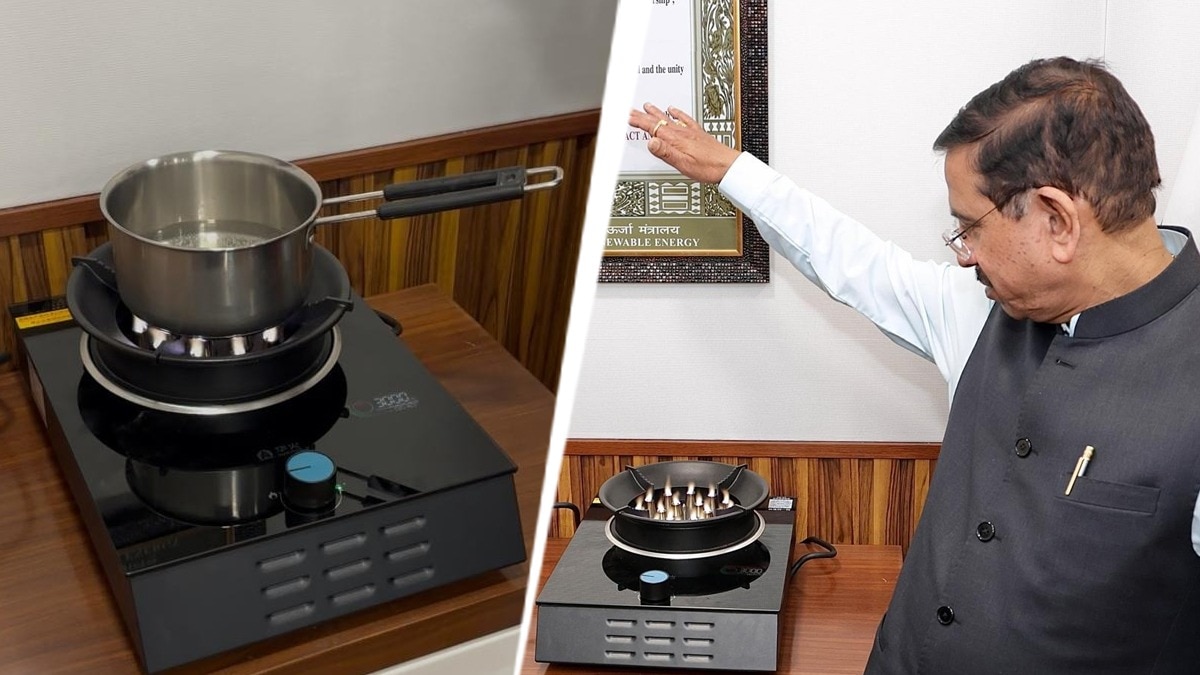
Union Minister Pralhad Joshi has pitched a shift in cooking technology as India navigates supply disruptions in liquefied petroleum gas (LPG), calling a new electricity-based stove a potential “game changer”.
In a post on X, Joshi said he witnessed a demonstration of an imported stove that produces flame-like burners using electricity, closely mimicking conventional LPG cooking. Impressed by the technology, he urged Indian manufacturers to adopt and scale it domestically.
“Yesterday, an Indian company demonstrated an imported stove that uses electricity to generate flame-like burners, similar to LPG, for cooking. I was truly impressed by this innovative technology and would like to see Indian manufacturers adopt and scale it domestically,” Joshi said in a post on X.
“When combined with @PMSuryaGhar, which enables electricity generation through solar power, this innovation could be a game changer in reducing dependence on LPG,” he added.
Yesterday, an Indian company demonstrated an imported stove that uses electricity to generate flame-like burners, similar to LPG, for cooking. I was truly impressed by this innovative technology and would like to see Indian manufacturers adopt and scale it domestically.
When pic.twitter.com/AQaNePu9N4— Pralhad Joshi (@JoshiPralhad) April 10, 2026
The New and Renewable Energy Minister’s remarks came at a time when India’s energy vulnerability has come into sharp focus. The country imports nearly 88 per cent of its crude oil, about half of its natural gas needs, and roughly 60 per cent of its LPG consumption, leaving it heavily exposed to global supply shocks.
The situation worsened after tensions in West Asia disrupted energy flows through the Strait of Hormuz, a key transit route for global oil and gas shipments. A substantial share of India’s imports — including over half of its crude, around 40 per cent of natural gas and up to 90 per cent of LPG — passes through this corridor.
A temporary closure of the strait during the US-Israel-Iran conflict led to supply bottlenecks, prompting India to initially curtail LPG supplies to commercial establishments such as hotels and restaurants. Supplies have since been partially restored to about 70 per cent of pre-crisis levels after alternative sourcing arrangements were made.
Shipping disruptions also added to the strain. Of the 28 Indian-flagged vessels present in or around the Strait of Hormuz when hostilities broke out in the Middle East, 16 remained stranded on the western side, carrying LNG, LPG and crude oil. Some vessels have managed to move to safer waters, but several India-bound shipments, including those on foreign-flagged carriers, are still stuck in the Gulf.
Relief signs emerged after the United States and Iran agreed to a conditional two-week ceasefire earlier this week, which included reopening the Strait of Hormuz. The development triggered a decline in crude oil prices and raised hopes of supply stabilisation.
At a recent briefing, External Affairs Ministry spokesperson Randhir Jaiswal said India is expecting unimpeded navigation through the crucial route following the ceasefire.
– Ends
Published By:
Sahil Sinha
Published On:
Apr 10, 2026 15:02 IST