Crime
Clancy’s defense attorney said Monday her case is “probably the most emotionally disturbing and challenging” he’s seen in decades of trying cases.
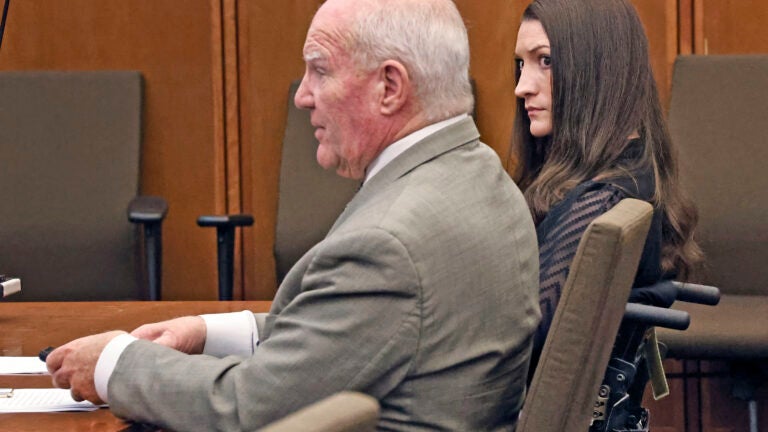
Attorney Kevin Reddington with his client Lindsay Clancy on June 18, 2026. Greg Derr/The Patriot Ledger, Pool
July 13, 2026 | 5:37 PM
3 minutes to read
Lindsay Clancy has lost her bid to have other women testify about their experiences with postpartum mental illness when Clancy stands trial later this month for allegedly murdering her children.
Lawyers on both sides faced off again Monday in Plymouth Superior Court, where jury selection in the hot-button case will begin in exactly one week. Judge William Sullivan said he plans to seat 18 jurors — including six alternates — as defense attorney Kevin Reddington noted the case’s “sheer emotional impact.”
“The impact of this case, which in my decades of trying cases is probably the most emotionally disturbing and challenging, I think is going to have a significant impact on jurors, more so than the usual that we deal with,” Reddington argued.
Clancy, 35, has pleaded not guilty to three counts of first-degree murder in the deaths of 5-year-old Cora, 3-year-old Dawson, and 8-month-old Callan Clancy. Prosecutors have painted the young Duxbury mother as a cold and calculating killer, alleging Clancy sent her husband out on errands on Jan. 24, 2023, then strangled their three children and attempted to take her own life.
But, Reddington has argued Clancy was overmedicated and struggling with postpartum mental illness and auditory hallucinations following the birth of her youngest child. He plans to pursue an insanity defense, essentially arguing that, even if Clancy did kill her children, she can’t be held criminally responsible due to her mental health.
“It’s so easy for us as a society to say, in a troubling case like this, ‘Oh my god, she’s guilty. Throw away the key, put her in jail, and just be done with it,’” Reddington said in court Monday. “Because it makes everybody feel better; it’s a feel-good reaction that OK, somebody has been punished because of doing a very bad thing.”
But, he told Sullivan the defense has heard from countless other women who shared their own experiences with postpartum depression, psychosis, auditory hallucinations, or intrusive thoughts of harming their children.
“For us to believe that somebody is hearing voices, the natural reaction from any one of us, I think, in this courtroom would be, ‘Come on. You’re not hearing voices. What are you talking about? You’re making this up. You’re trying to avoid respinsibillity,’” Reddington acknowledged. “But it is true, and it happens, and it is an affliction that people have put up with.”
He added: “A woman who has suffered and has put up with this affliction should be able to testify and say, probably in an emotionally charged fashion, very credibly, ‘I too have heard these command voices. I too acted on the command voices.’”
Yet, prosecutor Jennifer Sprague urged Sullivan to reject Reddington’s request for the additional layperson testimony, arguing the motion was legally unfounded. If the defense request were granted, she said, prosecutors would seek discovery evidence on each woman and be forced to call their own witnesses in rebuttal.
In other words, “women who suffered from postpartum depression and psychosis who did not kill their children, who locked themselves in a room to keep themselves from harming their children, who got in a car and drove away so they didn’t harm their children,” Sprague continued. “And so then it becomes a trial within a trial.”
Sullivan agreed, noting that expert witnesses can give jurors the relevant information about postpartum mental illness.
Separately, Reddington raised concerns about a draft questionnaire for prospective jurors, which included questions about each juror’s personal experiences with mental illness and mental health treatment.
“There is a stigma in this country of mental disease or illness. There is, whether we acknowledge it or not, and it’s embarrassing to many people,” Reddington argued, adding, “We’re flirting with disaster on that type of question.”
He said he was particularly concerned prosecutors might challenge any potential juror who admits to a personal brush with the mental health system.
“Anyone that has any issue whatsoever with mental disease, defect, or medications is going to be tossed because of alleged cause,” Reddington charged. “[Prosecutors] are going to say it’s for cause, because they have a preconceived notion. And that’s going to wipe out a significant number of citizens that are being brought here to this court to sit on a jury.”
But, Sprague said Reddington’s assumption was wrong, and that she would have no issue with a prospective juror who has had mental health treatment, so long as they can be fair and impartial. Sullivan said he would take a look at the questionnaire.
Jury selection in Clancy’s murder trial begins July 20. Attorneys estimate the trial will last at least four to six weeks.
Abby Patkin is a general assignment news reporter whose work touches on public transit, crime, health, and everything in between.
Sign up for the Today newsletter
Get everything you need to know to start your day, delivered right to your inbox every morning.