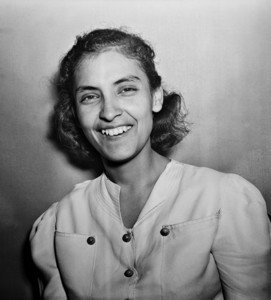
Emma Tenayuca was a labor organizer in Texas who is best known for leading a strike of pecan shellers in 1938. Workers called her “La Pasionaria“ which means “Passionflower.” From a young age, she survived violence and imprisonment in her quest to help workers get better working conditions and higher wages.
Tenayuca was born on December 21, 1916, and I know all of you December birthday people will identify with her plight – born too close to Christmas, she never got ‘birthday’ presents. Her family was Mexican American, and had lived in Texas for many generations. She was raised by grandparents who were interested in politics, and was also influenced by the speakers in the San Antonio town square. She was brought up with pride in her family and their roots, and she was encouraged to be educated and politically active by her family.
Emma Tenayuca in 1939, photographed for a Personality of the Week article in The San Antonio Light
Tenayuca was arrested for the first time at 16, for protesting alongside striking workers from the Finck Cigar Company. She used her bilingual language skills to help people with their problems and worked with many organizations working towards better pay and better conditions for Mexican-Americans.
One of the most common positions for Mexican-American women in the area was in the pecan industry. Pecan shelling for 6-7 cents a pound was difficult work (the meat of the shell must remain intact) for little pay. Additionally, the process filled the factory rooms with a fine dust that contributed towards tuberculosis.
In 1938, the factories cut pay to 3 cents a pound and Tenayuca, who was 21 years old at the time, found herself leading a strike of approximately 12,000 workers. The strike faced violent opposition, as detailed in the article “Remembering Emma Tenayuca:”
When Pecan production ground to a halt, the owners fought back: Tenayuca and hundreds of strikers were gassed and arrested by San Antonio police. Some were beaten as well. With the NWA rallying community support, the strike turned into a city-wide uprising of the poorest and most oppressed people in San Antonio.
Thirty-seven days after the strike began the pecan producers agreed to arbitration. A few weeks later, the workers had won a wage increase to seven or eight cents per pound.
Tenayuca faced opposition as a woman, as a Mexican-American, as a labor organizer, and as a member of the Communist Party (she left the Party in 1946). From Americans Who Tell the Truth:
In 1939, as Emma was giving a speech, an enraged mob attacked San Antonio’s Municipal Auditorium. Fearing that she would be lynched, Emma was led away through a secret passageway. The mob threw bricks, broke windows, set fires, ripped out auditorium seats, and later that night, together with the Ku Klux Klan, burned the city’s mayor in effigy for having defended Emma’s right to free speech. This event is still on record as San Antonio’s largest riot.
Tenayuca married another labor organizer, but it didn’t last (they divorced in the 1940s). Blacklisted throughout Texas, she left for San Francisco to attend college. She had a son in 1952, and worked as a teacher and returned to San Antonio to teach in the 1960s.
A 1939 photo with Tenayuca at the center
She never stopped working for women’s rights and worker rights. In 1942 she led a demonstration against the U.S. Border Patrol, which was beating migrants and leaving them to die in the desert. In 1944, she organized another rally which brought more attention to the Border Patrol’s brutal practices.
Emma Tenayuca died at the age of 83 of Alzheimer’s Disease. At her funeral, writer Carmen Tafolla said:
La Pasionaria, we called her, because she was our passion, because she was our heart — defendiendo a los pobres, speaking out at a time when neither Mexicans nor women were expected to speak at all.
Sources: