While climate activist Sonam Wangchuk was removed from Delhi’s Jantar Mantar on the 21st day of his hunger strike over concerns about his deteriorating health, nearly 700 kilometres away another Gandhian activist spent almost two weeks fasting on a funeral pyre with little official attention. The stark contrast has brought fresh focus on an extraordinary protest unfolding in Madhya Pradesh’s Chhattarpur district against alleged irregularities in compensation for families affected by the Ken-Betwa Linking Project.
Protestors with the poster in the water. (Photo-Â Abhishek Singh)
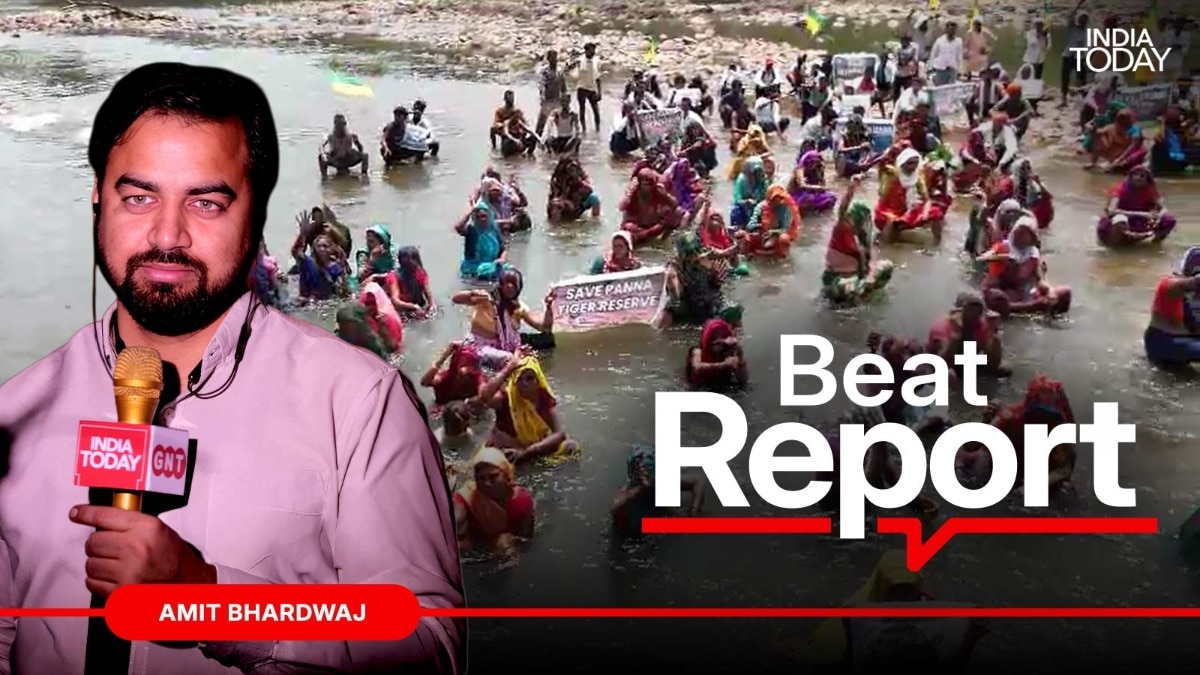
For days, Gandhian activist Amit Bhatnagar sat atop a symbolic funeral pyre in the middle of a tributary of the Ken River near the Panna Tiger Reserve, observing an indefinite hunger strike that began on July 6. Around him, tribal women stood for hours in neck-deep water while others lay on makeshift pyres, demanding what they call fair compensation, proper rehabilitation and recognition of their dependence on forests and rivers for survival.
Protestors speaking to India Today team. (Photo- Abhishek Singh)
The protest, locally known as the “Chita Satyagraha”, has become one of the most dramatic symbols of resistance against India’s first river-linking project. With monsoon currents strengthening and conditions worsening, protesters say they have no option but to continue until their grievances are addressed.
Among them is Samat Rani, who spends hours submerged in the river with mud smeared across her face. “They have taken away our soil, so I have covered myself with the same soil,” she told India Today. She said her family had not received adequate compensation and demanded land, forests and homes in return for what was being acquired.
Explaining why the forest matters, Rani said her family depends on it for firewood, mahua flowers, tendu leaves and other forest produce that sustains their livelihood. “We want our land, our jungle, our river and our home back,” she said.
Protestors in the water. (Photo- Abhishek Singh)
Leading the agitation is Amit Bhatnagar, a former politician who has been mobilising affected families for nearly five years. Sitting on the pyre during his fast, he alleged that assurances made after an earlier protest in April were never fulfilled.
“Instead of implementing the promises, cases were filed against us. We were threatened despite following Gandhian methods,” Bhatnagar alleged.
Pyre Protest in Madhya Pradesh. (Photo- Abhishek Singh)
He further claimed that compensation meant for local families had largely gone to outsiders through fraudulent practices. According to him, of nearly Rs 11 crore earmarked in one area, only about Rs 3 crore reached tribal and native families, while the rest allegedly went to ineligible beneficiaries. India Today could not independently verify the allegation.
The protesters are demanding three acres of land for each affected family, a high-level review of the compensation process and compensation based on current market rates rather than older valuations.
AAP councillor and law student Divya Ahirwar, who has been assisting the protesters with legal documentation, alleged violations of the Land Acquisition, Rehabilitation and Resettlement (LARR) Act, 2013. She claimed environmental assessments were inadequate and houses were demolished without proper notice. Ahirwar also alleged that multiple criminal cases were filed against her following the earlier phase of the protest.
The Ken-Betwa Linking Project, approved by the Union Cabinet in December 2021 at an estimated cost of Rs 44,605 crore, is India’s first river interlinking project. It aims to irrigate over 10 lakh hectares in the drought-prone Bundelkhand region, provide drinking water to around 62 lakh people and generate hydropower. The project involves constructing the Daudhan Dam and linking the Ken and Betwa rivers through a canal.
Protestors standing in water. (Photo-Abhishek Singh)
However, the project also requires acquisition of land in villages across Chhattarpur and Panna districts, including areas around the Panna Tiger Reserve. While the government says compensation is being provided under the LARR Act along with additional benefits, many villagers claim they have received payments only for agricultural land while compensation for houses, trees, cattle sheds and rehabilitation has either been reduced or omitted.
Gitti Bai, another protester, said her house had already been demolished and the protest site had become her only home.
“My land and home have been taken away. All I have left is my life,” she said, alleging that compensation did not reflect the value of her house, trees and other assets. She also claimed supply of drinking water and vegetables to the protest site had become difficult.
Another affected villager, Baburam Pal from Panna district, alleged that although multiple land parcels were officially recorded as irrigated in government revenue records, compensation surveys classified most of them as unirrigated, significantly reducing the compensation payable.
Displaying his land records, Pal claimed his compensation had been reduced from nearly Rs 70 lakh to about Rs 23 lakh because of the survey classification. He said the uncertainty had left him worried about his family’s future and the marriages of his four daughters.
The administration, however, disputes several of the protesters’ claims.
Chhattarpur District Collector Parth Jaiswal told India Today that many people participating in the agitation were actually affected by two other dam projects in neighbouring Panna district, Majhgaon and Runj, rather than the Ken-Betwa project alone.
According to Jaiswal, a survey found that 176 protesters at the Kupi protest site belonged to Panna district. He said their grievances had been forwarded to the Panna administration while maintaining that complaints relating to Ken-Betwa would also be examined.
“It is unfortunate that the name of the Ken-Betwa project is being used for all these issues. I am not denying that there may be complaints related to Ken-Betwa as well. We are ready to conduct further surveys wherever required. It is our duty to address their concerns,” Jaiswal said.
He added that after the April protest, a fresh survey resulted in around 700 additional beneficiaries being included in the compensation process.
Responding to questions over Bhatnagar’s health, Jaiswal said the administration had sent medical teams and medicines to the protest site and would continue to provide medical assistance whenever required. He also said no written request seeking special medical intervention had been received from the activist.
Hours after speaking to India Today, a heavy police contingent reached the protest site in Kupi village. Bhatnagar was removed from the riverbank protest and shifted to a local hospital, bringing an end to his hunger strike at the site.
Despite the police action, concerns over alleged survey discrepancies, rehabilitation, compensation and environmental impact continue to fuel resentment among affected families. With trust between villagers and the administration eroding, the Ken-Betwa Linking Project now faces not only engineering and environmental challenges but also an increasingly emotive battle over land, livelihood and justice.
– Ends
Published By:
Zafar Zaidi
Published On:
Jul 19, 2026 15:33 IST