

Source: CBS
In the basement kitchen of a North Philadelphia church, the folding tables go up on Saturday afternoon, and by Sunday, the smell of greens and fried chicken and someone’s grandmother’s potato salad has settled into the walls the way it does every summer, the way it has for generations. This is the season when family reunions fill church parking lots, when block parties spill onto Girard Avenue and Ridge, when cousins who have not seen each other since last August reach for the same serving spoon their aunt has used since before they were born.
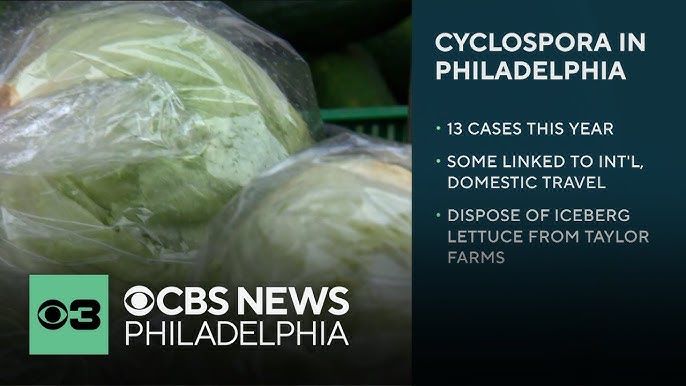
It is also this year the season in which Pennsylvania was added to the list of states caught up in a multistate outbreak of cyclosporiasis, a detail that turns an abstract public health notice into something much closer to home. The Centers for Disease Control and Prevention has tied the outbreak to iceberg lettuce from Taylor Farms de Mexico, a product that moved through both retail stores and food service, some of it landing on trays at Taco Bell locations before investigators traced it back. Across nine states, Illinois, Indiana, Kansas, Kentucky, Michigan, Ohio, Oklahoma, Pennsylvania, and West Virginia, the outbreak has sickened 1,947 people and hospitalized at least 98. No deaths have been reported, a fact that offers some comfort without erasing what the illness itself puts a body through.
The company recalled all iceberg lettuce sourced from central Mexico on July 17, and the timing landed in the middle of what public health officials are already calling an unusually severe stretch. The CDC has formally designated May 1 through August 31, 2026, as cyclosporiasis season, a recognition that the parasite’s numbers climb every year once the heat sets in and produce moves faster through the supply chain than anyone tracking it can always keep up with.
This year, the climb has not been gradual. As of the agency’s most recent surveillance count, 6,707 lab-confirmed domestic cases have been reported since May 1, spread across 45 states, with more than 11,500 additional suspected or pending cases still under investigation. A year ago, over a comparable stretch, the national count sat at 249. For the aunties who run the reunion planning committees, the deacons who coordinate the church picnic, the cousin who always brings the same seven-layer salad, that jump is the difference between food safety being a vague thing on a poster in the health department and something that requires an actual conversation before Saturday.
Cyclospora cayetanensis does not pass from one person to another the way a cold does. It travels through contaminated produce or water, which is exactly why it finds such fertile ground in the rituals that define summer eating. Church picnics, family reunions, block parties, the cookouts that start at noon and are still going after the streetlights come on: all of them depend on food that sits outside for hours, ladled from one bowl, refilled from a cooler that has been in the sun since ten in the morning. Potato salad, coleslaw, greens, the produce tray that shows up because somebody’s doctor told them to eat better.
Source: NPR
Lettuce and cilantro, in particular, carry a history with this parasite, ordinary ingredients that nobody at a cookout has ever thought to question because they have never had a reason to. When the illness does take hold, it announces itself as watery, sometimes explosive diarrhea, and it does not always behave the way a stomach bug is supposed to, fading and then returning in waves that can stretch on for more than a month. Symptoms tend to surface about a week after exposure, though the range runs from two to fourteen days, long enough that a person doing the mental math afterwards can end up blaming the wrong reunion, the wrong plate, the wrong cousin’s cooking entirely.
There is a particular kind of grief in that miscalculation, because so much of what gets served at these gatherings is an act of care, not a transaction. The woman who has made the same potato salad for thirty years of family reunions is continuing something her mother did before her, feeding people she has watched grow from children into parents themselves, and the recipe carries her name in the family the way a signature would. This year, for the first time in three decades, she has had to ask a question that would have felt absurd a decade ago: where did the lettuce in the salad come from?
Cooking kills the parasite. Rinsing, on its own, does not reliably do the job, and freezing does nothing at all, a fact that unsettles a set of habits so old they had stopped feeling like habits and started feeling like instinct. For a cook whose whole reputation rests on trust, that new uncertainty is not a minor inconvenience. It is a crack in something she thought was solid.
The people most at risk from that crack are often the ones sitting closest to the head of the table. Elders get served first at these gatherings, out of respect that runs so deep it is rarely spoken aloud, and it is precisely their immune systems, worn thinner by age or illness, that make them more vulnerable to a parasite a grandchild might shake off in a few uncomfortable days. The love embedded in handing grandma the first plate does not change. What has changed, at least for this season, is what that plate might be carrying without anyone at the table having any way to know it just by looking.
Part of the problem is that a recall notice does not travel the way a family does. It lives on a CDC web page, in a news brief that scrolls past on a phone, in language written for regulators rather than for the woman standing in her kitchen deciding whether the lettuce in her crisper drawer is the same lettuce named in the alert. Information in these communities has always moved through different channels: the deacon announcing the benediction, the group chat that includes every cousin and their spouse, the relative who works retail and texts a warning before the official notice even clears review. That network is often faster and more trusted than anything coming from a federal agency, and yet it depends entirely on someone catching the story in the first place. When that chain breaks, the gap does not show up in a surveillance report. It shows up two weeks later, in a bathroom, in a body that took a week to connect its own suffering back to a Sunday plate.
Source: WHYY
The instinct behind all of this, the shared plate, the imported produce, the trust placed in food that looks the way it has always looked, does not belong to any one country. Families across West Africa and throughout the diaspora build their own gatherings around the same architecture, jollof simmering in a pot big enough for forty people, greens and peppers and herbs sourced from markets that move produce across borders the way American supply chains move lettuce across state lines. The United States tracks and publishes its case counts in a way many other countries are simply not equipped to, which means the absence of a headline elsewhere is not proof of absence, only proof of a different kind of visibility. What travels intact across that ocean is the psychology, not the statistics: the assumption that food prepared with love and served among family carries its own kind of protection, and the quiet gap between what a household believes about a dish and what a laboratory could tell them if anyone thought to ask.
None of this is an argument for smaller gatherings or thinner tables. It is an argument for a few adjustments precise enough to survive contact with an actual Saturday afternoon. Cooking, rather than a quick rinse, is what neutralizes the parasite, a distinction that matters most for anything destined to be eaten raw. A bowl that has been sitting in the sun since the first cousins arrived does better when replaced partway through the afternoon than when left out for the full six hours, on the theory that it looked fine at noon. And before the folding tables go up, a few minutes spent checking the CDC’s current recall notices, particularly anything involving lettuce or fresh herbs tied to Taylor Farms de Mexico, closes exactly the gap that a federal web page cannot close on its own.
The season runs through the end of August. The reunions and the block parties and the church picnics will keep coming, the way they always have, and the difference this year lives in the small decisions being made at the counter beforehand, about where the lettuce came from and how long it has already been sitting out.
Anand Subramanian is a freelance photographer and content writer based out of Tamil Nadu, India. Having a background in Engineering always made him curious about life on the other side of the spectrum. He leapt forward towards the Photography life and never looked back. Specializing in Documentary and Portrait photography gave him an up-close and personal view into the complexities of human beings and those experiences helped him branch out from visual to words. Today he is mentoring passionate photographers and writing about the different dimensions of the art world.


