World Cup
“It’s frustrating to not speak clearly and quickly, but it could be much, much worse.”
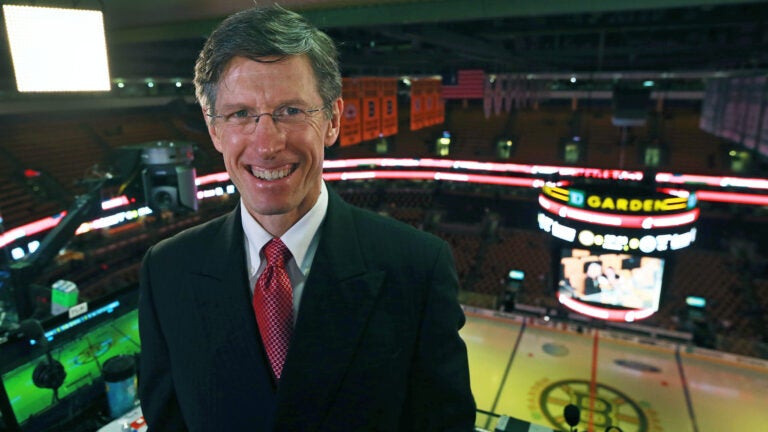
Jack Edwards at TD Garden in 2014. Globe Staff Photo/Jim Davis
June 12, 2026 | 3:43 PM
4 minutes to read
While Jack Edwards is known in New England for his years of play-by-play commentary for Bruins hockey games, his life has also revolved around another sport.
It started in his youth on the soccer field, leading to multiple recruiting offers from colleges. Eventually, he chose the University of New Hampshire.
“The coach told me I would play my freshman year, and that’s how I made my decision on schools,” Edwards joked in a recent interview with Boston.com. In between his sophomore and junior seasons, he tried to up his game by training in the altitude of Colorado.
“I had a summer job at The Red Lion in Vail,” he recalled. “I thought training at 8,000 feet would be good for me. I washed dishes by night and played soccer by day.”
But during one of his summertime games — having scored a hat-trick — disaster struck.
“I scored three goals and [hit] one post,” Edwards remembered. “I got sent in on a breakaway for my fourth goal. The goalie tackled over the ball, studs up, and broke my leg.”
“I was in a series of casts for seven months,” he said. “Sports medicine, thankfully, has come a long way from 1977.”
While he was laid up, Edwards discovered the thing that would define his professional career: sports broadcasting. He joined the student radio station, and eventually got to call UNH men’s hockey games.
“The Wildcats won their first ECAC title my senior year,” Edwards explained. “That was a launching pad for me.”
Working mostly in regional New England roles through the 1980s (along with spots at the U.S. Open and the 1988 Winter Olympics), Edwards joined ESPN full-time in 1991.
His soccer-related goals had changed by that point, but his ambition regarding the sport remained the same. He had his sights set on calling the World Cup (which at that point ABC had the television rights to).
“I campaigned from the first day I was hired at ESPN,” Edwards noted. After showcasing his ability on MLS Soccer Saturdays starting in 1999, Edwards was chosen to be a part of the only commentary crew to be sent by ESPN to the 2002 World Cup (hosted in Japan and South Korea).
“I called 23 games in 30 days,” Edwards said, demonstrating the rigorous schedule he navigated at the tournament.
The 2002 World Cup remains the best modern era run by the U.S. men, who reached the quarterfinals before bowing out to eventual finalists Germany.
It began with one of the most shocking results in U.S. soccer history. In the opener, former Revolution head coach Bruce Arena (then the U.S. coach) guided the Americans to a magical 3-2 upset over Portugal, a team that included 2001 FIFA World Player of the Year Luis Figo.
“The U.S. vs. Portugal game was the most underdog upset I have done in all my years of calling play-by-play,” said Edwards. “Portugal was favored to win the group, and there were some people who favored them to reach this semifinals of the World Cup.”
“An English fellow who was calling the World Cup next to me said, ‘Is this the soccer equivalent of the Miracle on Ice?’ I said not quite, but it’s in its class.”
As the games were played in South Korea, the 13-hour time difference meant that it kicked off at 5 a.m. local time in New England.
“I cherish the people who listened in the middle of the night,” said Edwards, referencing many of the games that had even earlier kickoff times. “Occasionally they’ll come up to me and tell me about that cup of coffee spilled when the goals went in.”
Edwards’s distinctive and descriptive commentary style — one that Bruins fans would become highly familiar with — was already on full display in 2002.
“I guarantee you this is stopping traffic all over Europe,” he declared when Brian McBride scored the third U.S. goal against Portugal.
As he looks at the 2026 World Cup, Edwards shares the concerns of many regarding the tournament’s organization.
“I think FIFA is guilty of squeezing every nickel out of the payers’ pockets,” he said. “I am disappointed that the tickets are so highly-priced, not to mention the specter of ICE and the intimidation of immigrants and visitors to this country.”
He also took aim at the organization of U.S. soccer at a youth level, highlighting the pay-for-play components that limit participation and the development of American talent.
“I’m disappointed in the adults who are making themselves rich on youth soccer in this country.”
As the U.S. begins its World Cup run, Edwards offered what he would consider a successful tournament for the co-hosts.
“If we win any game in single elimination, it’s all good,” he concluded.
Edwards, who stepped down from his play-by-play role with the Bruins in 2024 after being diagnosed with a disorder known as apraxia (which hinders the pace of his speech), also provided an update on his health.
“Everything works except my mouth,” he explained, noting that after a recent MRI, his doctor had a clear conclusion.
“He says it hasn’t affected my cognitive ability. I’m thankful for that. It’s frustrating to not speak clearly and quickly, but it could be much, much worse.”
Hayden Bird
Hayden Bird is a sports staff writer for Boston.com, where he has worked since 2016. He covers all things sports in New England.
⚽ Get the latest World Cup news
Receive updates on the 2026 FIFA World Cup