There are surface similarities between Below, a thriller miniseries that was recently released on Netflix, and Widow’s Bay, the most awarded Emmys comedy in a single year in history.
Both 2026 shows have a middle-aged male protagonist and are set in small fishing communities off the Atlantic coast along the North American eastern seaboard.
Both towns are being plagued by something monstrous in the water, and both shows end up with its inhabitants sheltering together as everything turns to sh-t.
Sign up to The Nightly’s newsletters.
Get the first look at the digital newspaper, curated daily stories and breaking headlines delivered to your inbox.
By continuing you agree to our Terms and Privacy Policy.
Below, which is Netflix’s number one series this week, and Widow’s Bay are not the same show, not even close. But they are useful examples of why so much TV at the moment feels so mid, barely remembered even as you’re watching it. It just flits away into the ether as if it was never here.
Widow’s Bay landed in like a category five storm, blowing you over with its wicked sense of humour, its balance of emotional drama with caustic jokes, and its bonkers episodic scenarios involving sea hags, a sunset cocktail party and the most intense genealogy lesson.
Matthew Rhys in Widow’s Bay. Credit: Apple TV
Above all, what Widow’s Bay immediately established were distinct characters – Tom, the ambitious and anxious town mayor, Patricia, the weird assistant who still carries the scars of childhood bullying, Wyck, a surly fisherman with a big jones for the town’s supernatural history.
Even the supporting ensemble were full of oddballs you remembered after just one scene.
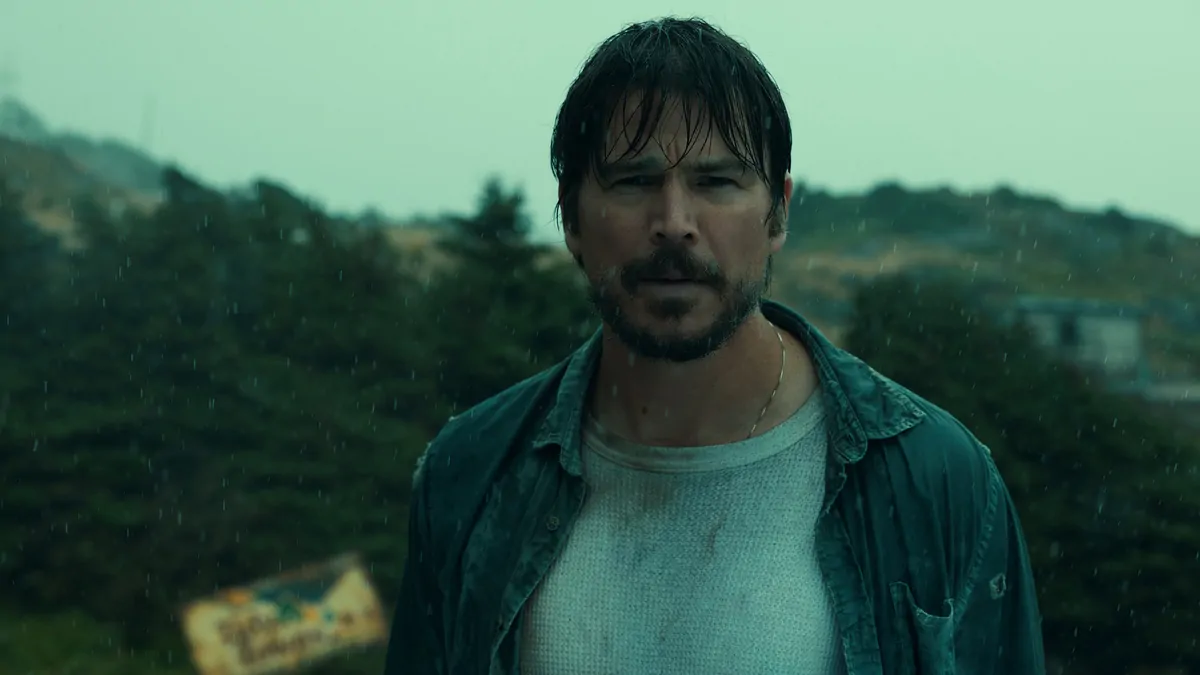
Below, on the other hand, not so much. There was Josh Hartnett’s lead character, Calvin, an old-school fisherman who witnessed a calamity as a child, and his oldest son Wade, who was, um, there, and Mackenzie Davis’ marine biologist, Dr Fonda, whose defining personality was mildly panicked.
No shade on any of those actors, who have all been really great in better shows (particularly Davis in Halt and Catch Fire and Station Eleven), but the writing wasn’t there.
Below is a microcosm of what’s wrong with TV in 2026. It’s plot-led rather than character-led.
The problem with it – and with so many shows – is that there isn’t the story to sustain six episodes, which leads to the common refrain of, “this should’ve been a movie”.
In the case of Below, there’s a giant-giant-giant squid that is killing people who dare to venture in or near the water, and Calvin, Dr Fonda and others first try to figure out what’s going on, and then how to stop the deaths.
Jaws was 124 minutes. Across six episodes, Below was almost double at 241 minutes, and it could’ve easily condensed its story into 100 minutes and gained plot momentum.
Without memorable characters and without a story which justified the runtime, you’re left with a whole lot of nothing. It’s not even that Below is bad, if it was, it might be more memorable.
Below is a TV show which exists. Credit: Netflix
The advantage TV has over film is you get time to develop and delve into characters, that’s not the whole point, but it should be a massive chunk of it.
Modern streaming shows, particularly miniseries or limited series, are built on the story, and seemingly only story, often laboriously stretching out one mystery through various twists and cliffhangers.
The problem with that is once the killer or kidnapper (because it’s always someone killing women or kidnapping children) is revealed, any tension and investment, if it existed in the first place, has dissipated, and you move on.
The only thing that vaguely sticks is “it was the newscaster whose secret identity was they knew each other as kids”, not the actual characters including, oh, you know, their names.
It’s the generification of TV, where showrunners seem to outdo each other in making the least impactful and least identifiable show possible.
Take, for example, all those Harlan Coben shows on Netflix. The characters, almost aways played by Richard Armitage or James Nesbitt, that populate these one dimensional series are as forgettable as the titles (I Will Find You, Missing You, Safe).
They are, at best, serviceable, and exist merely to scratch a particular itch, one which involves yet another story about some 17-year-old missing persons case, or an 11-year-old missing persons case, or a five-year-old missing person’s case (which had started off as a wrongly convicted murder case).
It’s variations on the same theme, which would be bad enough (and it is) but compounded by the fact that every character in these worlds is also the same variation of generically anguished and haunted. Snooze.
Richard Armitage in a Harlan Corben series adaptation – it really doesn’t matter which one. Credit: Netflix
It’s why you can’t remember if Armitage was in Missing You or Stay Close or The Stranger or Fool Me Once. All of them, he was in all of them. And, life on the line, you won’t be able to recall which one’s which.
This obsession with making disposable shows that spike for a week or two on the ratings charts, and then is never spoken of again, purpose served, has dragged down overall TV culture.
The industry needs to go back to more making shows that you want to talk about and love not because of some outlandish twist but because you want to hang out with those characters.
Parks and Recreation, a show Widow’s Bay creator Katie Dippold cut her teeth on, ran for 126 episodes. At about 22 minutes per instalment, it equates to a little under 50 hours. Did that show have 50 hours’ worth of story? No. Does it matter? No.
Because you didn’t watch and rewatch Parks and Rec for the story. There were no real cliffhangers or twists, it was a bunch of people interacting as co-workers and friends, as would-be lovers, lovers and ex-lovers, changing careers sometimes, learning life lessons at other times.
It was watching people grow, fall in love and move through life. And you did that because you loved Leslie Knope, April Ludgate, Ron Swanson, Tom Haverford, Ann Perkins, Ben Wyatt, Chris Traeger, Donna Meagle and especially Jerry Gergich.
It’s the same with Frasier or The Simpsons or Schitt’s Creek or 30 Rock or The Office, US and UK. Or Colin From Accounts or Utopia.
We loved Parks and Rec not because of the storylines but because of the people. Credit: NBC
There are comedies famously about nothing, ahem, Seinfeld, or which contrive to put their ensemble in increasingly strange situations a la Community.
Ditto with dramas. Mad Men, Breaking Bad, The Wire, The Secret Life of Us, Six Feet Under and The Sopranos all had their narrative organising principles. They were ostensibly about the ad world of the 1960s or running a family funeral home or a Baltimore police unit, but that was secondary.
Walter White got caught up in a lot of hijinks, but the show was about watching an everyman’s moral disintegration. The drug dealing was merely the vehicle.
The Sopranos wasn’t really about the schemes of New Jersey mobsters, they were about the New Jersey mobsters, as in the people. The intrigue and investment is in how they react to or drive the things that happen to them, and how it affects them, not the actual plot points themselves.
Tony ordering the hit on Uncle Philly isn’t about the act, it’s about his emotional and mental state. So a college tour with his daughter is as consequential to his development as any violent overtures.
When President Barlet and Josh are shot at the end of the first season of The West Wing, the super dramatic attempted assassination plot is secondary to how all the characters around them react to these events, and the ongoing trauma which informs Josh in subsequent episodes.
Janel Maloney, Bradley Whitford and Rob Lowe in The West Wing. Credit: NBC
The Diplomat does this well too (not coincidentally, its creator Debra Kahn is a former writer on The West Wing).
There’s a plot point in this new season which is seemingly enormous but is then, on a practical level, swept past, but the real consequences are how it affects Grace Penn, and evolves that character into an even darker place.
The Thick of It’s Malcolm Tucker isn’t an iconic TV character because he engineered political plays, but because he was a larger-than-life, sweary monster who stole every scene. You’d watch him do anything because who the character is informs the scene, not how he serves the plot.
In the best TV shows, characters are king.
The story should be a functionary to build the characters, whereas now, too many characters are just fodder to drive narrative beats.
It’s something network TV has long understood, and it’s why procedurals are still so enduring. You come back every week to Law & Order: SVU not for a new sexual assault case, you come back for Olivia Benson.
Phoebe Waller-Bridge in Fleabag Credit: Unknown/Supplied
Do you love The Last of Us because of the mushroom zombie apocalypse or because you love Ellie and Joel and their surrogate father-daughter bond? Do you love Arrested Development because George Bluth gets arrested for financial fraud or is it that the Bluths are narcissistic messes?
If you’re thinking about shows that were either long-running or beloved, what even happened in many of them? Like, what really happened, plot-wise, in Fleabag? Or Hacks? There were humiliations and triumphs, but they only mattered because they happened to characters you cared about.
And now, when we talk about Fleabag, we talk about Fleabag the character, and Hot Priest and uptight Claire.
So, TV writers, producers, executives, help us out here. We want to connect with people, not with cliffhangers. You want to make a plot-driven show? Please do it as an equally forgettable straight-to-streaming movie because then you will have saved everyone a lot of time.
Twists are cheap and disposable, characters are forever.