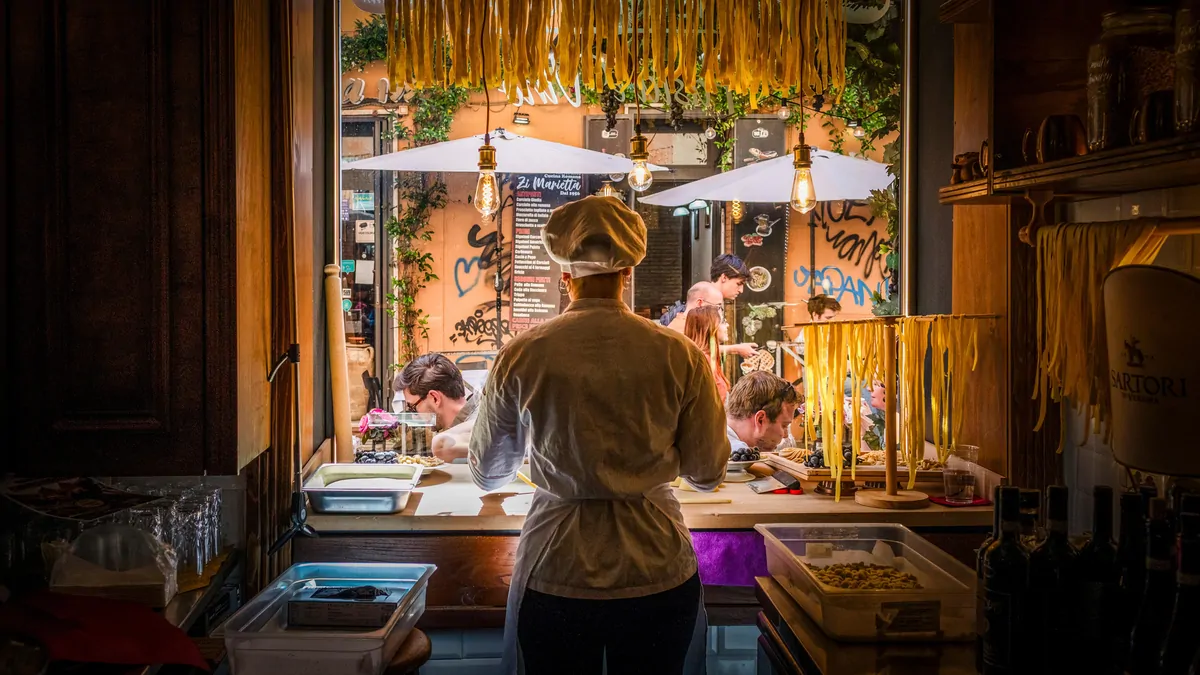
The woman in the window ignores the city foot traffic as she goes about her work, her hair pulled back beneath a white hat. Her eyes track the strands of dough she rolls beneath her palms. Outside, a group of tourists pauses to watch her toil, then one reads the restaurant sign near the door aloud.
“Pasta e Vino,” the woman says. And then in English: “Perfect!”
Technically, the restaurant’s full name is Come ‘na Vorta − Pasta e Vino (Roman dialect for “like it used to be” or “like in the old days”, plus Italian for “pasta and wine”), but the group doesn’t need to waste time on formalities. They decide on a place to eat.
Had the tourists kept walking through the sherbet-painted alleyways of Trastevere — a popular neighbourhood across the Tiber River — they’d have run into even more restaurants with prominently featured pasta-makers.
ROAM. Landing in your inbox weekly.
A digital-first travel magazine. Premium itineraries and adventures, practical information and exclusive offers for the discerning traveller.
By continuing you agree to our Terms and Privacy Policy.
It’s a shtick that’s spreading across the city’s historic centre, popping up near ancient ruins and charming piazzas — and reminiscent of the other made-for-Instagram hospitality trends, such as pasta served out of giant cheese wheels and saute pans.
Read the latest edition of ROAM now.
Only this one feeds off the international appreciation of the Italian “nonna” (or grandmother) whose generational kitchen wisdom and folksy charm won over the internet.
But the women — and they’re almost always women — working in the windows aren’t necessarily someone’s grandma. They’re part prep-cook, part marketing tool — strategically placed to entice customers online and in-person, one fresh noodle at a time.
They’re also something of a Rorschach test.
Some locals say the trend is more theatre than tradition and a surefire way to identify a tourist trap. Participating restaurant owners, and scores of online reviewers, say it’s an indicator of quality. After all, in an era of fast fashion, fast-casual chains and AI slop, what’s realer than a bowl of handmade pasta?
On a Tuesday afternoon in April, Sophie Minchilli walks her food tour through the city’s most famous farmers market in the Campo de’ Fiori. Across the cobblestone piazza, a line forms outside a restaurant where a woman rolled golden strands of pasta at a wooden table in the front window.
“It’s literally like a zoo,” offers Minchilli, who was born and raised in Rome.
As tourism and a demand for all things “authentic” exploded in Italy over the last decade, Minchilli has watched the pasta window trend spread. She sees their presence as a scourge — just more chain restaurants gentrifying the neighbourhoods she loves and where she leads her tours.
Osteria da Fortunata and Come ‘na Vorta lead Rome’s pasta-window trend. Credit: Luigi Avantaggiato/For The Washington Post
“I’ve watched these nonna-in-the-window pasta spots multiply like the Fibonacci sequence,” Erica Firpo, a writer and podcast host in Rome, says on email. “Almost every day, I sidestep the long queues of customers.”
One of Minchilli’s qualms is that the places employing the practice tend to stay open all day and night, which can be a sign of an operation catering to tourists, who want a sit-down pasta lunch at 3pm, a decidedly un-Italian move. A truly traditional establishment, she says, must close in the afternoon to give staff a break, restock and prepare for evening service.
Another issue is the fresh pasta itself.
“It is probably homemade and delicious, but it’s wrong,” says Minchilli.
Digestion and tradition rule the Italian diet. Visitors are often baffled by Italian culinary dictums, like no pairing fish with cheese, or no drinking big milky coffees after breakfast (a disaster for the stomach, they say). Pasta, too, has its own established ways. Its shape, ingredients and production vary by region.
Roman cuisine, Minchilli says, is rooted in dry pasta. Of the capital’s four iconic pastas — carbonara, gricia, amatriciana and cacio e pepe — only the latter is typically made with a fresh noodle, the square-shaped, long tonnarelli.
Marina Cacciapuoti, founder of magazine and travel planning company Italy Segreta, says there’s a misconception that fresh pasta is automatically better than dry pasta.
“In reality, quality depends on the flour, where it comes from, and the production process,” she says. “Some of Italy’s greatest pasta dishes are meant to be made with dried pasta, not fresh.”
And on the contrary, “seeing someone making fresh pasta in the window is not, in itself, a sign of quality or authenticity,” Cacciapuoti continues.
You’ll also find great restaurants around the capital that specialise in fresh pasta from other regions. But mostly, a restaurant advertising fresh pasta as traditional Roman cuisine comes off to guide and author Katie Parla as a red flag. Making the pasta production visible to customers? Even redder.
Amatriciana, one of the four traditional Roman pastas. Credit: Luigi Avantaggiato/For The Washington Post
“If you think about it, it’s the most genius marketing tool,” states Parla, who’s lived in Rome for more than 20 years. “They are providing staged content for the people. It looks photogenic. It mimics something that people perceive as authentic.”
The concept of watching food preparation for entertainment isn’t new in Italy and otherwise — think the showmanship of dough tossing at pizzerias and onion volcanoes lit aflame by chefs behind their Benihana grills. Sitting at a sushi master’s counter comes at a premium.
“It’s better than a cooking show, because this is live theatre,” says Karima Moyer-Nocchi, a food historian and author of the book, The Epic History Of Macaroni And Cheese From Ancient Rome To Modern America.
Moyer-Nocchi believes the pasta window trend goes deeper than entertainment. It’s a public display of “Italianita” or “the essence of being Italian”, she says.
Historically, Moyer-Nocchi says, pasta was seen as a luxury for special occasions. It’s a laborious product made with ingredients “that don’t cost much now but cost a lot then”, she said. “Having it on your table meant having the time and the money to be making pasta.”
Fast forward to today, and fresh pasta is once again considered a luxury. Most spaghetti eaters are not routinely making it from scratch — not even the contemporary Italian, who is as busy with the demands of modern life as their foreign counterpart, and not even the grandmas.
A pasta-maker works in the window of the Rome restaurant Come ‘Na Vorta. Credit: Luigi Avantaggiato/For The Washington Post
It fuels stereotypes and misconceptions: “You’re old, you’re a woman, you are Italian, and somehow you’ve got all of this stuff in your DNA,” says Moyer-Nocchi. “Well, just like women anywhere, there are women who don’t like to cook, who aren’t capable of cooking. My (Italian) mother-in-law is just awful.”
Over time, pasta-making has shifted from a kitchen chore to a symbol of Italian heritage, as romantic and impractical as singing gondoliers in Venice. And the restaurants performing that heritage tradition for their customers: “They’re selling Italy — the Italy that people long for,” says Moyer-Nocchi. “Even Italians love that idea, and it sells a lot of products to them.”
In the shadow of the Pantheon, a line forms in the Piazza della Rotonda. People are waiting for a table at Osteria da Fortunata, a chain of restaurants that serves the “flavours of authentic Roman cuisine”, its website says.
Fortunata’s guests dining alfresco had a postcard view of the basilica and the bustling piazza, where teenagers canoodle on the edge of a fountain. Staff in white dress shirts and black aprons — some wearing earpieces like secret service agents — carry out glazed terracotta plates of tangled pasta.
At the front of the dining room behind a large picture window, a woman wearing a name tag that reads “Tamo” forms fat strands of dough at a wooden table.
Osteria da Fortunata and Come ‘na Vorta − Pasta e Vino are the two restaurant groups leading Rome’s pasta window trend, “and we are both from the same family”, chimes Marcello Bettozzi, who owns the latter with his father and three brothers.
Bettozzi meant that literally. His aunt’s side of the family is behind Osteria da Fortunata, which has five locations in Rome, three in Milan one in Bologna and an outpost in Miami. Come ‘na Vorta has seven locations in Rome, two in Milan and plans to expand to Spain and England.
Both companies trace their origin to a great-grandmother who they say opened a fiaschetteria, which was like a wine bar, in Rome in the 1920s. Her daughter, Iris Palombi, then carried on her traditions and transformed the small establishment into a “proper restaurant”, Bettozzi said.
In the 2000s, the family opened more locations, taking inspiration from pizzerias where customers could watch pizzaiolos shape dough and had staff start rolling pasta in the dining room. Soon the practice became “like a trademark”, says Bettozzi.
Pasta is prepared fresh at a Rome restaurant. Credit: Luigi Avantaggiato/For The Washington Post
Around this time, Bettozzi said the family split the restaurant into two brands. Both companies say they serve authentic Roman specialties made with organic ingredients, and both prominently feature a cook in the window. Bettozzi stands behind the practice, even though he insists that “it’s marketing, of course” but it’s not a gimmick.
“I think it is really important to show what we do, because people you know sometimes (people) underestimate the value of our job —it’s just pasta, it’s just cooking, you know, it is easy,” he says. “We work seven days a week, 24 hours a day, 365 days … and this finally shows a bit more what is behind (the scenes).”
Osteria da Fortunata did not return multiple requests for an interview.
Osteria da Fortunata’s Pantheon location has a 4.7-star rating on Google Maps based on nearly 9000 reviews. The top keywords and phrases in those reviews include: “homemade pasta”, “view of the Pantheon”, “kind waiter” and “tourist trap.”
At 9pm on a Sunday night, I join the queue of about a dozen. Within a couple of minutes, a host comes out and says the wait for a seat with a view would be about a half hour, or I could sit inside now.
Rome’s Campo de’ Fiori. Credit: Luigi Avantaggiato/For The Washington Post
I take the immediate option and follow the employee into the packed dining room past Tamo at her pasta rolling station. He sends me up the stairway in the back. On the second floor, I learn the place was much bigger than it looked from the piazza. Rooms open up into more rooms. They’re as brightly lit as a supermarket.
A server with a chiselled jawline and a headset picks me off and shows me to a seat in a far corner. The restaurant churns with customers and servers, and plates of pasta coming and going. On the wall, a TV plays a video interview of grandma Iris on repeat.
I order a glass of house white wine and the cacio e pepe with fresh tonnarelli. My server warns me that the dish was “very salty and strong”.
My meal comes out a couple of minutes later. The wine was sickly sweet, but the pasta was decent — highly peppery, a little funky and pleasantly chewy. I’ve had better and worse.
A table of four women next to me finish every last strand and tube of pasta on their plates. One let out an audible “mmmmm”.